49 works in this view — arrow keys or swipe to move between them.
Dance in Art
Antonietta Pallerini
Unknown artist
- Collection:
- Prints depicting dance
- Source:
- New York Public Library
- Rights:
- Public domain — free to use, share and adapt.
- Recorded as:
- Public Domain
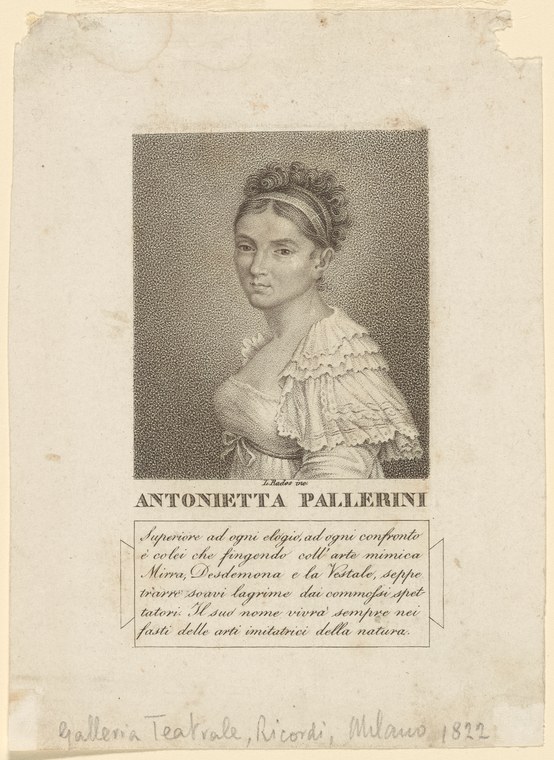
Pallerini was a significant figure in early 19th-century Italian dance, and this print is evidence of her celebrity and the market for images of female dancers during the Romantic period. It documents not what Pallerini danced, but how she was seen—as a beautiful, accomplished, and worthy subject for careful artistic representation. The work is also a technical achievement: the engraver has captured a remarkable likeness and invested considerable skill in rendering the delicate fabrics and the composed dignity of the sitter.
What you are looking at
A half-length portrait of a young woman, presented in the formal engraved style of early 19th-century theatrical portraiture. She is shown from roughly the waist up, turned slightly to her left, with her head upright and gaze directed toward the viewer with a composed, professional expression. Her dark hair is arranged up and back in the fashionable style of the period, crowned with what appears to be a laurel wreath or theatrical diadem. She wears a neoclassical draped garment—a fine white muslin or silk with short sleeves that fall from the shoulders in the Regency manner, gathered at the waist. A delicate lace or net shawl is draped across her shoulders and upper arms, pinned at the breast. The background is a uniform stippled tone typical of engraved technique. Below the portrait, her name is printed in capital letters: ANTONIETTA PALLERINI. Below this, a brief inscription in Italian appears in an ornamental cartouche, identifying her achievements in dance.
The dancing
The figure is stationary and formal, as befits a commemorative portrait rather than an action image. The pose is frontal and dignified, with the shoulders relaxed and the arms at rest. Her head is held with the upright carriage and serene composure expected of a prima ballerina of the period. There is no suggestion of active movement or the dynamic extension characteristic of theatrical dance performance; this is a portrait of the dancer as a person of status and refinement, not a record of movement.
The dance depicted
Antonietta Pallerini was an Italian prima ballerina, likely performing in the early 19th century. The inscription below her name—though small in the image—identifies her with achievements in dance ("Superiore ad ogni elogio..." suggests excellence beyond praise). This is a commemorative engraved portrait of the kind produced to celebrate celebrated dancers and circulate their likenesses to the theatre-going public. Without seeing the inscription clearly, it is difficult to specify which dances she was known for, but her status and the neoclassical dress suggest she was a principal dancer in the Romantic ballet period.
How it was made
This is a line engraving, a reproductive print made by incising fine parallel and crossed lines into a copper plate to create tone and form through hatching. The technique is clearly visible in the stippled background and the fine linear detail throughout the face and drapery. Engraving of this type was the standard medium for theatrical portraiture in the early 19th century, allowing for wide circulation of images of celebrated performers. The skill and finish of the work—the delicate rendering of the face and the precision of the lettering—suggest this was a professional commission, likely produced for sale to patrons and admirers of the theatre.
About this work
This is a commemorative engraved portrait of Antonietta Pallerini, an Italian prima ballerina of the early 19th century. It belongs to the tradition of theatrical portraiture that documented and celebrated the dancers of the Romantic era, circulating their images to a broad public audience. The work is not a record of movement or style—it is instead a portrait of status, presenting the dancer as an accomplished artist and a figure of refinement and beauty. Such prints were essential to the cult of the prima ballerina that defined the period; they appeared in collections, were sold as souvenirs at the theatre, and enshrined particular dancers in public memory.
How to look at it
Observe the engraver's skill in rendering the face: the fine hatching that suggests the modeling of the cheek and brow, the subtle suggestion of the eyes and mouth, the precision of the hair. Notice the care taken with the drapery of the shawl and the delicate rendering of the muslin sleeve. The formal pose and frontal presentation are characteristic of commemorative portraiture of the period, designed to present the subject as dignified and worthy of artistic attention. The inscription below, though difficult to read at this scale, locates this as a theatrical portrait, not a society portrait, and identifies Pallerini as a celebrated public figure.
The artist
The engraver is not identified in the record. The quality and finish of the work suggest a professional theatrical engraver working in Italy in the early 19th century, during the height of the Romantic ballet era. Engraved portraits of celebrated dancers were a significant minor industry in Europe and North America during this period, and the best engravers were skilled portraitists in their own right.
The period
This work dates to the Romantic era of ballet, roughly 1820–1860, when the art form shifted decisively toward ethereal female dancers in pointe work and transparent skirts. The neoclassical dress and hairstyle visible in this portrait—the draped muslin, the upswept hair, the classical diadem—reflect the visual language of the period. It was during this era that the cult of the prima ballerina reached its height, and dancers became celebrities whose images were widely reproduced and consumed. Engraved portraits were the primary medium through which the public encountered images of celebrated performers, and such prints were often collected or kept as mementos of theatre-going.
Where it lives
This work is held by the New York Public Library as part of its collection of prints depicting dance. The print was likely produced for sale or distribution to theatre patrons, and its presence in an institutional collection suggests it was valued as both a theatrical document and a work of printmaking skill.
Questions about this work
Who was Antonietta Pallerini?
She was an Italian prima ballerina of the early 19th century. The inscription on this print identifies her as a celebrated dancer, though further details of her career are not recorded in the visible text of this image. Such commemorative engravings were commissioned for dancers of significant reputation and public following.
Why is this a portrait rather than a dance scene?
By the early 19th century, the market for images of dancers included both action scenes (showing movement and costume in performance) and formal portraits of celebrated dancers as public figures. This engraving presents Pallerini as a person of status and accomplishment, suitable for display and collection. It documents her celebrity rather than her technique.
What kind of dance did Pallerini perform?
The neoclassical dress, upswept hair, and the period of the print suggest she was a ballet dancer of the Romantic era. Without reading the full inscription or consulting additional sources, the specific repertory cannot be determined from the image alone. Ballet dancers of her era typically performed in contemporary Romantic ballets as well as older classical pieces.
How was this print made?
This is a line engraving, made by incising fine lines into a copper plate. The hatching and stippling visible throughout the image are characteristic of the technique. Such prints were reproduced from a single plate and could be made in quantity, allowing wide distribution to theatre patrons and collectors.
More dance artwork





