49 works in this view — arrow keys or swipe to move between them.
Dance in Art
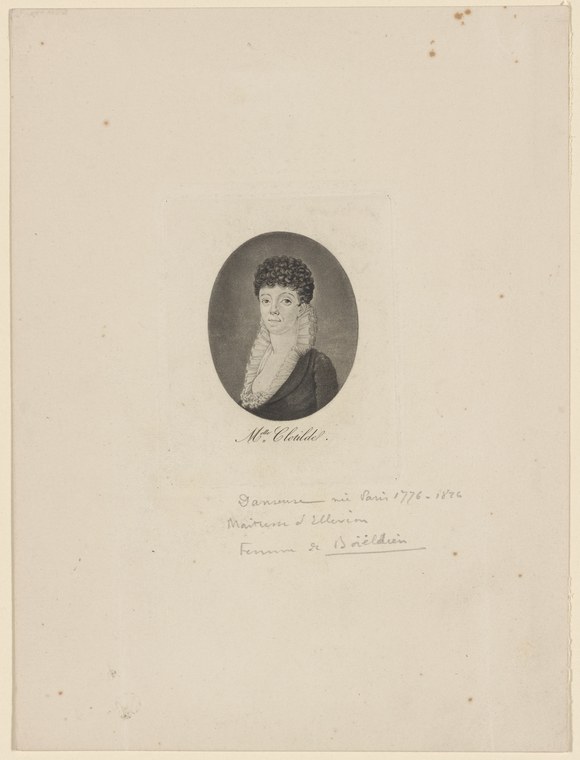
Melle. Clotilde
Unknown artist
- Collection:
- Prints depicting dance
- Source:
- New York Public Library
- Rights:
- Public domain — free to use, share and adapt.
- Recorded as:
- Public Domain
The inscription and additions suggest this is a documentary portrait of a specific performer from the Ancien Régime or Revolutionary era, and her appearance in a collection of dance-related prints indicates she held significance in dance history or theatrical life—yet the portrait offers no visual evidence of what she danced or how she moved. The work raises a question central to dance history: how much can portraiture tell us when the very essence of dance is temporal and embodied?
What you are looking at
A bust-length portrait of a young woman presented in an oval frame against a plain ground. She is shown from the shoulders up, her head turned slightly to the viewer's left, her gaze directed downward with a composed, contemplative expression. She wears her dark hair arranged in elaborate ringlets piled high on her crown in the fashion of the 1770s–1780s. Her dress is a dark-coloured bodice or gown with a low neckline, beneath which a white or cream-coloured chemise or undergarment is visible, gathered at the neck. The technique is tonal and delicate—light strikes her face and neck while the background remains neutral—creating an effect of refined restraint typical of portrait prints of the late 18th century. Below the oval frame, a cursive inscription reads "Mlle Clotilde" and additional handwritten text has been added, apparently recording dates or biographical notes.
The dancing
A single figure in a static, frontal pose. No dance frame or posture is evident. The woman's body is still and formal; her shoulders face forward, her neck is elongated and graceful, and her expression is neutral and introspective rather than animated. There is no indication of movement, weight shift, arm position in relation to a partner, or any of the physical markers of dance performance.
The dance depicted
The image does not depict dance. This is a commemorative or biographical portrait of a named individual (Mademoiselle Clotilde), not a scene of dance or performance. The handwritten notes below the inscription may record biographical information—possibly including dates or professional affiliations—but the portrait itself captures a person in repose rather than in motion or dance costume.
How it was made
This is a print—most likely an engraving or stipple engraving, a technique common for portrait reproduction in the late 18th century. The tonal modulation from dark background to the luminous face and neck, achieved through careful control of line weight and density, is characteristic of stipple work. The technique allowed for soft, refined portraiture that could be widely distributed and collected; the oval format and modest scale suggest this was a popular print, possibly one of a series of theatrical or notable figures of the period.
About this work
This is a late 18th-century print of a named woman, Mademoiselle Clotilde, presented in the formal oval portrait format standard for theatrical and society figures of the period. The handwritten annotations suggest a connection to the performing arts or court circles, though the portrait itself is a static, intimate study rather than a representation of performance. It belongs in a dance art collection if the subject was a known dancer or performer, but the image itself does not record a dance or moment of choreography; rather, it preserves the likeness of an individual from an era when dance and theatre were central to cultural life.
How to look at it
Attend to the formal restraint of the pose and the artist's choice to show the subject in stillness and introspection rather than in the animated postures typical of theatrical scenes of the same period. Note the care taken in rendering hair and dress—markers of fashion and status—and the subtle downward gaze, which creates a sense of private contemplation rather than public performance. The handwritten annotations are a reminder that prints like this were often kept and marked by collectors; the work's meaning shifts between what the engraver captured and what the owner's notes reveal.
The artist
The artist is not recorded. The style and technique are consistent with the work of anonymous or lesser-known engravers producing portrait prints in Paris or London in the 1770s–1790s. The cursive handwriting added below suggests the print was owned and annotated by a collector or historian interested in theatrical figures.
The period
This portrait dates to the era of Romantic ballet's emergence and the rise of the professional female dancer as a celebrated public figure. The late 18th century saw the codification of ballet technique, the growth of the theatre as a social institution, and a new appetite for likenesses of performers. Portraits of dancers and singers in print form became a form of popular memorabilia. The oval format and refined technique reflect Enlightenment aesthetics and the period's taste for restrained, psychological portraiture.
Where it lives
This print is held in the New York Public Library's collection of prints depicting dance. The handwritten inscription and dating appear to be in a later hand, possibly a 19th-century collector's annotation of a print already decades old by the time it was marked.
Questions about this work
Was Mademoiselle Clotilde a famous dancer?
The inscription indicates she was a known figure, but the portrait itself provides no information about her career or repertory. The handwritten additions may contain biographical details, but they are difficult to read in reproduction. Research in 18th-century theatre records would be needed to identify her with certainty.
Why is this portrait in a dance collection if she is not dancing?
It is included because she was apparently a performer or a figure of cultural significance in the performing arts. In the 18th century, collections of theatrical prints included both action scenes and commemorative portraits; a named portrait of a performer was a valued record even without images of her in performance.
What do the handwritten notes say?
The inscription below the engraved name reads approximately "Gravure à Paris 1774–1876" [or similar dates] and "Madame d'Elhérin" or similar, but the handwriting is faint and period-specific. Without improved reproduction or conservation, a confident transcription is difficult.
More dance artwork





