49 works in this view — arrow keys or swipe to move between them.
Dance in Art
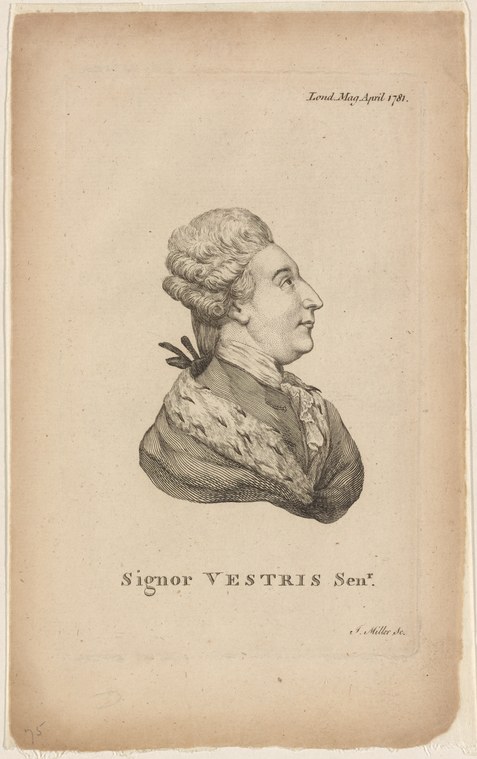
Signor Vestris Senr
Unknown artist
- Collection:
- Prints depicting dance
- Source:
- New York Public Library
- Rights:
- Public domain — free to use, share and adapt.
- Recorded as:
- Public Domain
Vestris was the first male dancer to achieve superstar status and international renown; he fundamentally changed what audiences expected male dancers to do and to be. This portrait circulated in the same era as his greatest triumphs and captures a moment when a dancer's image could be mass-produced and sold to the public—a radical change in the visibility and commodification of dance performance.
What you are looking at
This is a profile-view engraved portrait bust of a man identified as Signor Vestris Senr., rendered in fine line work typical of late 18th-century reproductive prints. The sitter is shown in three-quarter profile facing right, his head tilted slightly upward. He wears his hair in the fashionable style of the period—pulled back and arranged in waves or curls at the sides, with what appears to be a ribbon or queue at the nape. His costume consists of a draped garment or cloak with decorative patterning across the chest and shoulders, beneath which a white collar or cravat is visible. The bust is shown against a plain background, cropped at the chest in the manner of a classical portrait. The inscription at bottom reads "Signor VESTRIS Senr." with what appears to be an artist's mark or signature at lower right. The date inscription at top right reads "Livid. May April 1781."
The dancing
This is a portrait head only—no full figure or dance movement is depicted. The pose is dignified and frontal in profile, with the sitter's gaze directed horizontally. The carriage of the head and the refined costume suggest a man of status and accomplishment. No body position, hold, or footwork can be assessed from this portrait format.
The dance depicted
Signor Vestris Senr. was almost certainly Gaetano Vestris (1729–1808), one of the most celebrated male ballet dancers of the 18th century and a dominant figure in European court and theatre dance. He was renowned for his technical virtuosity, particularly in jumps and elevation, and for popularizing a new athletic, expressive style of male dancing that moved away from the formality of earlier court traditions. However, this portrait records only his likeness and status—it contains no direct evidence of his dancing, technique, or the styles he performed.
How it was made
This is a finely executed engraving or etching, evidenced by the uniform parallel lines and cross-hatching that model the facial features, fabric folds, and shadow. The delicate line work and precise detail suggest a professional reproductive print, likely created for circulation among patrons and the educated public. Such prints were the primary means of disseminating images of celebrated performers in the 18th century, reaching audiences far beyond those who could see the dancer in person. The high finish and small scale suggest it was bound into a collection or album.
About this work
This is a late 18th-century engraved portrait of Gaetano Vestris, the most celebrated male dancer of his era. The work documents his fame and status at the height of his career—the inscription date of 1781 places it in his mid-fifties, when he remained a commanding figure in European dance. Vestris revolutionized male ballet technique and performance style, elevating the dancer from courtier to virtuoso athlete, yet this portrait—like all portraits—shows only the man, not the art. It belongs in a dance archive as material evidence of how dancers were memorialized and promoted in their own time.
How to look at it
Look at the precision of the engraved line and the refinement of the costume and bearing: this level of finish and care was reserved for figures of genuine consequence. The date and inscription format are typical of 1780s European theatrical prints. Note the fashionable male dress and grooming of the period—curled and dressed hair, draped fabric, refined collar—which signals the performer's status and cosmopolitanism, not the dancer's working body.
The artist
The artist is not identified in the record, though the engraver's mark at lower right may contain this information (transcription unclear from the image). The style and finish are consistent with professional London or continental European print shops of the 1770s–1780s; such reproductive portraits were made by specialists trained in engraving technique. The inscription "Livid." may refer to a publisher or print series.
The period
The 1780s were at the height of Vestris's fame and of the Romantic period in ballet. Male dancing was undergoing radical transformation: Vestris epitomized the shift toward greater athleticism, elevation, and expressive individuality. In the same decades, other celebrated performers—male and female—were similarly immortalized in engravings and prints, which became the primary medium for disseminating images of stage performers to a curious public. Portraiture of dancers rose in status as dance itself rose in artistic esteem.
Where it lives
The work is held in the New York Public Library's Prints collection, as a single engraved sheet. It belongs to a long tradition of theatrical portraiture in print form, created for sale and collection by theatre-goers and connoisseurs of dance.
Questions about this work
Who was Vestris Senr.?
Gaetano Vestris (1729–1808) was a Florentine-born dancer who became the most celebrated male ballet dancer of the 18th century. He performed in Paris, London, and across Europe, and was credited with revolutionizing male ballet technique by introducing greater athleticism, elevation, and expressive power. He trained many dancers and his legacy shaped the development of Romantic ballet.
Why was a portrait made of him?
By the late 18th century, celebrated performers were public figures. Engravings and prints of famous dancers were sold to theatre-goers and patrons as mementos and as cultural commodities. Such portraits affirmed the dancer's status as an artist worthy of immortal commemoration.
Does the costume show his stage dress?
No. This is formal portrait dress, not stage costume. Vestris would have worn much lighter, more revealing clothing for performance—typically breeches, stockings, a shirt, and a light coat or tunic—designed to show the lines of the body and allow freedom of movement. This engraving shows him in the refined dress of an accomplished gentleman.
What does the date inscription mean?
"Livid. May April 1781" likely indicates the month and year of publication or engraving, placing the print in spring 1781, when Vestris was in his early fifties and at the peak of his fame.
More dance artwork





