49 works in this view — arrow keys or swipe to move between them.
Dance in Art
Schneider Zwick auf dem Maskenball
Unknown artist
- Collection:
- Prints depicting dance
- Source:
- New York Public Library
- Rights:
- Public domain — free to use, share and adapt.
- Recorded as:
- Public Domain
For historians of social dance and carnival culture, this print is primary evidence of how ballroom etiquette and masquerade participation were satirized and understood by the general public. It reveals the anxiety and comedy embedded in formal dance participation, showing that even in the 19th century, the pressure to perform correctly at a ball was a source of cultural humour. The work also demonstrates how satirical prints used the sequential image format to tell narrative stories about dance and social failure.
What you are looking at
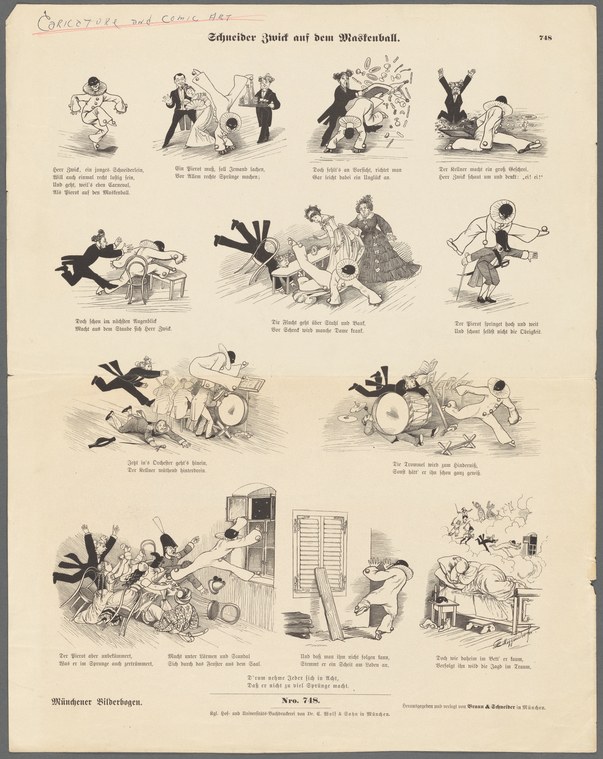
This is a comedic sequence of twelve vignettes arranged in a grid, each showing a man in formal evening dress suffering mishaps during a masquerade ball. The German title *Schneider Zwick auf dem Maskenball* (Tailor Zwick at the Masquerade Ball) identifies the protagonist. The scenes progress through escalating disasters: in the upper panels, he tangles with other dancers, trips, and collides; in the middle section, he tumbles with a drum and encounters an aggressive woman; in the lower panels, the chaos intensifies with multiple figures falling, furniture overturned, and the ball descending into slapstick pandemonium. Each scene shows multiple figures in full evening dress—tailcoats, formal gowns, and masks—frozen in moments of physical comedy. The setting is clearly an indoor ballroom, suggested by decorative elements and the density of costumed dancers. The composition uses rhythmic repetition and escalating action to tell a narrative of social mortification.
The dancing
The dancers throughout display exaggerated, ungainly postures characteristic of satirical humour: limbs splayed, bodies tilted at impossible angles, partners tangled together. There are no refined lines or ballroom holds; instead, the artist shows collision, entanglement, and loss of control. The protagonist appears in multiple scenes, always caught mid-fall or mid-stumble, his body language conveying panic and desperation. Other dancers react with raised arms, twisted torsos, and chaotic positioning. The women in their full-skirted gowns create visual interest as the fabric swings and distorts with movement. The overall effect is one of uncontrolled motion and physical comedy rather than skilled partnering.
The dance depicted
This is not documentation of actual dance technique but rather a comedic satire of ballroom culture and social dancing at a masquerade. The work parodies the formal conventions of the ball—where grace, precision, and order were expected—by showing a man (and by extension, the dancing public) as bumbling, clumsy, and accident-prone. While masquerade balls typically featured waltzes, quadrilles, and other formal dances of the period, the artist makes no attempt to show these dances being performed correctly. Instead, the narrative ridicules the pretension of formal social dancing and the vulnerability of the participant to public humiliation.
How it was made
This is a wood engraving or print, likely from the 19th century, identifiable by its fine line work, tonal modulation through cross-hatching, and the characteristic clarity and repeatability of relief printing. The print demonstrates the medium's strength in narrative sequence and slapstick humour—the grid format allows multiple moments to be read in sequence, much like a proto-comic strip. The German publisher mark at the bottom (*Münchener Bilderbogen*, a major publisher of satirical and humorous prints) confirms this as a mass-produced work intended for popular circulation. The technique allows for detailed facial expression and gesture despite the small scale of each vignette.
About this work
This is a satirical engraving from a popular German humour publication depicting the social chaos that ensues when an inept man attends a formal masquerade ball. Rather than celebrating ballroom dancing as an art, the work mocks the pretensions of formal social dancing and the comic vulnerability of the participant to physical and social disaster. It belongs in a dance gallery precisely because it documents how ballroom culture was perceived and ridiculed in the popular imagination—the masquerade ball as a site of both aspiration and humiliation. The work tells us as much about social attitudes toward dance and propriety as it does about the dances themselves.
How to look at it
Read the sequence from left to right and top to bottom, following the protagonist's escalating misfortunes. Notice how the artist uses compositional variety—some panels show two figures in close contact, others scatter multiple dancers across the frame—to maintain visual interest while telling a linear story. The key to understanding the humour is in the body language: look at how the protagonist's posture changes from scene to scene, from confident entrance to increasingly desperate flailing. The women in their full skirts function as visual anchors of respectability against which his chaos is measured.
The artist
The artist is unknown, but the work was published by Münchener Bilderbogen (Munich Picture Sheets), one of the most prolific and influential German publishers of satirical, humorous, and narrative prints in the 19th century. The publisher was known for employing skilled engravers to produce witty social satire and visual humour for a broad popular audience. These prints were affordable, widely distributed, and often collected in albums, making them a major vehicle for visual culture and popular commentary on urban manners.
The period
The masquerade ball was a prominent feature of 19th-century urban social life, particularly in Vienna, Munich, and other German-speaking cities. These events were occasions for transgression and role-play—masks allowed participants to adopt false identities—but they were also closely coded events with strict rules of dress and comportment. At the same time, the rise of satirical print culture created a market for lampooning the pretensions and anxieties of middle-class social participation. This print belongs to a tradition of visual satire about ballroom culture that included lithographs, engravings, and caricatures by artists like Honoré Daumier and Wilhelm Busch.
Where it lives
This work is held in the New York Public Library's collection of prints depicting dance. It was catalogued as part of their broader collection of popular prints and visual culture, which includes significant holdings of 19th-century German satirical and narrative prints.
Dance in this work
Questions about this work
Was this meant to be funny?
Yes, entirely. This is satire of ballroom culture and social pretension. The protagonist's repeated humiliations are designed to provoke laughter at the gap between the formality expected at a masquerade ball and the chaos that actually unfolds. The escalating disasters and exaggerated physical comedy are the point.
What dances are being shown here?
No specific dances are being performed correctly; the print satirizes ballroom dancing in general rather than depicting technique. In reality, a masquerade ball of this period would have featured waltzes, quadrilles, and polkas, but the artist's goal is not to show these being done well—it is to show social failure.
Is this a real person or character?
The title identifies him as 'Schneider Zwick' (Tailor Zwick), which suggests a recurring character, possibly from a serial or humour publication. The name 'Schneider' (tailor) may indicate his social status as a tradesman attempting to move in more elevated social circles, which would intensify the satirical humour.
What was Münchener Bilderbogen?
It was a major German publisher of popular prints, founded in Munich in 1848. They produced affordable, widely distributed engraved and lithographed prints featuring humour, satire, folk tales, and social commentary. These prints were collected, pasted into albums, and circulated among the urban middle class.
More dance artwork





