49 works in this view — arrow keys or swipe to move between them.
Dance in Art
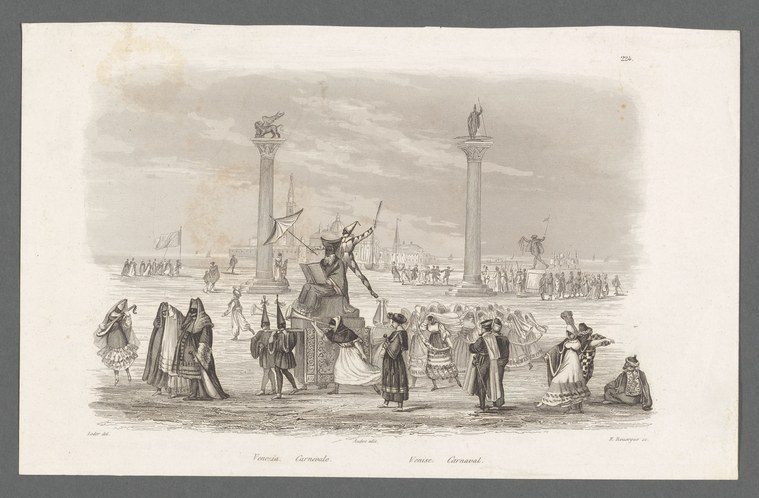
Venezia. Carnevale. Venise. Carnaval
Unknown artist
- Collection:
- Prints depicting dance
- Source:
- New York Public Library
- Rights:
- Public domain — free to use, share and adapt.
- Recorded as:
- Public Domain
Carnival dancing represents a crucial lineage in European dance culture: the tradition of social, non-hierarchical movement that persists outside formal institutions. For historians and dancers studying how dance functioned in 18th-century society—not as performance or courtly ritual, but as vernacular expression—this image is a rare documentary record of the body in carnival space. The dynamic, unschooled gesture of the central figure tells us something authentic about how bodies moved when they were permitted to move freely.
What you are looking at
A grand Venetian carnival scene set in what appears to be the Piazza San Marco, with the distinctive paired columns and basilica architecture visible in the background. The foreground fills with costumed revelers, musicians, and dancers in elaborate dress—cloaks, masks, feathered headdresses, and flowing garments typical of 18th-century carnival costume. In the center, a figure in dramatic pose appears to be mid-leap or in a theatrical gesture, arms raised expressively. The composition draws the eye from the animated crowd in the foreground toward the monumental architectural setting beyond, with figures distributed across the plaza in clusters of activity. The light is even and even-toned, characteristic of the engraving medium, giving the scene a clarity that emphasizes both the architectural grandeur and the intricate detail of costume and gesture.
The dancing
The central figure dominates through dynamic posture—legs extended or striding, upper body arched, arms raised and spread in an exuberant, uncontrolled gesture that reads as joy or abandon rather than formal dance technique. Figures around this performer are variously posed: some standing in conversation or observation, others in looser groupings. The bodies show the relaxed, social stance of carnival participants rather than trained dancers in a closed hold or frame. Arms and legs are depicted with anatomical attention, and the overall impression is of spontaneous, celebratory movement rather than choreographed steps.
The dance depicted
This depicts carnival dancing as a social, communal activity rather than a formalized dance style. The Venetian Carnevale was an annual festival where social hierarchies dissolved behind masks and costume, and dance was one expression of that temporary liberation. The image captures not a specific dance form—not a minuet, not a country dance—but the spirit of carnival movement itself: exuberant, unstructured, joyful. The dancer's raised arms and dynamic pose suggest the kind of uninhibited gesture characteristic of festive celebration, where movement was permitted to be expressive and individual rather than orderly.
How it was made
This is an engraving, likely 19th-century, identifiable from the fine parallel hatching used for shading, the crisp line work, and the tonal gradations achieved through density of mark-making rather than pigment. Engravings of this type were commercial prints, reproduced in multiple impressions and distributed widely, making them a primary vehicle for circulating images of historical subjects and celebrated locations to a broad, literate audience. The technique allowed the artist to capture fine detail in costume and expression, while the format—a formal print for framing or binding into a volume—suggests this was part of a series on Venetian subjects or carnival imagery.
About this work
This engraving documents the Venetian Carnevale as it was understood in the 19th century, presenting carnival not as a formal dance tradition but as a spectacular, exuberant social event where dance, costume, and architecture converge. The work belongs in a dance gallery because it captures an essential moment in European dance history—the moment when dance could be liberated from courtly or theatrical constraint and become expression of communal joy and temporary social transgression. The print preserves both the visual splendor of carnival (the costume, the setting, the crowd) and the sense of movement itself as an unconstrained, celebratory act.
How to look at it
Attend first to the central figure's gesture—the raised arms, the dynamic stride or leap—which the artist has chosen as the emotional center of the composition. This is not a moment of refined or restrained movement; it is peak expression, a body at the height of celebratory abandon. Notice how the artist has used the architectural frame (the columns and basilica) to contain and dignify this spontaneous energy, suggesting that even in its freedom, carnival movement is anchored in place and tradition. The finer details of costume—the masks, the feathered headdresses, the voluminous cloaks—reward close looking and demonstrate the artist's attention to the visual specificity of carnival dress.
The period
The Venetian Carnevale, suppressed during the Napoleonic era, was revived in the 19th century as both a tourist attraction and an object of nostalgic artistic interest. This engraving likely dates to the 19th century, when Venice itself had become a subject of intense cultural fascination across Europe—a picturesque, romantic emblem of the past. The image reflects that nostalgia: it frames carnival not as a living social practice but as a historical spectacle, a vision of an earlier, supposedly freer time. In the context of 19th-century art, such prints served both to document and to aestheticize the exotic 'otherness' of Venice.
Where it lives
The work is catalogued in the New York Public Library's collection of prints depicting dance, described by the title as both 'Venezia. Carnevale' and its French equivalent 'Venise. Carnaval,' suggesting it may have been part of a European publication series on celebrated cities and festivals. The bilingual titling indicates a work with transnational circulation.
Dance in this work
Questions about this work
What is carnival dancing?
Carnival dancing is celebratory, unstructured movement that emerged in Mediterranean and Latin traditions as an expression of communal joy, typically at the pre-Lenten festival. Unlike court dances or theatrical forms, it had no fixed steps or rules; participants danced socially and spontaneously, often masked and costumed. The Venetian Carnevale was the most famous instance, and it became legendary across Europe as a moment when normal social rules—including rules about how bodies should move—temporarily dissolved.
Why does the engraving show both Italian and French titles?
The bilingual titling (Venezia/Venise, Carnevale/Carnaval) indicates that this print was part of a commercial circulation that crossed linguistic and national boundaries. Such prints were often bound into albums or sold as individual sheets to educated, wealthy collectors across multiple European markets. The French version of the title would have made the work accessible and marketable to French audiences, while the Italian confirmed its 'authentic' Venetian subject.
How is this different from formal 18th-century dance?
Formal 18th-century dances—minuets, country dances, contradances—were structured by rules of technique, positioning, and progression. They were taught, practiced, and performed. Carnival dancing, by contrast, was improvisational and social, driven by music and emotion rather than choreographic design. The unschooled, expansive gesture of the central figure in this engraving exemplifies that freedom: it is permitted because it is carnival, when bodies are allowed to move according to feeling rather than instruction.
More dance artwork





