49 works in this view — arrow keys or swipe to move between them.
Dance in Art
Danse fantastique
Unknown artist
- Collection:
- Prints depicting dance
- Source:
- New York Public Library
- Rights:
- Public domain — free to use, share and adapt.
- Recorded as:
- Public Domain
The work demonstrates how dance imagery of the period could extend beyond human performers into the realm of animal burlesque and natural philosophy. It reveals the appetite among educated viewers for witty, learned visual puns that played with the conventions of both scientific illustration and choreographic representation, suggesting that dance was understood as a language legible even in the bodies of creatures.
What you are looking at
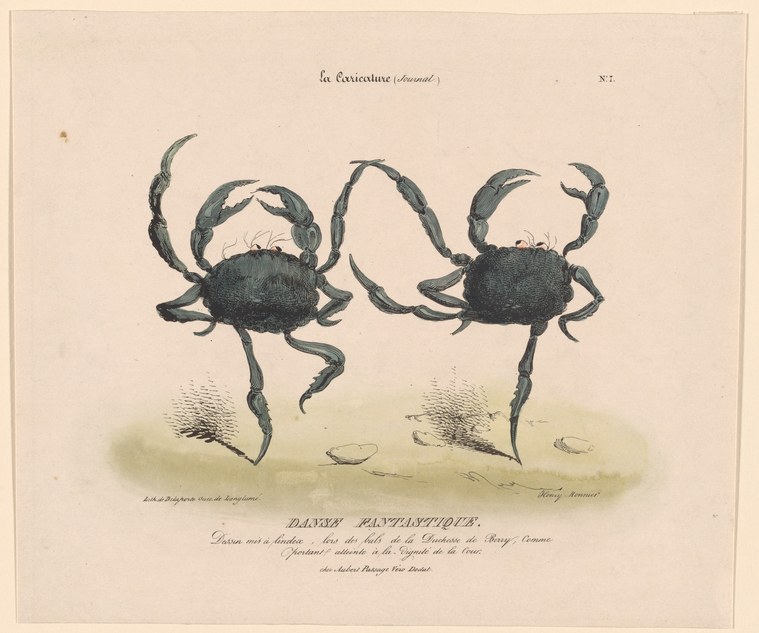
Two crabs face each other in a stark, minimalist composition against a pale background. Both creatures are rendered in dark ink with meticulous anatomical detail: their massive claws are raised and splayed, their eyestalks are extended upward, and their multiple legs are spread wide in a posture of confrontation or display. The crabs cast subtle shadows on a sandy foreground, grounding them in a shallow space. The title and inscription below identify this as a fantastical dance, but the image reads as pure natural history—an engraving of two specimens arranged symmetrically, as if positioned for scientific examination.
The dancing
The two crabs mirror each other exactly in stance and scale: both stand with legs planted wide, claws raised to shoulder height or higher, pincers open and menacing. The raised eyestalks and elevated claws create a visual impression of aggression or threat display rather than dance movement. There is no suggestion of weight transfer, rhythm, or the partnering dynamics that characterise choreographed movement. The symmetry is absolute and static, more heraldic than kinetic.
The dance depicted
The inscription labels this as a *danse fantastique*—a fantastical or whimsical dance—but the image itself resists interpretation as dance. No human dancers are shown, and the crabs' postures, while animated, do not conform to any known dance form. This appears to be a playful conceptual work: the title invites the viewer to read the crabs' aggressive stance as a humorous parody of human dancing, perhaps mocking courtship, duelling, or theatrical spectacle. The work plays on the period's taste for the grotesque and absurd.
How it was made
This is a hand-coloured engraving or aquatint, likely 18th century or early 19th century, executed with fine linear precision in the crabs' anatomy and delicate tonal wash in the background and shadows. The technique allows for sharp detail in the creature's exoskeleton and legs, and the hand-colouring—grey-green for the carapaces and legs—enhances naturalism. The inscription in French below the image indicates circulation in educated European circles, probably as a print sold individually or as part of a series on natural history or satirical subjects.
About this work
This is a witty engraving that exploits the formal conventions of natural-history illustration to create a visual pun: two crabs are presented as dancers, their aggressive territorial or mating display rendered as a *danse fantastique*. The work belongs to a tradition of animal satire and playful natural history that flourished in 18th-century printmaking, where the boundary between scientific documentation and comic invention was deliberately blurred. It sits at the intersection of dance representation and satirical art, offering a grotesque parody of human courtship and theatrical display through the lens of crustacean behaviour.
How to look at it
Observe the absolute stillness and symmetry of the composition: the crabs are frozen mid-threat, not mid-motion. The title invites you to read their stance as dance, but the image resists—the joke lies in that gap between the verbal conceit and the visual reality. Notice how carefully the artist has rendered the anatomical detail: this is not a crude parody but a precise scientific illustration repurposed for comic effect. The raised claws and eyestalks, which in a real crab signify dominance or territorial aggression, are presented as the signature gestures of a fantastical performer.
The period
The 18th and early 19th centuries saw a flourishing of satirical and naturalistic printmaking in France and across Europe. Hand-coloured engravings circulated widely among educated collectors and were a primary medium for distributing images of natural history, theatrical scenes, and political satire. The taste for *fantaisies* and grotesqueries—imaginary scenes that played with the conventions of high art and natural observation—was particularly strong in French printmaking. Dance itself was a fashionable subject during this period, both in theatrical contexts (ballet was developing into a recognisable art form) and in satirical commentary on courtship and social behaviour.
Where it lives
The work is held in the New York Public Library's collection of prints depicting dance. It appears to be a single sheet from the late 18th or early 19th century, likely part of a larger series or collection of satirical engravings.
Questions about this work
Is this actually a dance?
Not in any conventional sense. The title *Danse fantastique* is a witty fiction—a playful label applied to an engraving of two crabs in a confrontational stance. The work is a visual pun, inviting the viewer to read the crabs' natural behaviour (likely a threat or mating display) as if it were a choreographed performance. It is satire rather than documentation.
Why would someone call this a dance?
The inscription suggests this was meant as humour or social commentary. By labelling aggressive animal behaviour as a 'fantastic dance,' the artist may be mocking human courtship rituals, theatrical spectacle, or the pretensions of formal dance. It exploits the 18th-century appetite for learned visual puns that played with scientific and artistic conventions simultaneously.
What is the inscription at the bottom?
The French text identifies the work as a *Danse fantastique* and provides a naturalist description: 'Crabs met a female... des du hall de la Danse de Sorg, Comme frappant une à la Cognée de la Tuer.' The phrasing is deliberate wordplay, mixing scientific and theatrical language.
More dance artwork





