49 works in this view — arrow keys or swipe to move between them.
Dance in Art
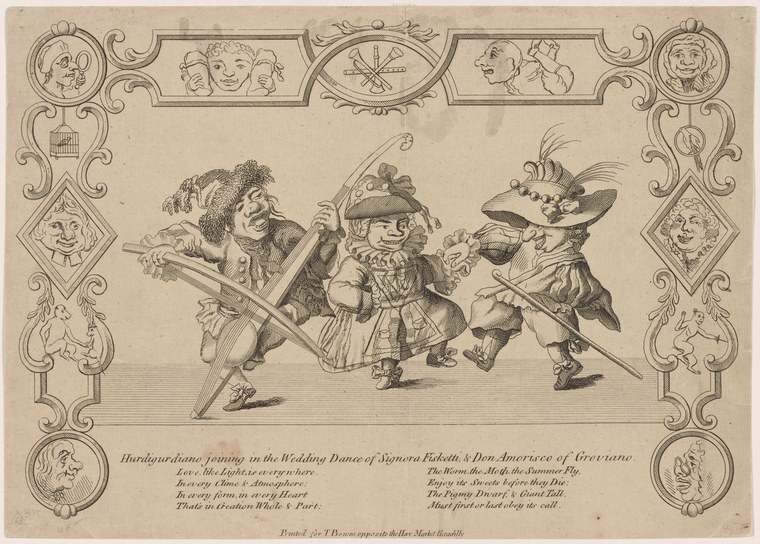
Hurdigurdiano joining in the wedding dance of Signora Fisketti
Unknown artist
- Collection:
- Prints depicting dance
- Source:
- New York Public Library
- Rights:
- Public domain — free to use, share and adapt.
- Recorded as:
- Public Domain
This print documents the contempt with which upper classes viewed popular and working-class festivity, and the power of visual satire to mark social boundaries through the body. For historians of dance and carnival, it is evidence of what street and wedding celebrations looked like to outsiders—and of how those celebrations were weaponized as markers of vulgarity and unfitness.
What you are looking at
This is a satirical engraving depicting three grotesque figures engaged in a raucous dance, their bodies contorted in exaggerated postures. The central figure, smallest and most active, cavorts with legs splayed and arms akimbo, while two larger figures flank him—one to the left in a wide stance with one leg extended, the other to the right in similar wild disarray. All three wear period costume including breeches, coats, and hats adorned with feathers; their faces are caricatured with prominent noses and distorted expressions. The setting is minimal: a bare ground line with no architecture or props, allowing the bodies to dominate. The composition is framed within an ornate cartouche featuring scrollwork, masks, cherubs, and decorative medallions in the margins—a classical Renaissance/Baroque border that contrasts sharply with the vulgar chaos of the central action. The print is executed in fine line engraving on a warm cream ground, with dense hatching defining form and shadow.
The dancing
The three dancers occupy no recognizable closed or open hold; instead, each inhabits its own gestural space. The leftmost figure stands with weight shifted onto one leg, the other extended laterally at hip height—a posture suggesting vigorous kicking or high stepping. The central figure displays the most extreme distortion: knees bent, one foot raised high, arms spread wide in a position of wild abandon. The rightmost figure adopts a similar wide-legged stance, torso twisted, creating an impression of simultaneous movement in opposing directions. None demonstrate the controlled frame, alignment, or coordinated partnering that would characterize formal dance of any period; the bodies appear instead to be locked in individual, anarchic motion—the hallmark of satirical representation.
The dance depicted
This is almost certainly a satirical or comic print mocking lower-class or carnival dancing, likely from the late 17th or early 18th century. The inscription identifies the figures as 'Hurdigurdiano' (hurdy-gurdy player or itinerant musician) and references a wedding dance associated with a 'Signora Fisketti,' suggesting that the work lampoons popular street festivities or peasant celebrations. The dance itself cannot be identified as any formal style; rather, the exaggeration and grotesquerie suggest the artist's intent was ridicule—the inversion of courtly decorum through wild, uncontrolled bodily display. The print likely satirizes both the music and the dancers, presenting them as objects of aristocratic contempt.
How it was made
This is an engraving, identifiable by the fine parallel hatching lines that build form and shadow, the precise linear detail of costume and facial features, and the overall clarity of line characteristic of burin work on copper. The engraving technique allowed wide distribution through multiple printed impressions, making it a vehicle for satire aimed at a literate, urban audience—likely the merchant or lower nobility who collected satirical prints. The ornate decorative border, executed with equal precision, suggests a print of some pretension, perhaps from a series or a collection of novelty or comic scenes. The medium's clarity would have made the grotesque distortion of the figures all the more pointed.
About this work
This engraved print is a 17th or early 18th-century satirical commentary on lower-class festivity and uncontrolled bodily expression. It depicts three grotesquely caricatured figures engaged in wild, uncoordinated movement presented as a 'wedding dance'—likely a Neapolitan or Italian street celebration—and mocks both the dancers and the music that drove them. The work sits at the intersection of printmaking, social satire, and visual commentary on class and decorum. It belongs in a gallery of dance art not because it depicts any formal or admirable dance, but because it reveals what educated viewers of its time regarded as the opposite of dance: ungoverned, lower-class bodily excess presented for ridicule and entertainment.
How to look at it
Attend first to the ornamentation: the decorative cartouche is skillfully executed and cost the engraver real labor, signaling that this is a 'serious' print meant for a cultivated audience. Then look at the contrast between that frame and the chaos within. Notice how none of the three figures touch or partner with one another—each is locked in private, distorted motion. The raised legs, twisted torsos, and splayed arms read as loss of control, not virtuosity. The caricatured faces—especially the prominent, exaggerated noses—were a standard tool of anti-Semitic and anti-peasant satire. Finally, observe the inscriptions and emblems in the border: they establish the print's social commentary before you even decode the central action.
The period
The engraving belongs to a rich tradition of Northern European satirical printmaking that flourished in the 17th and 18th centuries, particularly in the Netherlands and Germany. Prints mocking peasant and lower-class life were popular collectibles among the urban merchant and professional classes, who purchased them as evidence of refined taste and moral superiority. The ornate Baroque border—with its scrollwork, classical masks, and cherub heads—invokes high art and courtly aesthetics, making the savage caricature of the central figures all the more pointed through contrast. The print participates in a long visual genealogy of disdain for popular culture that would persist well into the modern period.
Where it lives
The work is held in the New York Public Library's collection of prints depicting dance, classified as a dance-related image. It survives as one impression from what was likely a commercial print edition, suggesting broad circulation among literate urban audiences.
Questions about this work
What is a 'Hurdigurdiano'?
The hurdy-gurdy is a medieval stringed instrument played by turning a crank; the player—the 'hurdigurdiano'—was typically an itinerant musician of low social status. The term became associated with popular street entertainment and carnival music, making it a ready-made object of mockery in satirical prints aimed at educated viewers.
Why is the border so elaborate when the figures are grotesque?
The ornate frame invokes high art and courtly taste, creating deliberate visual irony: the print announces itself as a refined object (via the frame) before revealing its subject as vulgar and contemptible (via the caricatures). This contrast was a standard rhetorical device in satirical printmaking.
Is this a dance we can identify?
No. The exaggeration and lack of partnering or formal structure indicate that the artist was not documenting a real dance but rather caricaturing lower-class festivity for comic and moral effect. The inscription suggests it may parody a Neapolitan or Italian wedding celebration, but the 'dance' as depicted is invention rather than ethnography.
Who would have bought this print?
Urban professionals, merchants, and lower nobility—collectors with enough money and education to appreciate the satirical commentary and display the print as evidence of refined taste. These prints were popular collectibles in Northern Europe and the Netherlands during the 17th and 18th centuries.
More dance artwork





