49 works in this view — arrow keys or swipe to move between them.
Dance in Art
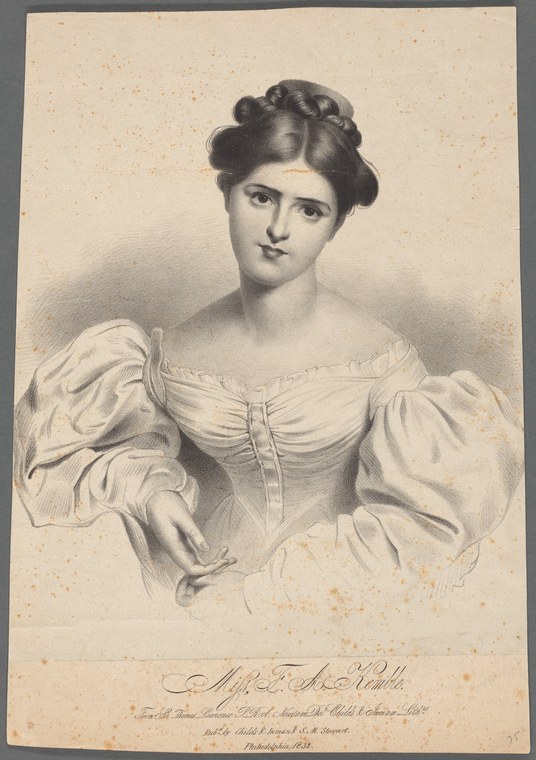
Miss F.A. Kemble
Unknown artist
- Collection:
- Prints depicting dance
- Source:
- New York Public Library
- Rights:
- Public domain — free to use, share and adapt.
- Recorded as:
- Public Domain
Fanny Kemble (1809–1893) was one of the 19th century's most influential actresses, and her career bridged theatre, dance, and literary achievement; understanding how her public image was constructed and circulated through printed portraits is essential to the cultural history of performance. This engraving documents both her prominence and the visual language used to market and commemorate female performers of the period.
What you are looking at
A three-quarter length portrait of a young woman in an elegant Empire-waist gown, rendered in fine stippled engraving. She is posed in a moment of graceful stillness, her body turned slightly to the viewer's right, her gaze direct and composed. The dress features the hallmark silhouette of early 19th-century fashion: a high waistline just below the bust, and full puffed sleeves that sit off the shoulder, the fabric gathered and voluminous. Her dark hair is arranged in elaborate loops and braids pinned atop her head in the Regency style. The background is neutral and shaded with careful cross-hatching to create depth without distraction, placing all emphasis on the figure and the delicate rendering of her facial features and the play of light across her muslin gown.
The dancing
The woman stands in a composed, upright posture characteristic of Regency portraiture—neither in motion nor in a dance hold, but rather in the controlled, elegant stance of formal dress presentation. Her arms are relaxed, the nearer one draped naturally across her body, the far arm at her side. Her shoulders are back and her frame is open, projecting the poise expected of a woman of status and accomplishment in the early 19th century. There is no suggestion of active dancing—the moment is one of repose and presentation.
The dance depicted
This is a portrait of a performer or woman of theatrical significance, but it does not depict dance in action. The subject's association with dance or theatre must come from her identity as Fanny Kemble, the celebrated British-American actress and dancer of the 19th century, rather than from any gesture or movement visible in the image itself. Kemble was renowned for her dramatic roles and her classical training, but this engraving captures her in formal presentation mode, not in performance.
How it was made
This is a finely executed engraving, identifiable by its characteristic stippled and hatched tonal work and crisp linear definition. The technique allows for exquisite detail in facial portraiture and the subtle rendering of fabric texture—the muslin appears almost luminous through careful manipulation of white paper and fine parallel lines. The medium's association with reproductive prints and its relative affordability compared to painted portraits suggests this was created for circulation among a broad educated audience, likely as a memorial or promotional image of the performer. The inscription at bottom, in cursive script typical of the period, further indicates this is a formal published print.
About this work
This is a Regency-era engraved portrait of a woman identified by inscription as Miss F. A. Kemble, a celebrated figure in 19th-century theatre and performance. Though catalogued within a collection of dance imagery, the work itself is portraiture rather than dance documentation—it shows a woman in formal dress pose, not in movement or performance. The image belongs in this collection because Fanny Kemble was a significant performer whose influence extended to dance and theatre practice, but viewers should understand that what is depicted here is formal presentation, not choreography or technique. The portrait is a document of her public identity and the aesthetic conventions of Regency-era theatrical celebrity.
How to look at it
Attend to the fineness of the engraving technique: the way light models the face and the silken texture of the dress. Notice the Regency silhouette and hairstyle, which are precisely dated. The inscribed name at the bottom of the print is the key to understanding the work's significance; without it, this would be simply an elegant portrait of a well-dressed young woman. The composition—a three-quarter view, direct gaze, neutral background—follows the conventions of theatrical portraiture meant to preserve and disseminate the image of a celebrated performer to a wide audience.
The artist
The engraver is not recorded. The engraving style, inscription format, and paper quality suggest a London-based professional print shop of the 1820s–1830s, likely produced while Kemble was at the height of her fame performing in plays such as *Romeo and Juliet* and *The Hunchback*. Portraits of celebrated actors were a standard commercial product in this period, circulated to theatregoers and collectors of theatrical imagery.
The period
This portrait dates to the Regency or early Victorian era (likely 1820s–1830s), a period when theatrical performance was enjoying unprecedented popularity and when the actress's image became a commodity in print culture. Fanny Kemble's career coincided with the height of Romantic theatre and the elevation of the actor/actress as a cultural celebrity. Dance and theatre were intimately connected in this period—actresses routinely performed in ballets, pantomimes, and dramatic works requiring choreographed movement—but formal portraiture of performers typically stressed their social status and classical education rather than their physical virtuosity.
Where it lives
The print is held by the New York Public Library in a collection designated as 'Prints depicting dance.' It is a reproductive engraving, likely 19th century, part of the standard portfolio of theatrical portraiture produced and circulated in London and subsequently collected in America.
Questions about this work
Was Fanny Kemble a dancer?
Fanny Kemble (1809–1893) was primarily an actress, but dance was integral to 19th-century theatre training and performance. Actresses of her era routinely performed in ballets, pantomimes, and dramatic roles requiring choreographed movement. Her classical training would have included dance technique, but she was celebrated above all for her dramatic acting.
Why is a portrait in a dance collection?
This portrait is included because Kemble was a significant figure in 19th-century performance culture, a period when theatre and dance were inseparable. Her image is part of the visual archive documenting performers whose work shaped both dramatic and choreographic practice.
What does the dress tell us?
The Empire-waist gown with puffed sleeves and the elaborate Regency hairstyle date this portrait to approximately 1820–1835. This was fashionable dress for a woman of status and theatrical prominence, not stage costume, indicating this is a formal portrait for public circulation rather than a record of a specific performance.
More dance artwork





