49 works in this view — arrow keys or swipe to move between them.
Dance in Art
Fanny Cerrito
Unknown artist
- Collection:
- Prints depicting dance
- Source:
- New York Public Library
- Rights:
- Public domain — free to use, share and adapt.
- Recorded as:
- Public Domain
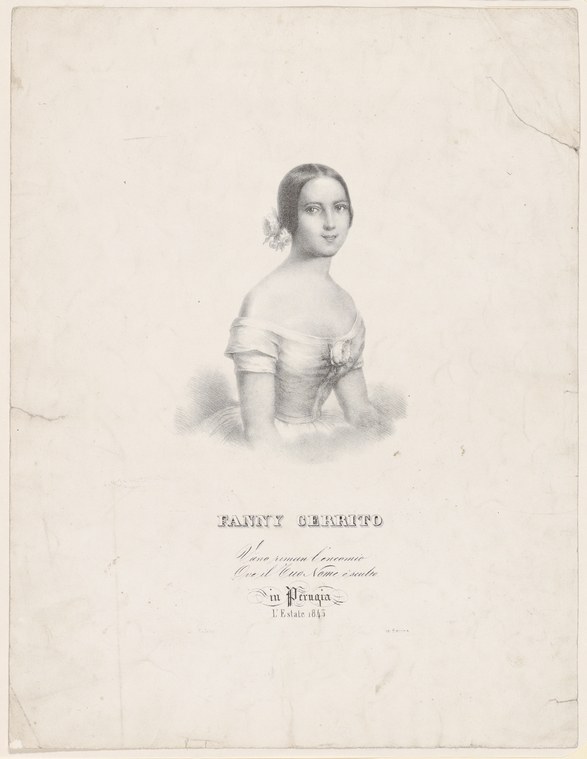
Fanny Cerrito was a foundational figure in Romantic ballet and one of the first dancers to achieve sustained international stardom and financial independence. This portrait is evidence of her celebrity status and the mechanisms by which that celebrity was constructed and consumed—lithographs like this shaped how the public imagined the great dancers of the age. For historians of dance and theater, such prints offer insight into the iconography of performance, the aesthetics of beauty, and the role of visual reproduction in establishing and maintaining a performer's legend.
What you are looking at
A half-length portrait of a young woman in three-quarter view, shown from behind and turning to gaze over her shoulder toward the viewer. She wears a pale, off-shoulder dress with short puffed sleeves characteristic of 1840s fashion, the bodice fitted and the fabric catching light in soft gradations. Her dark hair is pulled back and adorned with what appears to be a small flower or ornament. The background is plain and neutral, allowing the figure to dominate. The technique is graphite or lithographic crayon, rendered with careful attention to the modeling of the face, neck, and shoulders; the treatment is delicate and romantic, with subtle shading that creates volume and presence.
The dancing
The dancer's posture is upright and composed, with the shoulders held back and the head tilted slightly in a pose of graceful awareness. The turn of the head and body creates a gentle contrapposto—the torso faces away while the face turns toward the viewer, creating an impression of elegant self-consciousness. The arms are not visible, held either at the sides or behind the figure. The overall frame is one of stillness and poise rather than active movement.
The dance depicted
This is a portrait of Fanny Cerrito (1817–1909), one of the major ballet stars of the Romantic era, identified by the inscription below the image. The work does not depict her in active performance, but rather presents her as a public figure—a known dancer paused in a moment of repose or formal presentation. Cerrito was celebrated for her technical facility, her beauty, and her work in both pantomime and pure dance across Europe and Russia. The romantic styling and the gentle, introspective gaze align with how Cerrito was marketed and perceived during her peak years in the 1840s–1850s.
How it was made
This is a lithographic print, rendered in crayon or chalk on stone, a medium that allowed for mass production and wide circulation of celebrity likenesses in the 19th century. The soft modeling and tonal subtlety possible in lithography suit the romantic aesthetic of the period. Such prints were common collectors' items, sold separately or bound in albums, and served to publicize performers to a growing middle-class audience who attended the opera and ballet. The technique enabled the distribution of Cerrito's image across Europe, reinforcing her international fame.
About this work
This is a lithographic portrait of Fanny Cerrito, one of the greatest ballet dancers of the Romantic era, created during or shortly after her period of greatest celebrity. Though not a depiction of dance itself—no movement, no costume, no stage—the work is fundamentally about dance culture: it is a celebrity image, a commodity, a way that audiences encountered and possessed the likeness of a living performer. Cerrito's fame rested on her technical prowess, her interpretive gifts, and her beauty; all three are invoked here in a portrait that presents her as an object of refined attention. The work belongs in a gallery of dance in art because it documents how dance and dancers were represented, circulated, and commodified in the 19th-century public sphere.
How to look at it
Attend to the pose and expression: this is not a moment of virtuosity or dramatic intensity, but of composed, romantic repose. The three-quarter turn and the sidelong glance are conventions of feminine portraiture that invite the viewer's gaze while suggesting a private, introspective self. Note the care taken in rendering the neck and shoulders—the site of grace and poise in Romantic ballet. The plainness of the background and the focus on the figure's head and bust emphasize the dancer's face and bearing as the seat of her art, not the acrobatic display of the body.
The artist
The artist is not recorded. The work bears no visible signature, and the catalogue does not attribute it. Given the quality of execution, the professional printing, and the subject's renown, it was likely produced by a commercial lithographic firm or a society artist working in Paris or another major European city in the 1840s–1850s. Many such portraits were published without clear artist attribution, as the focus was on the celebrity of the subject rather than the fame of the portraitist.
The period
This portrait dates to the height of Romantic ballet, roughly the 1840s–1850s, when the ballet d'action was at its creative peak and when dancers like Marie Taglioni, Carlotta Grisi, and Fanny Cerrito competed for dominance of the European stage. The Romantic era in dance emphasized ethereal beauty, technical virtuosity, and pantomimic storytelling; the visual culture of ballet—costumes, poses, and celebrity likenesses—was a major industry. Lithography had made celebrity portraiture affordable and reproducible, allowing a middle-class audience to collect images of their favorite performers. The soft, idealized aesthetic of this portrait is typical of Romantic-era imagery: the sitter is presented as beautiful, refined, and introspective rather than as a spectacle of strength or exoticism.
Where it lives
This work is held in the New York Public Library's collection of prints depicting dance. It is catalogued as an anonymous work of unknown date, identified only through the inscription below the portrait. The New York Public Library's dance collections are among the most significant repositories of performance iconography from the 19th and early 20th centuries.
Questions about this work
Who was Fanny Cerrito?
Fanny Cerrito (1817–1909) was an Italian-Swiss ballet dancer and choreographer, one of the four great ballerinas of the Romantic era alongside Marie Taglioni, Carlotta Grisi, and Lucile Grahn. She was celebrated for her technical skill, her interpretive gifts, and her beauty, and she performed successfully across Europe and Russia. She was also one of the first female choreographers to achieve significant recognition, creating ballets for herself and others.
Why is this a portrait rather than a stage scene?
This is a publicity portrait—a way of marketing the dancer to the public off-stage. Such prints were sold to admirers and collectors and displayed in homes. They constructed the dancer's public identity and allowed audiences who could not attend performances to own an image of their favorite performer. In the 19th century, celebrity was increasingly mediated through such images.
How was this print made and distributed?
This is a lithograph, a technique that allowed artists to draw on a stone surface with a greasy crayon, which was then chemically treated so that ink would adhere only to the drawn areas. The stone could then be printed many times, making it far cheaper and faster than engraving. Such prints were sold individually, in series, or bound into albums, and were collected by middle-class enthusiasts of opera and ballet throughout Europe.
What can we learn about Romantic ballet from this image?
This portrait encapsulates key values of Romantic aesthetics: feminine beauty, grace, refinement, and introspection rather than spectacle. It shows how Romantic dancers were presented to the public—as idealized figures of sensibility and elegance, not as athletic or comedic performers. The image also reveals the commercial machinery of ballet: celebrity, reproduction, and consumption.
More dance artwork





