49 works in this view — arrow keys or swipe to move between them.
Dance in Art
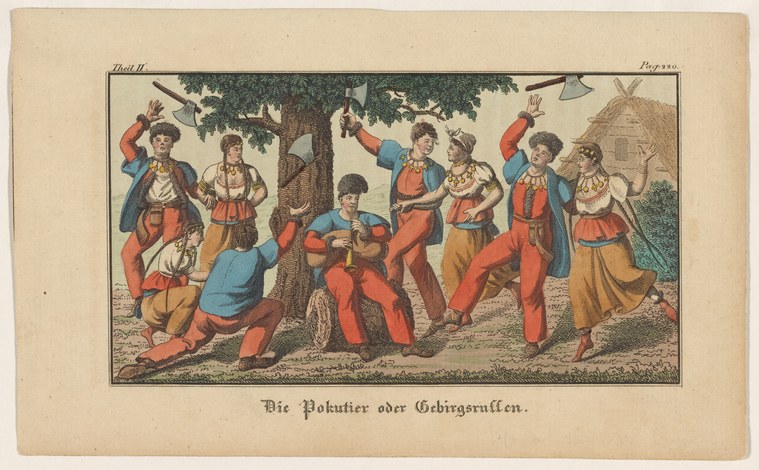
Die Pokutier oder Gelingsruffen
Unknown artist
- Collection:
- Prints depicting dance
- Source:
- New York Public Library
- Rights:
- Public domain — free to use, share and adapt.
- Recorded as:
- Public Domain
This image is one of the few surviving visual records of a named early modern folk dance or game, rendered with enough specificity that we can observe the postures, costumes, and group dynamics of non-elite dance culture. For historians of dance, carnival, or folk custom, it provides concrete evidence of what "popular" movement looked like before modern choreography or academic standardization. For artists and performers, it demonstrates that extreme physicality, acrobatics, and apparent chaos were not alien to early modern festive culture.
What you are looking at
A lively outdoor scene of roughly a dozen figures in early modern dress gathered beneath a large tree, frozen in the moment of a communal dance or game. The composition is dense and animated: figures in the foreground crouch, leap, and gesture with raised arms, while others stand or process in the background. The costumes—red and blue doublets, yellow and orange skirts, white collars and cuffs—are those of German or Northern European peasants or townsfolk of the 16th century. The setting is rural, with a thatched building visible on the right and a flat, sandy ground beneath the tree's substantial canopy. The mood is one of uninhibited merriment: bodies are twisted and contorted, several figures appear to be in mid-jump or extreme flexion, and the overall composition suggests chaos and exuberance rather than formal order. A hand or bell hangs from the tree's branch, and the engraver has paid close attention to the textures of bark, fabric, and ground.
The dancing
The bodies show no ballroom training or courtly discipline. Instead, they exhibit exaggerated postures: deep squatting, high jumps with legs extended, arms flung upward or outward, and torsos bent at acute angles. One central figure appears nearly horizontal, supported or suspended by others. The dancers wear no specific hold; instead, they are distributed across the space in loose clusters, some appearing to interact directly with neighbors, others engaged in solitary acrobatic display. The footwork is not visible in detail, but the weight distribution suggests explosive, upward movement and rapid changes of level. This is group play rather than coupled dance.
The dance depicted
The title *Die Pokutier oder Gditgsruffen*—likely "The Pokuty" or a similar regional term, possibly relating to a penitential or mock-penitential game—suggests a specific German or Central European folk tradition, though the exact dance form is not immediately identifiable from modern nomenclature. The scene depicts what appears to be a participatory game or ritualized play rather than a choreographed dance. The extreme postures, the involvement of multiple figures at different levels, and the apparent spontaneity suggest either a forfeit game, a carnival or festival performance, or a ceremonial mock-punishment game common in early modern folk culture. The lack of instruments or musicians visible implies music accompanied the scene but was not deemed essential to document.
How it was made
This is a hand-colored woodcut or engraving, likely from the 16th or early 17th century, executed with fine parallel lines to suggest shadow and volume. The coloring is applied after the black-line impression, using translucent washes of red, blue, yellow, and ochre that do not entirely cover the underlying engraving. The technique allowed rapid reproduction and wide circulation through book illustration or single-sheet broadside sales. The precision of the line work and the careful attention to costume detail suggests the artist was documenting a known cultural practice with some authority, making this a source document for folk custom as much as an artwork.
About this work
This is a colored engraving documenting an early modern German or Northern European folk game or dance known as the Pokuty (or similar), performed outdoors in a state of boisterous play. The scene is crowded, gestural, and acrobatic—far removed from the courtly decorum or theatrical polish of Renaissance court dances. Instead, it records the physicality and uninhibited joy of popular festival or carnival custom, where bodies contort, leap, and interact in patterns that seem improvisational or game-like. The work belongs to a tradition of German and Dutch prints documenting folk life and popular customs, often produced for moral instruction, entertainment, or ethnographic interest. Such prints circulated widely in the 16th and 17th centuries and offer historians rare visual evidence of how ordinary people danced and played.
How to look at it
Look first at the bodies themselves: the depth and variety of postures tells you this is not a learned or choreographed dance but a game or ritualized play where each participant finds their own extreme position. Notice how the tree anchors the composition and provides a frame for the action—the figures crowd beneath it as if drawn by its presence, suggesting the Pokuty may have been a tree-centered ritual. Observe the costumes: the careful rendering of doublets, hose, and skirts indicates the artist took seriously the documentation of actual dress, making this a reliable source for how ordinary people dressed for festival. Finally, attend to the moment: the artist has chosen a peak moment of exuberance and physical contact, not a moment of order or repose.
The period
The print dates to the 16th or early 17th century, a period of intense documentation of folk customs and popular life in Northern European prints. German and Flemish engravers and woodcut artists produced hundreds of broadsheets and book illustrations recording peasant dances, festivals, games, and ceremonies, often with moral or satirical intent. These works reflect both genuine ethnographic interest and a condescending urban gaze on rural and lower-class behavior. The Pokuty may have been a regional or seasonal game, associated with carnival, Shrovetide, or other festive occasions when the normal social hierarchy was temporarily inverted and physical excess was permitted or celebrated.
Where it lives
The work is held in the New York Public Library's print collection, which documents early modern broadsheets, book illustrations, and single-sheet prints. Such items were often mass-produced and widely circulated, making them common in institutional collections; this piece is cataloged as a print but lacks specific information on medium, date, or artist attribution.
Dance in this work
Questions about this work
What is the Pokuty and where was it danced?
The Pokuty (or a similar name) appears to be a German or Central European folk game or dance, but historical documentation is sparse. The print itself is our primary evidence for its existence and practice. Such games were typically regional, seasonal (often tied to carnival or harvest), and involved ritual physical excess or mock punishment. The title suggests it may have had a penitential or mock-penitential aspect.
Why are the dancers in such extreme positions?
The extreme postures—deep squats, high jumps, contorted spines—suggest this was either a forfeit game where participants had to perform prescribed physical challenges, a carnival ritual where exaggeration and grotesquerie were valued, or a demonstration of physical prowess. The lack of formality and the variety of postures indicate that individual creativity or improvisation was part of the game.
Is this a dance or a game?
The distinction may not have been sharp in early modern folk culture. What we would now call a "game" with rules and forfeits often involved rhythmic movement, music, and bodily display. The Pokuty combines elements of both: it has a name and apparent traditional form (suggesting it is a recognized cultural practice), but the movements are individualized and acrobatic rather than choreographed. It is best understood as a form of play-dance or festive game.
Who made this print and when?
The artist is not recorded in available documentation. The print appears to date to the 16th or early 17th century based on style, costumes, and printing technique, but a precise date is not established. It was likely produced as a broadsheet or book illustration intended for a German or Northern European audience interested in depicting folk customs and popular life.
More dance artwork





