49 works in this view — arrow keys or swipe to move between them.
Dance in Art
The midnight schottisch
Unknown artist
- Collection:
- Prints depicting dance
- Source:
- New York Public Library
- Rights:
- Public domain — free to use, share and adapt.
- Recorded as:
- Public Domain
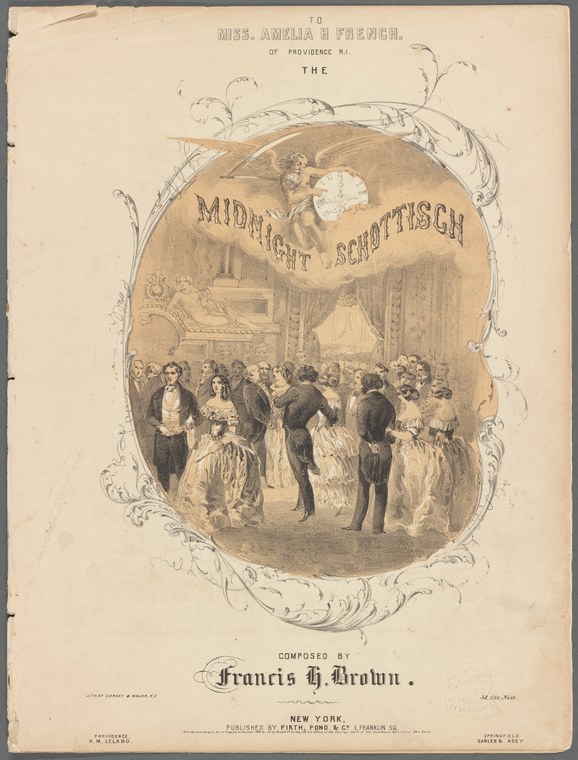
The schottische represents a moment when European ballroom dances—polka, waltz, galop—were spreading rapidly across the Americas, creating a shared transatlantic social culture. This printed score, dedicated to a named woman (Amelia B. French of Providence, Rhode Island), shows how dance was domesticated and feminized as a home entertainment and courtship practice. The image is valuable evidence for how dance was visualized and marketed to the middle class in the nineteenth century: formal, orderly, and romanticized, rather than captured in the act of moving.
What you are looking at
This is the title page of a published musical composition, not a representation of an actual dance performance. The engraved image shows an interior ballroom or assembly room scene, framed within a decorative scrollwork border. A crowd of elegantly dressed figures in mid-nineteenth-century formal wear—men in tailcoats and women in full skirts—occupy a grand interior space. The perspective draws the eye through the room toward a distant archway or doorway; the architectural setting suggests a substantial public venue or hotel ballroom. The composition is crowded but ordered, with figures arranged in loose groups suggesting both social congregation and the possibility of movement across the floor. The lighting is even and cool, created through the engraving technique; there is no dramatic chiaroscuro, but rather the neutral documentary tone of a mid-century print. The title "The Midnight Schottisch" curves across the upper portion of the image in ornamental lettering.
The dancing
The figures are rendered in profile and three-quarter view, showing the formal dress conventions of the 1840s-1850s. Men wear dark tailcoats, waistcoats, and light trousers; women wear high-waisted dresses with full skirts falling to the ankles, some with visible crinolines or hoops. The postures are upright and composed rather than active; most figures appear to be standing, conversing, or processing through the room rather than actively dancing. No clear couple is caught mid-movement, and the scene reads as a social gathering before or between dances rather than a moment of active stepping. This reflects the conventions of the period's dance prints: the scene establishes the occasion and the participants rather than freezing a specific moment of choreography.
The dance depicted
The schottische (also spelled schottische or schottish) was a popular ballroom dance of the mid-nineteenth century, related to the polka and galop but danced in 4/4 time with a distinctive hop-step pattern. It typically involved couples in closed position (man and woman face-to-face, one hand joined, the other on waist or shoulder) moving around the ballroom in a traveling step with a characteristic bounce. The title "Midnight Schottisch" suggests a fashionable dance occasion, possibly at a formal evening assembly—the "midnight" may indicate the hour or serve as a romantic embellishment typical of dance music titles of the period. The image itself does not depict active dancing; instead, it documents the social context in which the schottische would be performed: a ballroom filled with fashionable people in formal dress, assembled for the evening's entertainments.
How it was made
This is a hand-colored engraving, likely steel-engraved, typical of music-publication title pages of the 1840s-1850s. The decorative border is finely rendered through line engraving; the architectural and figural details are built up through parallel lines (hatching) to suggest form and shadow. The hand-coloring—warm ochre and tan tones for the interior space, blue-gray for clothing shadows—was applied after printing, a standard practice for higher-quality music publications. The technique allowed for wide circulation: engraved plates could be printed in large numbers and hand-colored by workshop teams, making the image affordable and accessible to amateur musicians and dancers who purchased published dance music. The formal, documentary style suggests this was a popular composition with a significant market.
About this work
This is the title page of a published piano or orchestral arrangement of a schottische, a ballroom dance that was hugely fashionable in the 1840s-1850s across North America and Europe. The engraved image shows the social setting in which such dances took place—a formal ballroom assembly—rather than the specific choreography. The composition documents not the dance itself but the cultural moment of the mid-nineteenth-century ballroom, when dancing was a central social practice of the urban and rural middle and upper classes. The work belongs in a gallery of dance in art because it testifies to how dance was circulated, commodified, and imagined during this period: through sheet music covers that established the glamour and formality of the occasion, even as the image stops short of showing the actual movement.
How to look at it
Attend to the setting first: this is an interior architectural space rendered in formal perspective, establishing the social venue as the true subject. The crowd of figures is not arranged as active dancers would be, but as a gathered assembly—note the conversational clusters and the orderly spacing around the room's perimeter. Look at the dress: the formal tailcoats and full skirts are exactly contemporary with the 1840s-1850s, and the image serves as a reliable document of ballroom costume. Finally, consider what is absent: there are no couples clearly in mid-step, no visible footwork, no dynamic lines of movement. The image is theatrical and evocative but not documentary of the dance itself—it captures the occasion rather than the choreography, a common choice for nineteenth-century dance prints.
The artist
The composition is credited to Francis H. Brown, of whom little is recorded in standard references. He was one of many mid-nineteenth-century American composers who wrote dances for piano and small orchestra, feeding the enormous market for parlor and ballroom music. The engraver is not identified on the title page, but the quality of the work suggests a competent professional workshop, likely New York-based given the publisher's location. This was a highly specialized commercial practice: composers, engravers, printers, colorists, and publishers formed an integrated industry of dance music production that operated largely outside the concert-music establishment.
The period
The schottische was at the height of its popularity in the 1840s-1850s, spreading from Germany and Bohemia across Europe and then to North America. It arrived in an era when the waltz was already established as the dominant ballroom dance, and the polka was creating a craze among younger dancers. The formal ballroom culture shown in this image was the domain of the prosperous middle class: merchants, professionals, and gentry who gathered for assemblies, subscription dances, and formal entertainments. Dancing masters published thousands of instructional works; composers produced countless dance pieces for amateur musicians to perform at home or at public dances. The dedication to a specific woman (Amelia B. French) suggests this may have been a gift or compliment, a common practice among dance music composers of the period. The art of the period—particularly lithography and engraving—focused heavily on documenting this social world: ballroom scenes, fashionable assembly rooms, and the rituals of courtship and display that dancing enabled.
Where it lives
This work is held in the New York Public Library's collection of prints depicting dance, part of a larger archive of music covers, dance instruction materials, and visual representations of dancing from the eighteenth century onward. The item is catalogued as a print, though the specific technique and date are not fully recorded in the available metadata.
Dance in this work
Questions about this work
What is a schottische?
A schottische is a ballroom dance in 4/4 time, popular in the mid-nineteenth century, with a characteristic hop-step pattern similar to the polka. Couples danced it in closed position, moving around the ballroom. It was imported to North America from Germany and Bohemia and became a standard fixture of formal and semi-formal dance occasions.
Why is this titled 'Midnight Schottisch'?
The title likely refers to the fashionable hour of the dance—midnight balls and assemblies were prestigious events—or is simply a romantic embellishment typical of dance music titles. The word 'midnight' evokes elegance, excitement, and exclusivity, qualities that publishers marketed to buyers of dance music.
Does the image show actual dancers performing the schottische?
No. The title page shows the ballroom setting and fashionable assembly in which the schottische would be danced, but no couple is caught in mid-step. This was a common approach for music covers of the period: they documented the social occasion and context rather than the specific choreography of the dance.
Why was this music published and how was it used?
Dance music was published in enormous quantities in the nineteenth century for home and public consumption. Pianists would purchase these scores to perform for social dancing, either at home for family and friends or by professional musicians at public balls and assemblies. The printed image and title established the dance's prestige and glamour.
More dance artwork





