49 works in this view — arrow keys or swipe to move between them.
Dance in Art
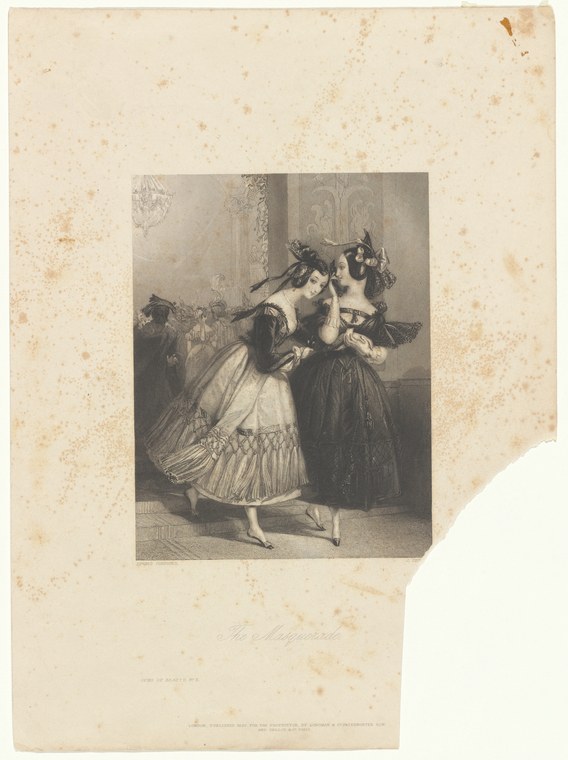
The masquerade
Unknown artist
- Collection:
- Prints depicting dance
- Source:
- New York Public Library
- Rights:
- Public domain — free to use, share and adapt.
- Recorded as:
- Public Domain
This work documents the masquerade ball as a social performance space, where dance functioned alongside drama, flirtation, and spectacle. For historians of 19th-century social dance and theatrical culture, it captures the affective world—surprise, intimacy, playful intrigue—that surrounded ballroom dancing in the period.
What you are looking at
Two young women in Romantic-era ball dress occupy a richly appointed interior. The figure at left, in a pale tulle gown with a low neckline and short puffed sleeves, leans forward in an attitude of animated surprise or delight, her face turned toward her companion. The woman at right, dressed in darker silk or velvet with similar period styling, gestures expressively toward her. Both figures are caught mid-interaction, their bodies angled toward one another in a moment of intimate social exchange rather than formal dance. The setting suggests a drawing room or ballroom: architectural details and drapery are visible in soft grays and browns in the background, lit by what appears to be candlelight or gas lighting of the period. The engraving technique and the title "The Masquerade" suggest this captures a scene from a masquerade ball or theatrical performance rather than a choreographed dance proper—a moment of flirtation, revelation, or social drama within a festive occasion.
The dancing
Neither figure is in a dance hold or frame. Both are standing, weight shifted slightly forward and inward toward one another, in the posture of animated conversation or social play. The left figure's forward lean and raised hand suggest surprise or acknowledgment; the right figure's extended gesture appears to be addressing or beckoning her companion. The compositions and positioning—frontal, face-to-face, intimate in scale—prioritize facial expression and social drama over bodily movement. There is no visible footwork or evidence of formal dance technique.
The dance depicted
This is not a depiction of structured dance choreography, but rather of social interaction in a dance context. The title "The Masquerade" indicates a masquerade ball, where dances occurred but were interspersed with flirtation, intrigue, and unmasking. The image captures a dramatic or comedic moment—possibly a recognition, a flirtation, or a revelation of identity—rather than the dance itself. Without a confirmed artist or date, the specific theatrical or literary source is unclear, though the style and subject suggest a mid-19th-century visual source that may reference a popular play, opera, or novel.
How it was made
This is an engraving or etching, executed in fine lines on a white ground, with subtle tonal variation achieved through parallel hatching and cross-hatching. The technique's precision and tonal control permitted the rendering of fabric texture, facial expression, and spatial atmosphere. The print's circulation as a reproductive work—evidenced by the paper mount and publication context—suggests it was intended for a broad audience, likely derived from a painting or theatrical design. The wear and foxing visible on the page indicate age and historical circulation.
About this work
"The Masquerade" depicts a moment of social drama at a masked ball—two women in elegant Romantic dress caught in animated conversation or surprise rather than in formal dance. The work belongs to the rich tradition of 19th-century theatrical and narrative prints that captured the social and romantic intrigues of ballroom life. While the masquerade itself was a dancing occasion, this image prioritizes narrative and character interaction over choreography; it testifies to the masquerade as a social institution and a subject of popular entertainment, where the excitement lay as much in the chance encounters and identity play as in the formal dances themselves.
How to look at it
Attend to the physical proximity and orientation of the two figures: their bodies lean inward, creating an intimate diagonal composition despite their formal dress. Notice the artist's choice to capture dialogue and emotion rather than movement—the raised hands, the turned heads, the open mouths suggesting speech. This is a narrative print rather than a dance document; it values the theatrical moment and social interaction that framed the actual dancing.
The period
The Romantic era (roughly 1815–1848) saw the masquerade ball flourish as both a real social occasion and a literary and theatrical subject. In visual culture, prints like this one—reproductive engravings of theatrical or literary scenes—were mass-produced and circulated widely, bringing scenes of glamour, intrigue, and modish dress into middle-class homes. The work dates stylistically to the mid-19th century, when Romantic ballet and theatrical spectacle were at their height, and the masquerade remained a favored setting for social comedy and romantic drama in plays, operas, and novels.
Where it lives
The work is held in the New York Public Library's "Prints depicting dance" collection. It is a reproductive print from a larger tradition of 19th-century theatrical and literary imagery, likely derived from a painting, book illustration, or theatrical design rather than drawn directly from life.
Dance in this work
Questions about this work
Is this a dance picture or a theatrical picture?
Both. The masquerade ball was a social occasion centered on dancing, but it was also a dramatic event, valued for the intrigue and flirtation that unfolding between formal dances. This print captures the social and narrative dimension rather than the choreography.
What is the historical significance of the masquerade ball?
Masquerade balls were recurring social events in Europe and America from the 17th through 19th centuries, where participants wore masks and costumes to conceal identity, enabling transgressive social interaction. They were also frequently depicted in literature, opera, and visual art as sites of romance, intrigue, and social commentary. By the 19th century, the masquerade had become as much a theatrical subject as a lived practice.
Can you identify the source of this print—a specific play or novel?
Without an artist attribution or inscription visible in the current image, the specific source cannot be confirmed. The style and subject suggest a mid-19th-century theatrical or literary source, but further research would be required to trace it.
More dance artwork





