49 works in this view — arrow keys or swipe to move between them.
Dance in Art
Fanny Elssler
Unknown artist
- Collection:
- Prints depicting dance
- Source:
- New York Public Library
- Rights:
- Public domain — free to use, share and adapt.
- Recorded as:
- Public Domain
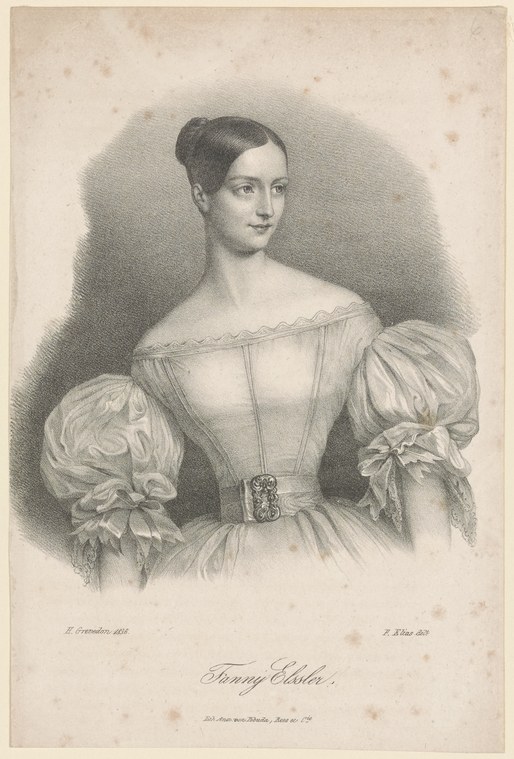
Fanny Elssler was a towering figure in Romantic ballet, famous for her technical prowess and her performances of character dances that audiences found exciting and exotic. This portrait is evidence of the machinery of celebrity that surrounded her—the prints, lithographs, and engravings that circulated her image, made her recognizable, and transformed a stage performer into a public icon. For anyone studying how dancers' bodies and images were commodified and consumed in the 19th century, this print is essential.
What you are looking at
A three-quarter-length portrait of a young woman in a formal ball gown, rendered as an engraved or lithographed bust against a soft, vignette background. She wears a white or cream off-shoulder dress with dramatically voluminous puffed sleeves tied with ribbon bows at the upper arm—the signature silhouette of 1830s fashion. The bodice is fitted and corseted, cinched at the waist with an ornamental buckle or brooch. Her dark hair is parted centrally and drawn back smoothly in the period style. Her pose is upright and composed, her expression neutral and aristocratic, her gaze directed slightly away from the viewer. The engraving technique has rendered the fabric with fine parallel lines that suggest both the weight and luminosity of silk or satin. Below the portrait, a script inscription reads "Fanny Elssler," establishing the sitter's identity, with additional text noting dates ("H Grevedon, delt" and what appears to be "E. Desmadryl sc." or similar, crediting artist and engraver).
The dancing
The figure is stationary and posed for portraiture rather than captured in motion. Her shoulders are squared to the viewer, her arms at rest at her sides, with no visible arm extension or active positioning. The portrait convention of the 1830s—a moment of stillness and social presentation—governs the image entirely. There is no suggestion of weight transfer, balance, or the dynamic line through the body that would characterize a dancer in motion.
The dance depicted
Fanny Elssler (1810–1884) was one of the most celebrated dancers of the Romantic ballet era, known for her technical brilliance, vivacity, and specialization in character dances and national dances (particularly the Spanish cachucha and cracovienne). This portrait does not depict her dancing. It is a formal society portrait of the kind produced for promotional purposes, to hang in drawing rooms, or to circulate in prints among admirers and the theatre-going public. The image captures Elssler as a fashionable woman of her era rather than as a performer in motion.
How it was made
This is an engraving or possibly a lithograph, a reproductive print technique that allowed wide circulation and affordable purchase. The fine parallel hatching lines (visible particularly in the background vignette and the shading of the face) are characteristic of engraving; the soft gradations and the script signatures suggest a professional reproductive print made from an original drawing, most likely by the artist credited as H. Grevedon (Henri Grevedon, a painter and lithographer active in this period). The technique allowed the image to be produced in multiple copies and distributed to the theatrical public, making it a form of celebrity merchandise typical of the Romantic era.
About this work
This is a formal society portrait of the renowned Romantic-era dancer Fanny Elssler, rendered as a professional reproductive engraving intended for public circulation. It documents her as a fashionable woman of the 1830s rather than as a performer, following the convention of dancer portraiture common in the period—publicity images created for sale to admirers and the theatre-going public. As such, it belongs in a gallery of dance in art not because it depicts dancing, but because it is a primary historical document of how dancers were presented to society, how they marketed themselves, and what role the print market played in creating and sustaining the cult of the Romantic ballet star.
How to look at it
This portrait should be read as a historical document of theatrical celebrity rather than as a record of dance. Attend to the fashion details—the puffed sleeves, the corseted waist, the smooth upswept hair—which place it firmly in the 1830s and show Elssler as a fashionable woman. The engraving technique, with its fine lines and soft vignette, suggests the luxury and professional status of the print. Note the signatures: these credits make clear that this is a commercial product, a collaboration between artist and engraver, designed for circulation and sale. The formal pose and neutral gaze follow the portrait convention of the era, in which a dancer might present herself as a lady rather than in the energetic, expressive mode of performance.
The artist
Henri Grevedon (1776–1860) was a French painter, lithographer, and printmaker who specialized in portraiture and theatrical subjects. He was prolific in creating lithographed portraits of actors, dancers, and other public figures during the 1820s–1840s, a period when lithography made such images affordable and widely available. The print credits suggest that Grevedon drew or painted the original portrait and that it was then engraved by a professional reproductive engraver (possibly E. Desmadryl or a similar name) for publication. This division of labour was standard practice in the print trade.
The period
In the 1830s, the Romantic ballet was at its height, with dancers like Marie Taglioni, Carlotta Grisi, and Fanny Elssler achieving celebrity status rivaling that of operatic singers. The period saw an explosion of print culture surrounding the theatre: lithographed portraits, costume engravings, and scene prints flooded the market, sold in print shops and at theatres themselves. Elssler's career coincided with her American tour (1840–1842), during which her fame reached new heights. Prints like this one were tools of celebrity marketing, allowing a dancer's image to circulate far beyond the reach of the theatre itself. The formal fashion portrait—showing the dancer in contemporary dress rather than in costume—was a way of asserting her status as a woman of fashion and social standing, not merely a stage performer.
Where it lives
The work is held in the New York Public Library's prints collection, identified as part of their holdings on dance iconography. It is a reproductive print, likely one of many impressions produced from the same plate or stone; the exact date of publication is not recorded in the catalogue, but the inscription dates and the fashion point to the 1830s.
Questions about this work
Is this a picture of Fanny Elssler dancing?
No. This is a formal society portrait of Elssler in fashionable dress, not a depiction of her performing. It was created for circulation as a print to admirers and the theatre-going public—a form of celebrity merchandise. Portraits of dancers in this era were often made in street dress or ball gowns rather than in costume, as a way of asserting their status as ladies.
Who was Fanny Elssler?
Fanny Elssler (1810–1884) was one of the most celebrated dancers of the Romantic ballet era. She was known for her technical brilliance, her vivacity, and her specialty in character dances and national dances, particularly the Spanish cachucha. She performed throughout Europe and had a hugely successful American tour in 1840–1842.
How was this portrait made?
This is an engraving (or possibly a lithograph), a professional reproductive print technique. It was likely drawn or painted by Henri Grevedon and then engraved by a professional reproductive engraver for publication. This allowed the image to be produced in multiple copies and sold affordably, making it accessible to the theatre-going public.
Why do prints like this matter to dance history?
These prints are evidence of how dancers were marketed as celebrities in the 19th century. They show how a performer's image could circulate far beyond the theatre, how dancers presented themselves to society, and how the print industry played a crucial role in creating the cult of the Romantic ballet star.
More dance artwork





