49 works in this view — arrow keys or swipe to move between them.
Dance in Art
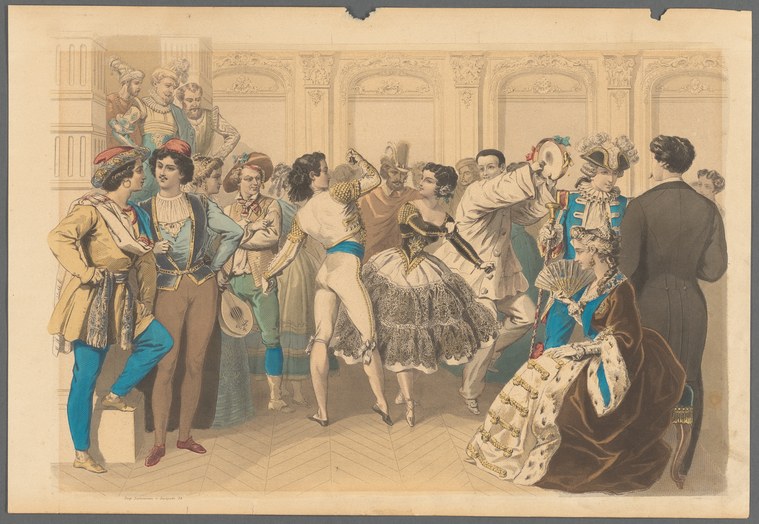
A fancy-dress ball with a couple in Spanish costume at center
Unknown artist
- Collection:
- Prints depicting dance
- Source:
- New York Public Library
- Rights:
- Public domain — free to use, share and adapt.
- Recorded as:
- Public Domain
This image documents the intersection of ballroom dance, theatrical costume, and Orientalist fantasy in 19th-century social life—showing how Spanish and other 'exotic' identities were performed and consumed at the heart of European elite society. For students of ballroom history, it provides rare visual evidence of the actual dress, spatial arrangement, and social dynamics of a fancy-dress ball, a form of entertainment that shaped both ballroom custom and broader popular culture.
What you are looking at
A grand ballroom scene during a fancy-dress ball, rendered in hand-colored engraving or lithograph. The setting is an ornate interior with classical architectural details—pilasters, arched panels, and decorative moldings—suggesting an aristocratic residence or palace. Two figures in Spanish costume occupy the center: a woman in a dark skirt with white underskirt or petticoat, and a man in tight breeches and a short jacket, both wearing elaborate headpieces. Around them, roughly a dozen costumed revelers in various theatrical dress mill about in conversation and observation—a figure in military uniform, others in silks and satins, some in masks or turbans. The composition pulls the eye toward the Spanish couple, who appear to be dancing or about to dance while onlookers attend. The hand-coloring emphasizes the blue silk ribbons and gold accents in the costumes, and the spatial recession of the ballroom recedes convincingly toward the back wall.
The dancing
The two central figures are not in a formal ballroom hold; instead, they stand in a more theatrical pose, with the woman's body angled away from the man, her posture suggesting both coquetry and performance. The man's stance is upright and formal. Neither figure shows the rigid frame or synchronized leg action of a strict waltz or quadrille; their positioning is more performative, as if they are the subject of curiosity for the surrounding company rather than participants in an organized set dance. The surrounding figures are static, watching—only the central pair appears to be in motion or about to move.
The dance depicted
This depicts a fancy-dress ball in the 19th century (likely mid-century, based on costume vocabulary and printing style), where it was fashionable for revelers to adopt theatrical or exotic costumes including Spanish dress. The image does not show a specific named dance being performed; rather, it captures the moment of a costumed performance or display within a ballroom setting. Spanish costume was a popular choice for fancy-dress balls and was often associated with a romanticized, sensual exoticism. The couple's pose and the rapt attention of onlookers suggest this is a *display* of Spanish dress and manner rather than an execution of a Spanish dance form such as the seguidilla or fandango, though the visual language of exoticism and performance evokes the cultural associations Spanish dance carried in European ballrooms.
How it was made
This is a hand-colored engraving or possibly a colored lithograph, evidenced by the fine linear details, the modeling of form through line rather than pure tone, and the characteristic appearance of applied watercolor or pigment over a printed base. The technique allowed for relatively rapid reproduction and wide circulation—such images were popular as prints for middle-class audiences and as illustrations in periodicals documenting social life. The hand-coloring, likely applied after printing, indicates this was a valued copy, either a luxury version or a special commission. The precision of the architectural setting and the individuation of costume suggest the engraver was attentive to the documentary function of the image: capturing the actual fashions and furnishings of the period.
About this work
This is a documentary engraving of a fancy-dress ball, a popular form of aristocratic and upper-middle-class social entertainment in the 19th century. The work captures the theatrical and erotic fascination with Spanish costume and performance that characterized European ballroom culture in the 1840s–1860s. The central couple in Spanish dress, posed as a spectacle for watching guests, embodies the way fancy-dress balls functioned as stages for the performance of identity, exoticism, and social wit. The work belongs to a substantial tradition of prints documenting ballroom life, coterie behavior, and the costumes and manners of fashionable society—a visual culture that documented and popularized ballroom conventions even as the balls themselves were happening.
For dance historians, the work is valuable less for its depiction of actual Spanish dance technique than for what it reveals about how Spanish identity and costume were consumed and performed within a European ballroom context. The stillness and formality of the surrounding guests, and the theatrical framing of the central pair, show that fancy-dress performances were interruptions in the normal flow of ballroom activity—moments when one couple became the object of collective attention, enacting fantasy rather than participating in a mass social dance.
How to look at it
Observe the compositional hierarchy: the Spanish couple is isolated and framed, their pose theatrical and self-conscious, while the other guests form a loose, attentive perimeter. Note the contrast between the stiffness of the onlookers—their static poses and formal dress—and the slight sense of movement in the central pair's posture. Look closely at the architectural setting: the regularity and grandeur of the classical interior underscores the formality of the occasion and the precision of social ritual. The hand-coloring emphasizes the richness of fabric and the brilliant blue ribbons that mark the Spanish costume as special, distinct, set apart from the muted grays and blacks of the evening dress around it.
The period
Fancy-dress balls were at their height in the 1840s–1860s, a period when theatricality, historical costume, and Orientalist fantasy pervaded European social life. The ballroom itself was undergoing transformation during this period: the rigid geometry of the quadrille and cotillion was giving way to the waltz, which allowed couples to dance in closed embrace and relative privacy within a public space. Fancy-dress balls represented a parallel form of ballroom spectacle—highly structured, costumed, and performative, but distinct from the social dances of the evening. Spanish costume was particularly fashionable, drawing on Romantic-era association of Spain with passion, danger, and sensuality. In visual culture, engravings and lithographs of ballroom scenes were among the most popular forms of social documentation, allowing readers of newspapers and print journals to follow the fashions and manners of the elite.
Where it lives
This work is held in the New York Public Library's collection of prints depicting dance. It is part of a larger documentary tradition of ballroom prints that includes images of quadrilles, waltzes, and fancy-dress events from the mid-19th century.
Dance in this work
Questions about this work
Is this a Spanish dance?
Not exactly. The couple is wearing Spanish costume and are the focus of attention at a ballroom, but the image shows a costumed display or performance within a fancy-dress ball rather than the execution of a specific Spanish dance form like the fandango or seguidilla. Spanish costume at fancy-dress balls was more about theatricality and exoticism than authentic dance practice.
What is a fancy-dress ball?
A fancy-dress ball was a formal entertainment in which upper-class guests wore elaborate costumes—historical, theatrical, or exotic—and danced, conversed, and performed for one another. These balls were distinct from regular ballroom dancing and more about spectacle and social performance than participation in formal dances like the quadrille.
What does this tell us about Spanish dance in Europe?
This image shows that Spanish costume and identity held powerful appeal for European audiences in the 19th century, but were often consumed as fantasy and exoticism rather than as authentic cultural practice. The Spanish couple becomes a spectacle for European guests, which reveals the power imbalance and appropriation at work in Orientalist culture.
How was this image made and distributed?
This is a hand-colored engraving or lithograph, a technique that allowed prints to be made in multiple copies and widely distributed. Such prints were popular as illustrations in newspapers and periodicals documenting high society, making them accessible to middle-class audiences interested in the fashions and manners of the elite.
More dance artwork





