49 works in this view — arrow keys or swipe to move between them.
Dance in Art
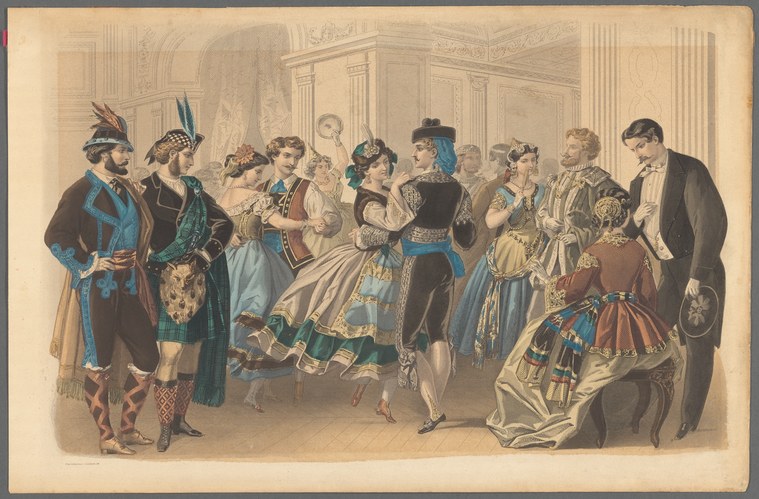
A fancy-dress ball with a couple in Slavic (?) costume at center
Unknown artist
- Collection:
- Prints depicting dance
- Source:
- New York Public Library
- Rights:
- Public domain — free to use, share and adapt.
- Recorded as:
- Public Domain
This work documents the nineteenth-century phenomenon of 'folk' dance as European high-society entertainment, showing the precise moment when vernacular cultural practice became costumed spectacle. For dance historians, it reveals the viewing conventions, spatial arrangements, and social hierarchies that governed how courtly audiences experienced and understood non-elite dance forms.
What you are looking at
A formal indoor ball in what appears to be an eighteenth or nineteenth-century aristocratic setting, with fluted columns and ornamental ceiling visible in the background. The scene centers on a couple in elaborate Slavic folk costume amid an assembly of elegantly dressed guests in contemporary European court dress. The man wears a dark jacket with blue and gold braiding, and the woman a full skirt in white with embroidered green and blue trim and a decorative headdress. They stand nearly at the center of the composition, watched by roughly a dozen onlookers arranged in a loose circle around them. The guests wear black tailcoats, evening gowns, and fashionable accessories of the period. The lighting is even and the space appears ceremonial—a spectacle staged within a formal gathering rather than general social dancing.
The dancing
The central couple are poised in an upright, formal stance with clear separation rather than close embrace. The man's posture is reserved and frontal; the woman's torso is erect, her weight centered. Her skirt spreads full and shows no mid-turn catch, suggesting a moment of relative stillness or presentation rather than active rotation. The surrounding figures stand as spectators, many with hands clasped or at rest, indicating that attention has turned toward the demonstration. No visible contact between the central pair beyond the formality of proximity; their relative distance and his turned gaze outward suggest display more than intimate partnering.
The dance depicted
This appears to document the performance of a Slavic folk dance at a European ball—likely a Russian, Polish, or Ukrainian dance performed as a novelty or entertainment for aristocratic observers. The costume and the framing of the couple as a focal point for a watching circle suggests this is a choreographed exhibition of 'folk' material staged within a ballroom context, rather than vernacular dancing as it would occur in its origin community. The spectatorial arrangement and the formal setting indicate that the folk dance has become theatrical—a demonstration of cultural difference presented for cosmopolitan leisure-class amusement.
How it was made
This is a hand-colored lithograph or engraving, likely from the mid-nineteenth century. The printing technique is evident in the even pale background wash, the fine linear detail in architectural and costume elements, and the applied color in the clothing and accessories. The technique allowed for mass reproduction and wide circulation, making it a document of popular entertainment and ballroom culture aimed at a broad educated audience. The quality and care of hand-coloring suggest this was a commercial print of some status—the work of a publisher with access to good production methods and skilled colorists.
About this work
This print captures a moment of nineteenth-century salon entertainment: the display of Slavic folk dance as an exotic curiosity within European high society. It documents not the dance itself as a lived cultural practice, but its transformation into spectacle for an aristocratic audience. The image reveals the mechanics of how European elites encountered and consumed 'folk' culture in this period—as staged performances, separate from the life of the ball, presented by costumed dancers to watching circles of formally dressed guests. It belongs in a gallery about dance because it shows how folk material entered the ballroom not as participation but as theatrical presentation, a boundary between vernacular and elite that shaped European dance culture for a century.
How to look at it
Notice the stillness at the center of the composition—this is not a moment of dynamic movement but of presentation and display. The artist has chosen to freeze the couple in a moment of relative pause, allowing the spectators and the architectural setting to be read. Look at the arrangement: the watching circle creates a frame within the frame, marking this as a performance or 'turn' within a larger social event. The contrast between the elaborate folk costume and the severe European evening dress of the observers establishes the folk dance as entertainment, a break from the ball's ordinary business—something to be viewed and judged rather than joined.
The period
The nineteenth century saw growing European fascination with folk and national cultures, partly as Romanticism elevated the 'authentic' and 'primitive' as sources of emotional and artistic truth. Simultaneously, colonial and imperial expansion made the presentation of 'exotic' peoples and practices a fashionable ballroom entertainment. The dance depicted here sits at the intersection of these currents: genuine folk costume and movement transformed into salon performance, where aristocratic audiences could experience cultural difference in controlled, aesthetic terms. Ballroom culture itself was entering its period of greatest codification and commercialization, with dance masters publishing strict choreographies and print culture (like this) circulating images of proper forms and novel entertainments.
Where it lives
The work is held in the New York Public Library's collection of prints depicting dance. It is catalogued with minimal documentation, typical of nineteenth-century commercial prints, which were produced in quantity and circulated without elaborate archival attribution.
Dance in this work
Questions about this work
Is this a real Slavic dance or a Europeanized invention?
The costume and basic elements likely derive from authentic Slavic folk dress and movement, but the context here—a formal ballroom, a watching audience, the couple framed as performers—indicates that this is a theatrical adaptation. The print documents the dance as it appeared in European salon performance, not as it would have been danced in its origin community. Whether the choreography faithfully represents the source tradition cannot be determined from the image alone.
Why would an aristocratic ball include a folk dance performance?
By the nineteenth century, it was fashionable for European high society to treat folk and 'national' cultures as sources of entertainment and aesthetic curiosity. These performances staged cultural difference and allowed elite audiences to feel cosmopolitan and connected to 'authentic' or 'primitive' traditions. They also fit the ballroom's growing role as a stage for display—a space where dancers and performers could be watched as much as a space for general dancing.
Who are these people? Is this a specific ball or a generic scene?
The print does not identify the participants or the specific event. It is likely a generic representation of a type of entertainment that occurred in aristocratic ballrooms across Europe during this period, intended to circulate widely as an image of fashionable leisure rather than to document a particular historical moment.
What other dances might have been performed at this ball?
European ballrooms of this period typically featured quadrilles, waltzes, polkas, and cotillions—highly codified ballroom dances. Folk performances like this one were novelties inserted into an otherwise standardized evening, offering variety and the appeal of the exotic.
More dance artwork





