49 works in this view — arrow keys or swipe to move between them.
Dance in Art
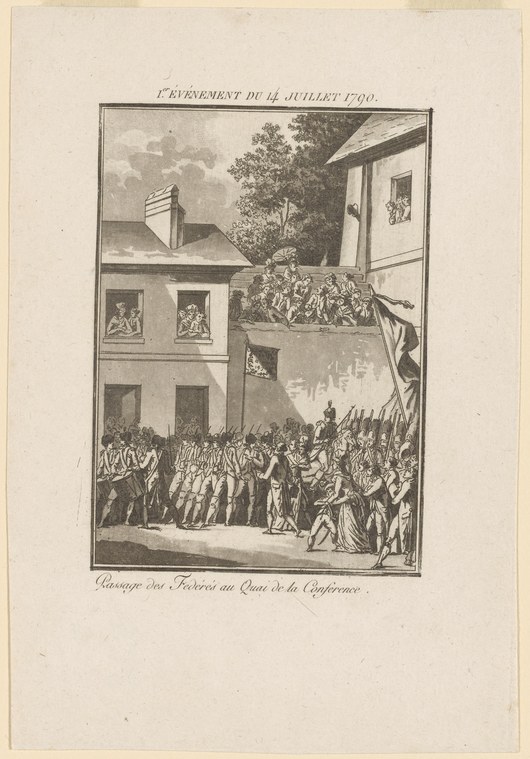
Passage des Fédérés au Quai de la Conference
Unknown artist
- Collection:
- Prints depicting dance
- Source:
- New York Public Library
- Rights:
- Public domain — free to use, share and adapt.
- Recorded as:
- Public Domain
This engraving records how a Revolutionary society visualized collective civic gathering and patriotic assembly—moments that often included music, song, and festive bodily participation. It documents the public sphere in which Revolutionary dance and civic celebration took place, even though no specific dance is depicted here.
What you are looking at
A large crowd fills a courtyard or public square before a multi-story building in what appears to be a revolutionary political gathering. The composition is organized around a raised platform or balcony extending from the right side of the building, where uniformed figures stand elevated above the assembled masses. The crowd below, rendered in lighter tones, occupies the foreground and middle ground; their postures suggest excited attention directed toward the platform. The building itself is rendered with classical proportions—regular windows, a pitched roof with a chimney visible at the upper left—and the scene is framed by simple architectural lines. The sky above is sketched lightly. The title refers to July 14, 1790, and the caption speaks of "Passage des Fédérés au Quai de la Conférence" (Passage of the Federated [National Guard] at the Quai de la Conférence), suggesting this depicts a civic ceremony or military procession at a specific Parisian location during the early Revolutionary period.
The dancing
The crowd is depicted as a sea of individual figures, some standing, some suggesting forward movement or clustering. The uniformed figures on the raised platform hold erect, formal postures typical of military or civic ceremony. The density of bodies in the crowd and the orientation of heads toward the platform indicate attention and assembly rather than coordinated physical movement. No paired holds, embraces, or synchronized stepping is evident.
The dance depicted
This is not a depiction of dance. The scene documents a civic or military ceremonial gathering—specifically a procession or assembly of the National Guard (Fédérés) during the Revolutionary calendar year 1790. The crowd's movement is processional and crowd-based rather than choreographed. While large public gatherings sometimes included celebratory music and spontaneous dancing, nothing in this image suggests rhythmic or patterned movement. The composition is that of a historical engraving documenting a moment of Revolutionary political significance, not a dance scene.
How it was made
This is a line engraving, recognizable from the fine parallel hatching used to create tone and shadow, the precise geometric rendering of architecture, and the characteristic treatment of the crowd as a texture rather than individual portraiture. The technique allows for reproducible prints distributed to document and commemorate the event, making this a record of historical significance rather than a unique artwork. Engravings like this circulated widely in Revolutionary France as visual journalism, creating public memory of key civic moments.
About this work
This is a historical engraving documenting a civic ceremony from July 14, 1790—the first anniversary celebration of the storming of the Bastille, showing a procession or assembly of National Guard troops (Fédérés) at the Quai de la Conférence in Paris. It captures a moment of Revolutionary public gathering and celebration, rendered in the documentary style typical of the period's political prints. While no actual dance takes place in the image, such Revolutionary gatherings frequently incorporated patriotic song, music, and celebratory movement, making civic ceremonies of this era part of the broader landscape of public bodily culture and festive expression. The work belongs in a dance-in-art collection as evidence of how Revolutionary France imagined and documented communal celebration and public body politics.
How to look at it
Read the composition as a study in crowd assembly and civic order rather than individual choreography. Note how the artist uses the raised platform to establish hierarchy and focus—the uniformed figures command attention from the crowd below. The engraver's technique of rendering the crowd as a unified texture rather than individual portraits emphasizes collective rather than individual body. The architectural framing and the regular composition stress civic dignity and formal ceremony rather than spontaneous festivity.
The period
In 1790, France was in the early Revolutionary period, celebrating the first anniversary of the July 14, 1789 storming of the Bastille. The National Guard (Garde Nationale), reorganized after the Revolution, held ceremonial significance as representatives of civic virtue and constitutional order. Public celebrations of Revolutionary events typically involved patriotic gatherings, military displays, music, and expressions of collective will. Engravings like this were produced to document and distribute images of key civic moments to a literate public, serving as both news and propaganda. Such images shaped how citizens understood and remembered their own participation in Revolutionary events.
Where it lives
Held by the New York Public Library in its collection of prints depicting dance, where it is catalogued as a document of 18th-century public gathering and celebration.
Questions about this work
Is anyone dancing in this image?
No. The scene depicts a formal civic gathering or military procession, not a choreographed dance. However, such Revolutionary celebrations often included music, song, and festive movement as part of the broader ceremonial experience.
What is the Quai de la Conférence and why does it matter?
The Quai de la Conférence is a location along the Seine in Paris, near the Tuileries. In 1790, it was a significant site for Revolutionary civic ceremonies and demonstrations.
Why is this in a dance collection if there is no dance?
It documents the public culture and civic celebration of Revolutionary France, when patriotic gatherings, music, and collective movement were integral to how citizens expressed and experienced revolutionary ideals. Dance historians study these broader contexts of public body culture.
More dance artwork





