49 works in this view — arrow keys or swipe to move between them.
Dance in Art
Entrée triomphale des monumuents des sciences et arts en France
Unknown artist
- Collection:
- Prints depicting dance
- Source:
- New York Public Library
- Rights:
- Public domain — free to use, share and adapt.
- Recorded as:
- Public Domain
The work is significant because it captures dance and movement in its civic and ceremonial dimension rather than its theatrical or entertainment function. For historians of dance and court culture, it reveals how processional movement, formal gesture, and the spatial organization of crowds were understood as performance in early modern Europe. It documents the infrastructure of spectacle: the architecture, the crowds, the symbols, and the slow, measured pace at which power and culture moved through public space.
What you are looking at
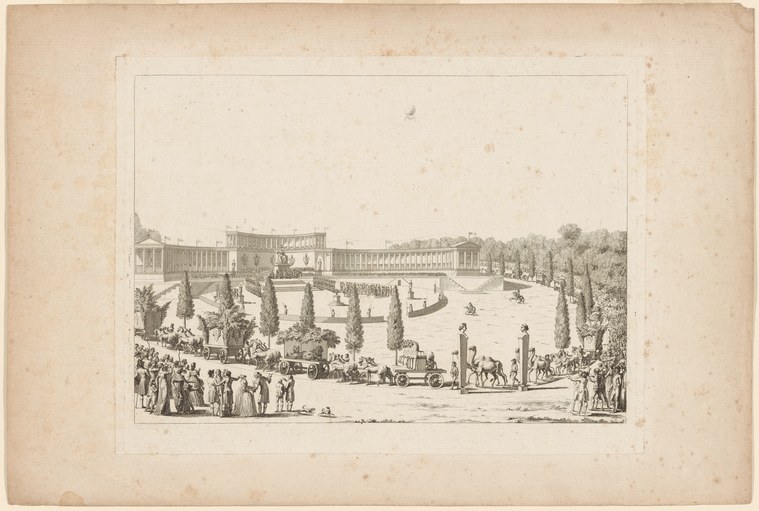
A grand ceremonial procession unfolds in a classical courtyard framed by palatial architecture. The composition is dominated by symmetrical neoclassical buildings with colonnades and mansard roofs; cypresses line the perimeter, emphasizing the formal geometry. The scene depicts what appears to be a triumphal entry: in the foreground, figures in period dress (18th century) gather in dense groups along the sides of the space, their attention drawn toward a central processional route. At the centre, allegorical or symbolic figures—possibly representing the 'monuments of sciences and arts' named in the title—move through the courtyard on or near wheeled structures or platforms. The light is even and architectural, characteristic of an engraving's silvery tonality, casting no deep shadows. The entire composition emphasizes spectacle, order, and the display of cultural or intellectual treasures within a space of civic grandeur.
The dancing
The figures lining the courtyard stand in static or slowly ambulatory postures, their bodies turned to orient toward the procession; hands are raised and gestures are broadly expansive, suggesting amazement or celebration. The gestures are not balletic or technical—these are spectators rather than trained dancers. The central processional figures are too distant and small to read individual limbs, but their movement is processional and measured: walking or being carried in a formal, hierarchical arrangement rather than executing steps.
The dance depicted
This is not a depiction of structured dance in any recognizable sense. The work documents a civic or courtly spectacle—a triumphal procession—in which formal movement and assembly serve ceremonial rather than choreographic ends. If dance is present, it exists as the ceremonial walking and positioning of figures within a symbolic spatial order, and as the rhythmic, patterned movement of crowds witnessing and responding to a display. This aligns with the courtly culture of the 17th or early 18th century in which ceremonial procession, triumph, and spectacle were themselves forms of embodied performance.
How it was made
This is an engraving, identifiable from the fine parallel hatching, crisp linear definition, and the characteristic silvery-grey tonality of the paper. The technique allows for precise architectural rendering and the systematic organization of numerous small figures in deep space, making it ideal for documenting large ceremonial events. Engravings of this type were distributed widely as prints and served as official records or commemorative documents of state occasions, suggesting this work was created for a educated, courtly, or intellectual audience interested in civic spectacle.
About this work
This engraving documents a grand processional spectacle in a classical courtyard, titled *Entrée triomphale des monuments des sciences et arts en France* (Triumphal Entry of the Monuments of Sciences and Arts into France). The work belongs to the tradition of ceremonial court art, wherein formal movement, procession, and the arrangement of bodies in space create a visual and embodied expression of state power and cultural values. It records a moment when dance and spectacle converged in the service of courtly ideology—movement that was choreographed not by musicians but by architects and state officials, using the human body as an instrument of symbolic order.
How to look at it
Attend to the symmetry and spatial hierarchy: the viewer's eye is drawn along the central processional route by the flanking crowds and the architectural framing. The slow, measured tempo of the procession contrasts with the animated clustering of spectators, creating a rhythm of stillness and motion. Note how individual bodies are absorbed into collective formations—the spectators form a unified mass, while the procession moves with ceremonial deliberation. The artist has chosen the moment not of climax but of advance: the spectacle is in motion, unfolding, and the viewer witnesses the slow accumulation of symbolic power through movement through space.
The period
This work belongs to the age of French court spectacle and the *fête galante*, a tradition in which elaborate, staged processions celebrated royal power, diplomatic alliances, or the patronage of the arts. The architectural style and the title's emphasis on 'sciences and arts' suggest a moment of cultural pride, possibly during or after the reign of Louis XIV or Louis XV, when France was consolidating its position as a centre of intellectual and aesthetic authority. The engraving's formal classicism and its commemoration of a state occasion reflect the Enlightenment's investment in the visual and bodily demonstration of rational order and cultural achievement.
Where it lives
The work is held in the New York Public Library as part of its collection of prints depicting dance. It is catalogued with minimal metadata (artist, date, and medium unknown), suggesting it may have entered the collection as part of a larger acquisition or as an uncatalogued donation.
Dance in this work
Questions about this work
Is this actually a dance?
Not in the modern sense. This is a ceremonial procession, a form of courtly spectacle in which formal movement and spatial arrangement serve symbolic rather than aesthetic or entertainment ends. For early modern courts, however, such processions were understood as performances—carefully choreographed in space and movement to display power, knowledge, and cultural achievement.
What are the 'monuments of sciences and arts' in the title?
The title suggests allegorical or symbolic representations—possibly floats, statuary, or performed figures representing abstract concepts. Without additional documentation, the specific iconography cannot be determined from the print alone, though the architectural grandeur and assembled crowds suggest an official state occasion.
What period is this from?
The clothing, architecture, and style of the engraving suggest the late 17th or 18th century, most likely French. The formal classicism and emphasis on courtly spectacle point toward the height of French court culture, though the exact date and occasion remain unknown.
More dance artwork





