49 works in this view — arrow keys or swipe to move between them.
Dance in Art
Three o'clock in the morning ... music by Julian Robeldo
Unknown artist
- Collection:
- Prints depicting dance
- Source:
- New York Public Library
- Rights:
- Public domain — free to use, share and adapt.
- Recorded as:
- Public Domain
This object shows how dance was promoted and sold in the early 20th century: as published music, as theatrical sensation, and as commodity tied to celebrity orchestrators. For dance historians, it is evidence of the repertoire dancers actually performed to, and the orientalist and exoticist fantasies embedded in popular dance marketing of the period.
What you are looking at
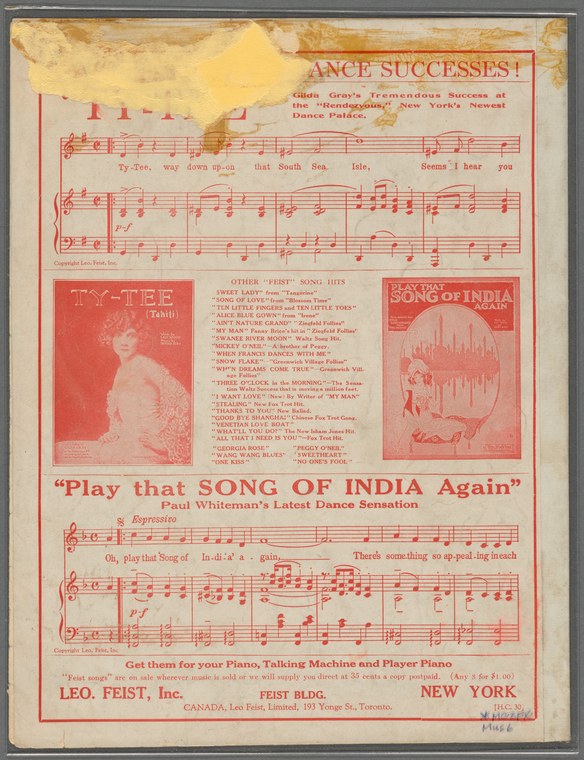
This is a printed sheet music cover advertising dance successes at the Hippodrome and Dance Palace, with the music and lyrics for two pieces. The upper half shows a waltz or ballroom piece in standard musical notation, with piano accompaniment. Below the musical staff, a theatrical advertisement banner announces "Song of India" as "Paul Whiteman's Latest Dance Sensation," flanked by two illustrated vignettes: on the left, a stylized figure in what appears to be South Asian dress (labeled "TY-TEE Tahiti"), and on the right, an architectural scene labeled "Song of India" showing an Indian palace or temple silhouette. The lower half of the page reproduces another piece of sheet music for "Play that SONG OF INDIA Again," again with piano notation. The entire document is printed in red and sepia tones on aged cream paper, with heavy ornamental borders and typography typical of early 20th-century popular music publishing.
The dancing
The image contains no clear depiction of dancers in motion. The small illustrated figures in the vignettes are stylized and emblematic rather than anatomically detailed. The left figure appears to be posed in a static attitude, while the right side is architectural rather than figural. This is primarily a music publishing document rather than a dance illustration per se.
The dance depicted
This is promotional material for popular ballroom and theatrical dance music from the early 20th century, specifically advertising orchestral arrangements by Paul Whiteman. The pieces advertised—"Three O'Clock in the Morning" and "Play That Song of India Again"—were among the popular social dance numbers and theatrical songs of the jazz age. The inclusion of "Song of India" imagery suggests an orientalist fascination typical of the period, blending Indian and Polynesian aesthetics in exotic fantasy. These were not concert pieces but commercial dance hall and theatrical music meant to accompany social dancing.
How it was made
This is a letterpress or offset lithographic print, evidently from a music publisher's catalogue or promotional sheet. The registration of red and black/sepia on aged stock, the ornamental rules and borders, and the typography are consistent with commercial music publishing of 1920–1930. The technique allowed rapid mass production and wide distribution to performers, venues, and the public. The dual function—both advertisement and functional sheet music—was standard for popular music of this era, which relied on print circulation to reach dance halls, theaters, and amateur musicians.
About this work
This is a promotional sheet music cover from the early jazz age, advertising Paul Whiteman's orchestral arrangements of popular ballroom and theatrical songs. Rather than depicting dance directly, it markets the music that accompanied social dancing in that period. The work sits at the intersection of commercial graphic design, music publishing, and popular dance culture. It belongs in a gallery of dance imagery because it documents the material conditions and advertising strategies through which popular dance was circulated and consumed—the sheet music that dancers and bandleaders would have encountered in actual dance halls and theaters.
How to look at it
Attend first to the typography and graphic design: the ornamental framing, the hierarchy of type sizes, the color scheme. These choices marketed the music as sophisticated and fashionable. Note the vignettes: the theatrical "Song of India" imagery is entirely imagined and decorative, designed to evoke exotic glamour rather than ethnographic accuracy. The sheet music itself—the tempo markings, the style of notation, the piano accompaniment—tells you what kind of music dancers would have heard and how the music was structured for performance.
The artist
Paul Whiteman (1890–1967) was a bandleader and composer central to the commercialization of jazz and popular dance music in the 1920s and 1930s. He recorded prolifically and toured extensively, and his arrangements of popular songs were distributed to dance halls and theaters. This sheet music is part of the apparatus by which Whiteman's name became synonymous with modern dance music of the era.
The period
In the 1920s and 1930s, ballroom dancing and theatrical dance were major entertainment industries, and sheet music was the primary medium for circulating new dances and songs. Jazz and syncopated music drove social dance fashions; the Charleston, foxtrot, and variations on standard ballroom hold dominated. Simultaneously, theatrical and orientalist fantasy—particularly "Indian" and "Polynesian" imagery—was a staple of commercial entertainment, reflecting both imperial aesthetics and modernist exoticism. Paul Whiteman's orchestrations exemplified the commercialization and respectability of jazz and syncopated music for middle-class audiences.
Where it lives
This sheet music cover is held in the Prints depicting dance collection at the New York Public Library. It is a commercial music publishing artefact, one of hundreds of thousands produced and distributed in the early 20th century.
Questions about this work
Is this a depiction of a dance, or just a music cover?
It is primarily a music cover and advertisement, not a scene of actual dancers. However, it is a crucial artifact for understanding dance history: it shows what music dancers danced to, how that music was marketed, and what commercial and aesthetic fantasies surrounded dance in this period. For a gallery focused on dance imagery, it documents the material culture of dance.
Who was Paul Whiteman?
Paul Whiteman was a bandleader and composer of the 1920s–1940s, famous for orchestrating popular songs and jazz-influenced pieces for ballroom and theatrical dance. His arrangements were widely distributed and performed, making him a major figure in the commercialization of jazz and modern dance music.
What does 'Song of India' refer to?
This is likely a popular song or dance number of the era, marketed with orientalist imagery. The vignette of the palace is entirely theatrical and fanciful, designed to evoke exoticism rather than represent actual Indian architecture or dance. Such imagery was typical of 1920s–1930s popular entertainment.
More dance artwork





