49 works in this view — arrow keys or swipe to move between them.
Dance in Art
Profezia per l'anno 1863 [handwritten]
Unknown artist
- Collection:
- Prints depicting dance
- Source:
- New York Public Library
- Rights:
- Public domain — free to use, share and adapt.
- Recorded as:
- Public Domain
This work demonstrates how dance imagery—specifically the trope of collective, transgressive carnival celebration—was deployed in nineteenth-century political satire to imagine and advocate for social transformation. The print offers rare visual evidence of how ordinary Italians imagined popular festivity and egalitarian gathering in the immediate aftermath of national unification.
What you are looking at
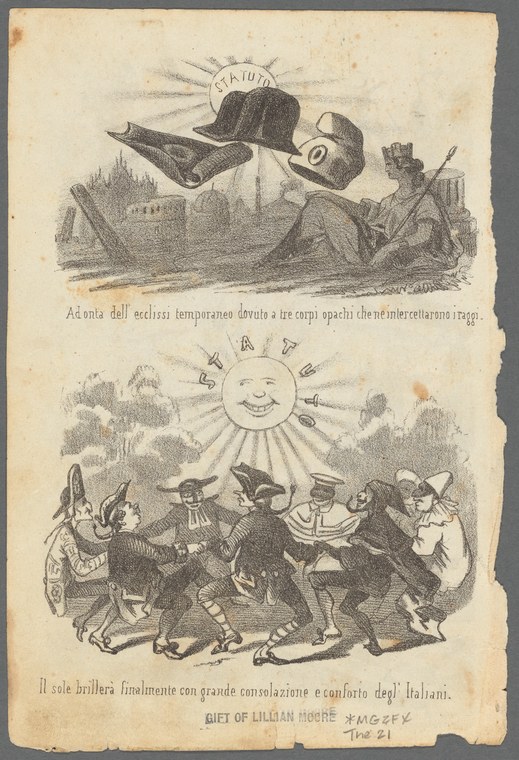
This is a satirical Italian print in two panels, each depicting a fantastical prophecy for the year 1863. The upper panel shows three large hats or bonnets floating in mid-air above a cityscape, radiating light like celestial objects or omens, while a solitary figure below gestures upward in alarm or wonder. The caption reads: "Ad onta dell' eclissi temporaneo dburuto a tre corpi opachi che né'milercatano l'raggio" (Despite the temporary eclipse, three opaque bodies that block its rays). The lower panel presents a crowded, chaotic scene of numerous small figures dancing and cavorting around a large smiling sun face with radiating rays. The figures appear to be various stock characters—soldiers, clerics, harlequins, and common folk—engaged in exuberant, disordered movement. The composition is dense and grotesque, with overlapping bodies and a carnivalesque energy. The caption reads: "Il sole brillera finalmente con grande consolazione e conforto degl'Italiani" (The sun will finally shine with great consolation and comfort for the Italians). The print is rendered in fine engraved lines with careful cross-hatching to create tone and depth.
The dancing
The dancers in the lower panel are rendered as small, quickly sketched figures in various postures of abandon—some with arms raised, others in profile, some appearing to leap or stumble. They lack the formal alignment or unified spacing of courtly or balletic composition; instead they cluster and overlap, suggesting improvised, chaotic movement rather than structured dance. The variety of costume and body type (fat, thin, tall, short) and the absence of any clear partnering or formation suggest this is meant to represent popular, carnivalesque revelry rather than theatrical or social dance with defined steps. The upper panel's solitary figure adopts a pose of astonishment or prayer, with one arm raised toward the celestial hats.
The dance depicted
This is not a depiction of a specific dance tradition but rather a satirical use of dance and carnival imagery as political allegory. The lower panel's frenzied gathering of mixed social types dancing around the sun appears to be prophetic satire about Italian national unity and liberation—a 'the whole nation dancing together' conceit. The chaotic, egalitarian jumble of dancers suggests the romantic ideal of unified popular celebration rather than any particular choreographic practice. The work uses dance as a metaphor for collective joy and social harmony, employing the visual language of carnival—transgression, mixture, and abandon—to express hope for Italy's future after a decade of unification struggles.
How it was made
This is an engraving, identifiable by the fine parallel lines (hatching and cross-hatching) that create tone and volume, the crisp black-and-white contrast, and the linear precision of the composition. Engraving was an economical medium for political and satirical prints, allowing for mass reproduction and rapid distribution. The technique's capacity for fine detail and dense patterning made it ideal for the complex, crowded scenes of popular celebration that appear here. The wear and foxing visible on the paper suggest this is an impression from the nineteenth century, consistent with the 1863 date proposed in the handwritten title.
About this work
This is a hand-colored (or possibly just aged) Italian satirical engraving of 1863, presenting two allegorical scenes framed as 'prophecies' for the year. The upper panel offers a cryptic celestial omen; the lower delivers its interpretation—a jubilant, chaotic gathering of all social classes dancing together in celebration. The work belongs to a tradition of popular political prints that used carnival imagery and collective festivity as metaphors for national aspiration. Italy had achieved unification in 1861, and this print appears to offer an optimistic vision of the benefits that liberation and unity would bring, rendered through the symbolic language of universal dance and celebration.
How to look at it
Attend first to the compositional split: the upper panel's static, ominous pyramid of floating hats versus the lower panel's explosive, all-over scatter of moving bodies. The engraver has used the contrast between sparse line work (above) and dense, chaotic hatching (below) to signal the transition from crisis to celebration. Look at how the individual dancers in the lower panel are differentiated by costume and posture—the print's satire depends on the recognition that these are recognizable social types (clergy, nobility, military, common folk, even harlequins) all mixed together in undignified motion. The smiling sun face is the key to reading the allegory: the prophecy is that national unification ('the sun') will bring joy to all Italians, expressed through their imagined participation in carnival.
The artist
The artist is not recorded. The style is consistent with mid-nineteenth-century Italian popular printmaking, likely produced in a commercial workshop in Rome, Naples, or Milan. The work's subject matter and satirical mode suggest it was created for a broad audience rather than collectors or institutions.
The period
Italy achieved political unification in 1861 under King Victor Emmanuel II. The years immediately following—including 1863—were marked by intense optimism and debate about what the unified nation would become. Carnival traditions, long suppressed or restricted by papal and foreign rule, experienced something of a revival and took on heightened political significance as symbols of popular liberation. Theatrical and popular dance were experiencing rapid transformation: Romantic ballet and opera remained the high-art forms of choice, but street performance and carnival revelry were increasingly coded as expressions of national and popular identity. Satirical prints were a major vehicle for political commentary and prophecy, especially in Italy, where they circulated widely among the literate urban classes.
Where it lives
The work is held in the New York Public Library's collection of prints depicting dance. It is catalogued only with a handwritten title and the collection label visible in the image; no other documentation of acquisition or earlier provenance is recorded.
Questions about this work
Is this a real prophecy or a joke?
It is political satire, not divination. The 'prophecies' are the engraver's ironic commentary on recent Italian unification (1861). The upper panel's ominous hats are probably a dig at specific political figures or events of 1862–63; the lower panel's jubilant mob is the engraver's hopeful—or mocking—vision of what national unity would deliver. The humor relies on the reader understanding current events.
Who are these dancers supposed to be?
They are stock characters and social types: soldiers in uniform, clergy in robes, figures in harlequin costume, merchants, and common folk. The point is that they are all dancing together—a utopian or satirical vision of social unity and shared celebration across class and profession. The artist did not intend to depict recognizable individuals but rather the idea of 'all of society' in carnival.
What is the dance? Can you identify steps or style?
There is no single identifiable dance. The movements are rendered as generic carnival revelry—jumping, gesturing, clustering. The engraver has prioritized the visual metaphor (unified festivity) over choreographic accuracy. The work is political allegory, not a document of actual dance practice.
Why are the hats so important in the upper panel?
The hats are the prophecy's central image: three 'opaque bodies' that eclipse or block the sun, as stated in the Italian caption. Their meaning is now obscure—they may refer to specific political obstacles or rival powers that the engraver believed would briefly obscure Italy's future. The lower panel reinterprets the image: whatever these obstacles are, the sun (Italy) will shine through, and all will celebrate.
More dance artwork





