49 works in this view — arrow keys or swipe to move between them.
Dance in Art
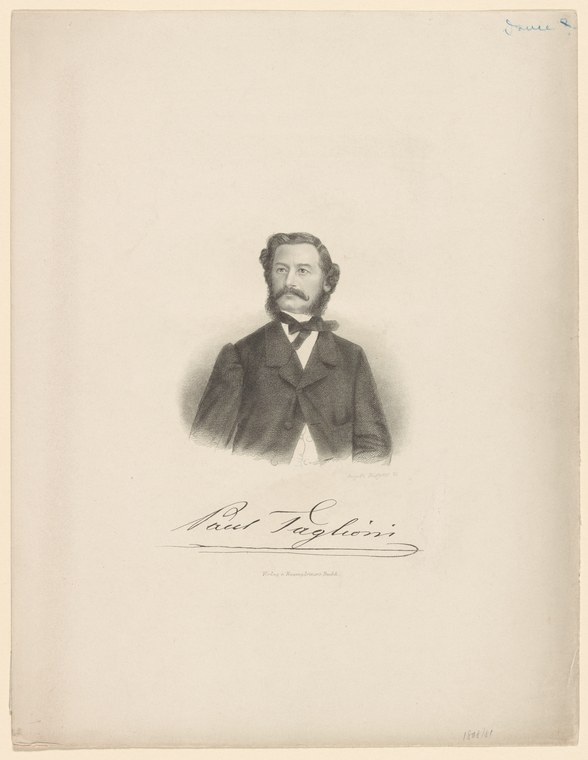
Paul Taglioni (fac. sig.)
Unknown artist
- Collection:
- Prints depicting dance
- Source:
- New York Public Library
- Rights:
- Public domain — free to use, share and adapt.
- Recorded as:
- Public Domain
Taglioni was a central figure in the dissemination and codification of Romantic ballet technique and aesthetics across Europe. This portrait is evidence of how dancers and choreographers of this period were documented and circulated as public figures; such prints were sold, collected, and distributed to theaters and academies, making them instruments of professional authority and historical memory.
What you are looking at
A half-length portrait of a man in mid-nineteenth-century dress, shown against a plain background. He wears a dark jacket over a white shirt and dark tie, his posture upright and composed. His face is rendered with considerable detail—dark hair and mustache, a steady forward gaze—suggesting this is a formal representation of a notable figure. The engraving technique creates soft modeling through cross-hatching, giving the face volume and presence. Below the portrait, a signature in italic script reads "Paul Taglioni." The simplicity of the composition—the figure isolated against white space, the focus on the face and upper body—is characteristic of portrait engravings made for circulation among subscribers or as part of a larger publication series.
The dancing
The sitter is shown from the chest up, with shoulders squared and head held level. His gaze is direct and frontal, addressing the viewer with an air of authority and composure. There is no dynamic gesture or implied movement; the pose is one of stillness and formality appropriate to a documentary portrait. The clothing—precisely rendered dark fabric and crisp white linen—signals respectability and professional standing.
The dance depicted
This is a portrait of Paul Taglioni, a major figure in nineteenth-century European ballet. Taglioni (1808–1884) was a dancer, choreographer, and ballet master, son of the celebrated dancer Marie Taglioni and nephew of the legendary dancer Filippo Taglioni. He was known for his work as a dancer in the Romantic ballet repertoire and for his later career as a choreographer and director at major European opera houses, particularly in Berlin and Stockholm. The portrait itself does not depict dance or a dancing figure; it is a documentary image made to circulate among the educated public and dance world of the period.
How it was made
This is an engraving, executed in the classical portrait style. The technique—fine line work and cross-hatching to model form—allows for precise rendering of facial features and fabric texture. The medium was widely used for reproducible portraiture in the nineteenth century and suggests this image was intended for publication or distribution as a standalone print, possibly as part of a biographical or theatrical series. The signature below the portrait is integral to the composition.
About this work
This is a formal documentary portrait of Paul Taglioni, a significant choreographer and administrator in European Romantic ballet. The image does not depict dance itself but rather presents Taglioni as a historical figure—a record of his appearance during his career in the mid-nineteenth century. It belongs in a gallery of dance art because it documents one of the era's key figures in ballet production and pedagogy, and because such portrait prints were central to how the dance world of the period circulated knowledge of its practitioners and leaders. Taglioni's work shaped the repertoire and institutions that defined Romantic ballet.
How to look at it
This is not a dance image but a documentary portrait in the style of the period. The viewer should attend to the formal conventions at work: the frontal pose, the focus on the face as a site of character and authority, the careful rendering of professional dress. The engraving technique creates an appearance of precision and objectivity—this is how Taglioni looked, how he wished to be seen and remembered. The directness of his gaze establishes a claim on the viewer's attention; he is presented not as a performer but as a figure of intellectual and administrative standing.
The artist
The artist is not recorded in the catalogue. The signature below the portrait is Taglioni's own—a common convention in engraved portraits, where the subject's name appears below rather than the engraver's credit. The image was likely commissioned by a publisher or theater and executed by a professional engraver in the standard commercial mode of the 1840s or 1850s.
The period
This portrait dates to the height of Romantic ballet in Europe. By the 1840s–1850s, ballet had become a major form of theatrical entertainment and was undergoing rapid professionalization. Taglioni's generation—he was the son of Marie Taglioni, the era's most celebrated dancer—occupied a new role as choreographer-administrators who shaped both the aesthetic direction of ballet and the institutional structures through which it was produced and taught. Portrait prints of dancers and ballet masters were widely collected and served both as commemorative objects and as markers of professional status.
Where it lives
The image is held by the New York Public Library as part of a collection of prints depicting dance. It is a commercial engraving, likely published in the nineteenth century as a standalone portrait or as part of a series of theatrical or biographical prints.
Questions about this work
Who was Paul Taglioni?
Paul Taglioni (1808–1884) was a dancer, choreographer, and ballet master who played a major role in shaping European Romantic ballet. He was the son of dancer Marie Taglioni and nephew of the influential choreographer Filippo Taglioni. After an early career as a dancer, he became a director and choreographer at major European opera houses, including those in Berlin and Stockholm, where he produced and staged new ballet works.
Why is this a portrait and not a dance image?
This is a formal documentary portrait made for circulation as a print. It presents Taglioni as a historical figure and professional authority rather than as a dancer performing. Such portraits were common in the nineteenth century and served to document and memorialize notable figures for the educated public.
What dance style did Taglioni work in?
Taglioni was a central figure in Romantic ballet, the dominant European ballet aesthetic of the mid-nineteenth century. His choreography and direction helped establish the repertoire and technique that defined the style, and he was instrumental in spreading Romantic ballet conventions across Europe's major opera houses.
What does the signature below the portrait mean?
The signature is Taglioni's name, which appears below the image as a label. This was standard practice in engraved portraits; the artist's name might appear elsewhere or not at all. The signature identifies the subject rather than the maker.
More dance artwork





