49 works in this view — arrow keys or swipe to move between them.
Dance in Art
Dancing couple
Unknown artist
- Collection:
- Prints depicting dance
- Source:
- New York Public Library
- Rights:
- Public domain — free to use, share and adapt.
- Recorded as:
- Public Domain
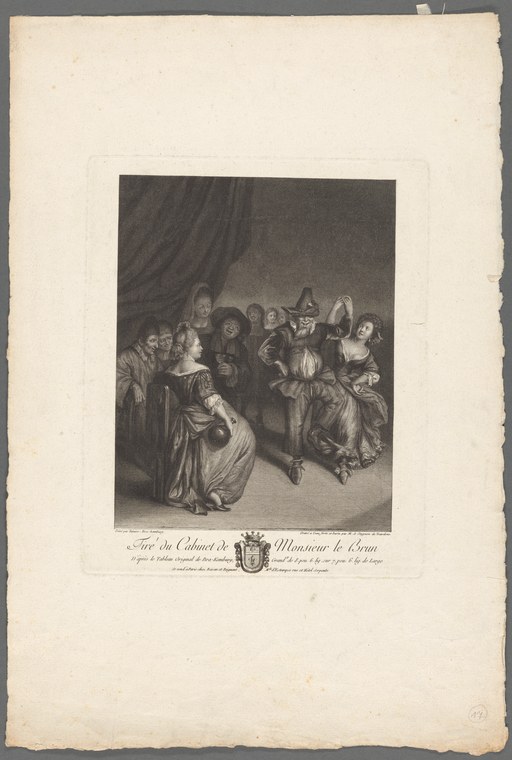
This print documents how theatrical performance and the female body in motion were visualized, recorded, and circulated through the print trade in the 18th or early 19th century. It provides evidence of theatrical staging conventions—the use of dramatic lighting, the relationship between performer and audience, and the codified gestures of theatrical presentation—at a moment when such performances were beginning to be systematized and preserved through engravings. For historians of dance and theater, it reveals both what performance looked like and how it was deemed worthy of commemoration and circulation in print.
What you are looking at
A theatrical scene set indoors, lit from above by a warm, dramatic light that casts deep shadows across the composition. A woman in an elegant long dress stands at left center, her body inclined forward with her arms raised and extended, as if caught mid-movement or in the act of beckoning. She is surrounded by a gathered crowd of onlookers—men and women in period costume—who cluster around her, their faces turned toward her with evident attention. The figures are densely arranged in the middle distance, creating a sense of social gathering or theatrical event. In the background, a heavy curtain or drapery hangs, reinforcing the theatrical setting. The engraving's soft modeling and dramatic chiaroscuro suggest a narrative moment of high emotional content: the woman's posture and the crowd's focus suggest she may be performing, entreating, or being presented to the assembly.
The dancing
The central female figure displays an open, extended frame with both arms raised and spread—a gesture of appeal, presentation, or invitation rather than a closed ballroom hold. Her torso leans forward slightly from the hips, and her legs are obscured by her full skirt, making footwork assessment impossible. The surrounding figures are stationary spectators rather than dance partners; they stand in loose groupings, watching rather than participating in synchronized movement. No visible couple work or formation dancing is present; this is a performance or presentation moment observed by an audience rather than social partner dancing.
The dance depicted
This image does not depict ballroom or social partner dance in any recognizable form. The central figure's raised-arm gesture and the theatrical setting suggest performance rather than social dancing—possibly a theatrical dance, a moment of appeal or supplication within a dramatic scene, or a presentation. The woman's extended arms and forward-leaning posture are consistent with theatrical gesture rather than the closed or semi-closed frames typical of historic ballroom forms. The dense crowd of stationary observers reinforces that this is a watched performance or dramatic moment rather than participatory social dance. Without additional context (title inscription visible at bottom but not legible in this image), identification of a specific dance form cannot be made with confidence.
How it was made
This is an engraving (possibly a mezzotint or stipple engraving, given the soft tonal modeling) printed on laid paper and laid down on a larger backing sheet. The technique allows the artist to create rich atmospheric effects through careful tonal gradation—the dramatic lighting and shadow are achieved through accumulated line and dot work. The fine detail and sophisticated modeling suggest this is a professionally executed reproductive print, likely from the late 18th or early 19th century. The presence of a coat of arms and French text at the bottom (partially legible) indicates this was a formal, published work with identified patronage, intended for a cultured audience.
About this work
This engraving depicts a moment of theatrical performance or dramatic presentation set indoors, with a centrally positioned woman in an attitude of extended gesture surrounded by an assembled crowd. The work is a formal, professionally executed print with heraldic and inscribed information, suggesting it documented a specific theatrical event, literary scene, or narrative moment of cultural significance. The raised arms and forward inclination of the central figure, combined with the theatrical setting and rapt attention of observers, situate this firmly within theatrical rather than social dance conventions. The work belongs in a dance gallery as a record of how theatrical gesture and performance were visualized and circulated in print form, and as evidence of the relationship between theater, dance, and spectacle in the period.
How to look at it
Attend to the central figure's raised arms and forward-leaning posture—this is theatrical gesture language, not ballroom frame. Notice how the artist has used chiaroscuro (the contrast of deep shadow and bright light from above) to focus the viewer's eye on the woman's body and to create a sense of drama and heightened emotion. The crowd of onlookers, rendered less distinctly in the background, serves to frame and legitimize the central action: this is a moment being watched, witnessed, and recorded as significant. The engraving's formal inscription at the base, though partially legible, indicates this was a documented historical moment rather than a generic dance scene.
The period
In the late 18th and early 19th centuries, engravings of theatrical scenes, including dances and dramatic moments, became a significant medium for documenting and circulating performances to audiences who could not attend live theater. Theatrical printing served both commemorative and promotional functions—preserving famous performances and famous performers in visual form, and advertising upcoming entertainments. This period also saw the formalization of theatrical gesture and movement through written dance notation and illustrated manuals. The quality and heraldic details of this print suggest it documented a notable theatrical event, possibly from the French or German court tradition or from a major urban theater.
Where it lives
This work is held in the New York Public Library's collection of prints depicting dance. It is a formal, professionally executed engraving with institutional marks and heraldic insignia, indicating it was a published work of some official standing or patronage.
Questions about this work
Is this a ballroom dance?
No. The raised arms, forward lean, theatrical setting, and assembled spectators indicate this is theatrical performance or dramatic gesture rather than social ballroom dancing. The woman is being watched as a performer, not partnered in a social dance.
What is the woman doing?
Her extended arms and forward-leaning posture suggest she is appealing, entreating, presenting, or performing—making a theatrical gesture toward the assembled crowd. Without the full inscription, the specific narrative cannot be determined, but her body language is that of performance rather than social interaction.
What period is this from?
Based on the engraving technique, the style of dress, and the theatrical conventions depicted, this appears to be from the late 18th or early 19th century. The formal heraldic inscription and professional quality suggest it documents a specific theatrical event of cultural standing.
More dance artwork





