49 works in this view — arrow keys or swipe to move between them.
Dance in Art
Le triomphe de cypris
Unknown artist
- Collection:
- Prints depicting dance
- Source:
- New York Public Library
- Rights:
- Public domain — free to use, share and adapt.
- Recorded as:
- Public Domain
This work illustrates the visual boundary between allegorical female figures and actual dance representation in 19th-century prints. Recognizing that Cypris is not a dancer—despite her theatrical costume and idealized beauty—helps historians distinguish between two major genres of figure imagery that shared the same print market and often the same artists.
What you are looking at
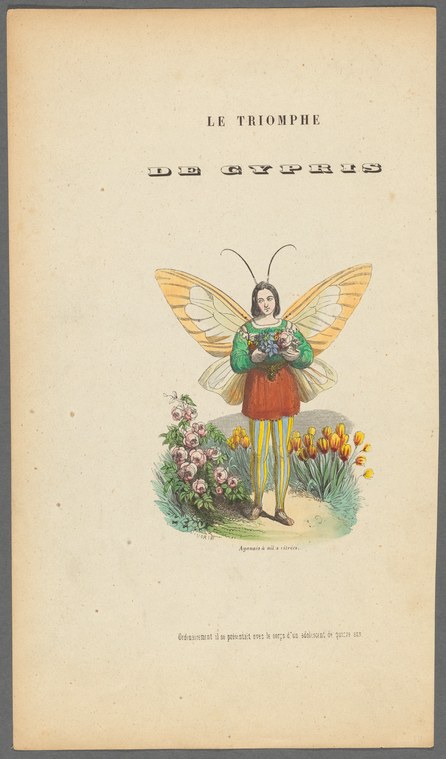
A winged female figure in classical dress stands among flowers in a sunlit garden. She wears a flowing red skirt and green bodice, her large golden wings folded at her back. Her arms are raised and crossed before her chest, cradling a small bouquet of pink and white blossoms. Around her feet grow pink roses on the left and golden-yellow tulips on the right, rendered in bright watercolor tones. The figure appears to embody Cypris (Aphrodite), the classical goddess of love, and the composition suggests a triumphant moment—hence the title—where the natural world itself celebrates her presence. The hand-colored print is rendered against a pale cream ground, with the botanical elements naturalistic and carefully detailed.
The dancing
A single figure dominates the composition, posed in a frontal stance with weight evenly distributed. Both arms are raised to chest height in a crossed, embracing gesture that suggests gathering or presenting the flowers rather than any formal dance position. The figure's posture is upright and symmetrical, without the turned-out hip placement or weight shift characteristic of theatrical dance. The crossed-arm position reads more as a symbolic or allegorical gesture—the presentation of love's floral tributes—than as any articulated dance movement or technique.
The dance depicted
This work does not depict dance in any recognizable sense. Though the figure is winged and allegorical, suggesting classical or mythological subject matter, the pose and gesture are static and emblematic rather than kinetic. The crossed arms and frontal presentation are consistent with 19th-century allegorical or emblematic prints where the figure represents an abstract concept rather than performs a dance. No hold, frame, footwork, or movement vocabulary of any dance form is evident.
How it was made
This is a hand-colored engraving or lithograph, most likely French, dating from the 19th century. The fine line work, subtle modeling in the figure's drapery, and the delicate handling of the wings suggest engraving; the bright, flat color washes applied by hand suggest a print designed for coloring after impression. The technique was economical and allowed for wide circulation among the middle-class audience for allegorical and natural-history prints. The inscription 'Approuvé au Ministère de l'Intérieur' visible at bottom indicates official French approval, placing this within the commercial print trade of the period.
About this work
This is an allegorical print celebrating Cypris (Aphrodite) as the triumph of love, rendered in the style of 19th-century French commercial decoration. The work belongs in a gallery about dance not because it depicts dance, but because it illustrates how the body was posed and presented in allegorical imagery of the period—the figure's stance and gesture reflect conventions of how the feminine body was arranged for symbolic rather than kinetic effect. Understanding this distinction clarifies how dance imagery differs from allegorical figure imagery in the same era: one captures movement, the other arrests it. The work is valuable chiefly as evidence of how non-dance allegorical imagery operated visually, and how contemporary audiences understood the difference between a dancer's body and a symbolic figure's pose.
How to look at it
Observe the figure's stillness and symmetry. The crossed arms, the direct gaze, and the centered composition arrest movement rather than suggest it. Compare this to how a Romantic ballet figure—say, from a contemporary lithograph of *La Sylphide*—would be posed: with asymmetry, tilt, and gesture implying motion. Here, the figure serves as a focal point for decoration and meaning, not a captured moment of kinetic action. The flowers are as important as the figure: she is not dancing *with* them, but standing among them as their queen or embodiment.
The period
The 19th century saw a major expansion of hand-colored allegorical and botanical prints aimed at middle-class households. Figures from classical mythology remained fashionable subjects, combined with Romantic interest in nature and flowers as emblems of emotion. The style reflects the period's taste for decorative, instructive prints that merged aesthetics with gentle moralizing—in this case, celebrating love through nature and classical reference. The artistic conventions of theatrical ballet were being codified and popularized during the same period, but this work shows how differently a classical female figure could be presented when the goal was allegory rather than dance documentation.
Where it lives
Held in the New York Public Library's collection of prints depicting dance. The catalogue entry's classification under 'dance' appears to reflect the allegorical or mythological nature of the subject rather than the presence of actual dance content—a common feature of broad historical collecting practices.
Questions about this work
Is this a ballet or theatrical dance image?
No. Though the figure wears theatrical costume and represents a classical subject, the pose and gesture are purely allegorical and symbolic. The figure is not captured in motion, does not show dance technique, and exhibits none of the asymmetry or weight-shift that would indicate a dancer's body. This is a decorative print celebrating love as an abstract concept.
Why is this in a dance collection?
The figure's classical costume and winged form may have prompted its classification as dance-related material, and mythological subjects were commonly featured in 19th-century theatrical imagery. However, the work itself does not document or depict dance practice. Its inclusion highlights how allegorical imagery and dance imagery shared cultural space and audiences, even when distinct in form.
What does 'Le triomphe de Cypris' mean?
The title translates to 'The Triumph of Cypris,' referring to Aphrodite/Venus (Cypris is an epithet). The composition presents the goddess of love surrounded by flowers—symbols of beauty, desire, and nature—as if celebrating her dominion. The image is emblematic rather than narrative.
More dance artwork





