49 works in this view — arrow keys or swipe to move between them.
Dance in Art
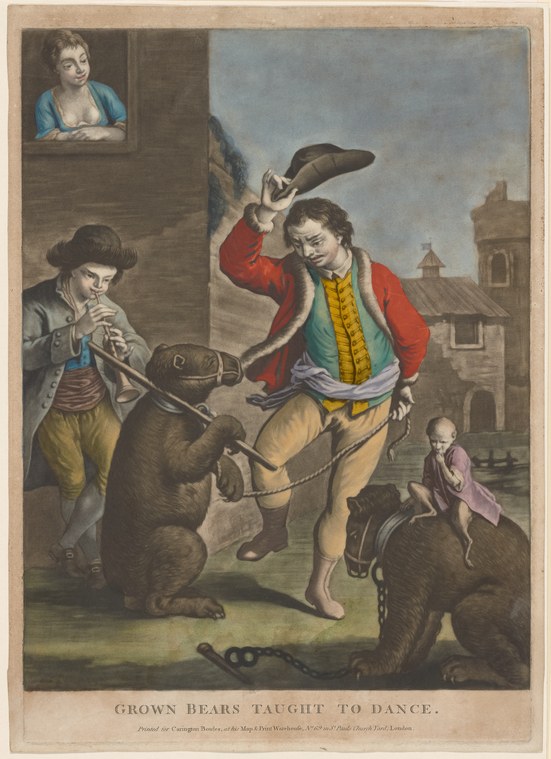
Grown bears taught to dance
Unknown artist
- Collection:
- Prints depicting dance
- Source:
- New York Public Library
- Rights:
- Public domain — free to use, share and adapt.
- Recorded as:
- Public Domain
Trained bear dancing is a historical practice now largely invisible, yet it occupied real cultural space and was subject of satirical and documentary visual representation. Examining this print forces recognition that the history of dance is not the history of ballet or social dance alone, but includes animal performance, street spectacle, and forms of bodily control that test the boundaries of what we mean by dance. It is a reminder that historical definitions of dance were broader and stranger than modern categories suggest.
What you are looking at
A hand-colored engraving depicting trained bears performing a dance in what appears to be an 18th-century street or courtyard setting. Two human handlers in tricorn hats and breeches manage the animals—one figure holds a staff or wand, the other gestures expressively. The bears stand upright on hind legs in the center, one wearing a red coat and the other a yellow garment, both engaged in what the handlers are orchestrating as rhythmic movement. A woman looks down from a window in the dark building at left; a small figure in pink appears at right, and architectural forms—possibly a gate or fortification—define the background. The sky is rendered in pale blue wash, giving the scene the quality of street theater or fair entertainment.
The dancing
The two bears stand upright, bipedal, with forelegs raised or positioned to suggest rhythmic stepping—a posture that inverts normal animal movement and approximates human dance. The handlers flank them: one wields what may be a conducting implement or musical stick; the other holds one arm aloft in an exhortatory gesture, the body angled to suggest active encouragement. Both handlers lean forward, their weight and attention directed toward the animals. The composition emphasizes the handlers' agency in producing movement from the bears rather than the animals' autonomous choice.
The dance depicted
This depicts trained bear dancing, a form of street performance and popular entertainment common in 17th- and 18th-century Europe. The handlers are teaching or displaying trained bears executing upright movements to music or command—a practice that appears in satirical prints, festival imagery, and accounts of carnival and fair culture. The bears' red and yellow coats suggest costumes meant to heighten the spectacle and mark them as performers. This is not a conventional social or theatrical dance but rather a feat of animal training presented as entertainment, a category that occupied a recognized place in popular visual culture and street performance of the period.
How it was made
This is a hand-colored engraving or etching, identifiable by the fine linear work defining forms and the evident hand application of watercolor or pigmented wash. The technique allowed for multiple impressions and broad distribution, making it a commercial print likely produced for public sale. The inscription at the base—a title or credit line—confirms its status as a published work. The hand-coloring distinguishes this from a plain engraving and suggests either special commission or higher market value, as coloring was labor-intensive and could not be mechanized in this period.
About this work
This is a record of trained bear performance as spectacle and entertainment, a practice that was genuinely recognized in 18th-century culture as a form of movement display and public amusement. The print documents not the bears themselves but the labor and orchestration of the handlers—the skill involved in producing coordinated upright movement from animals and the theatrical framing that made such movement legible as performance. The image belongs in a gallery about dance because it captures a historical moment in which the definition of dance encompassed not only human movement but animal movement rendered rhythmic and entertaining through human direction and costume. It reveals a boundary case: what counted as dance, who could be a dancer, and how communities recognized and valued the production of spectacle through controlled body movement.
The work is also a document of vernacular performance—street entertainment, fair culture, and the world of itinerant performers and showmen that existed alongside and often in tension with courtly and theatrical dance. It records what bodies (human and animal) were made to do, and how, in the context of popular diversion.
How to look at it
Attend first to the upright posture of the bears—this is the fundamental transformation the handler has achieved and the core spectacle being displayed. Notice the handlers' hands and the angles of their bodies: they are not passive bystanders but active directors, their gestures and implements orchestrating the movement moment by moment. The red and yellow coats on the bears signal costuming and intentional beautification for public view. Look at the window figure above and the smaller onlooker: they represent the public gaze, the audience that validates the performance as worth watching. The composition emphasizes control and labor—the handlers work visibly to sustain the unnatural postures and movements the bears are made to perform.
The period
In the 17th and 18th centuries, trained animal performance was a staple of street entertainment, carnival, and fair culture, particularly in Europe. Satirical and documentary prints of the period frequently depicted such performances, often treating them as subjects of mockery or fascination. The practice appears in written accounts of fairs, festivals, and street life, suggesting that handlers and their animals were recognizable figures in public culture. Animal training and exhibition were also connected to early modern curiosity, menageries, and the display of the exotic and unusual—all practices that reflected and reinforced attitudes toward the animal body and its capacity to be shaped into human-like behavior. The print form itself was the dominant vehicle for circulating images of popular entertainment and street life during this era.
Where it lives
The work is held in the New York Public Library's collection of prints depicting dance. It is a published commercial print of the 18th century or later, issued for public sale and distribution; the inscription at the base indicates it was a titled, attributed, or credited work within the print market.
Dance in this work
Questions about this work
Was trained bear dancing a real practice?
Yes. Trained bear performance was a recognized form of street and fair entertainment in early modern and 18th-century Europe. Handlers taught bears to walk upright and perform rhythmic movements, often to music, and exhibited them as public spectacle. The practice appears in written accounts, travel narratives, and satirical literature of the period, as well as in visual imagery such as this print.
Why are the bears wearing clothes?
The red and yellow garments served multiple purposes: they marked the bears as performers and intentionally beautified them for public view, they may have held equipment or signaled training, and they heightened the comedy or curiosity of the spectacle by making the animals appear more human-like. Costume was a standard tool in popular entertainment.
Is this dance?
By the standards of the period in which it was made, yes—at least insofar as it depicts coordinated, rhythmic movement of bodies (even animal bodies) orchestrated for public entertainment and spectacle. The question exposes how historical definitions of dance differ from modern ones. Today we would classify this as trained animal performance; in the 18th century the boundary was more permeable.
Who made this print?
The artist is not recorded in the catalogue information. The inscription at the base of the image may contain a maker's name or credit, but without a clear transcription of that text it cannot be confirmed here.
More dance artwork





