49 works in this view — arrow keys or swipe to move between them.
Dance in Art
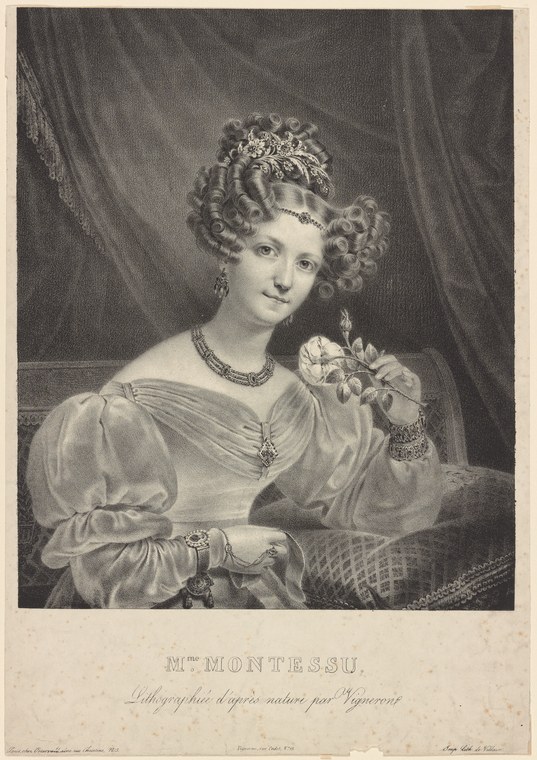
Mme. Montessu, lithographée d'après nature par Vigneron
Unknown artist
- Collection:
- Prints depicting dance
- Source:
- New York Public Library
- Rights:
- Public domain — free to use, share and adapt.
- Recorded as:
- Public Domain
The work documents the celebrity culture that surrounded theatrical performers in the Regency era and shows how lithography democratized the circulation of fashionable imagery. For dance historians, it illuminates the non-movement contexts in which dancers existed—the costume, grooming, and aesthetic ideals that shaped their public personas and how their images were commodified and distributed.
What you are looking at
A young woman is portrayed in three-quarter view against a dark, draped background. She wears an elegant high-waisted gown of fine muslin or similar fabric with voluminous puffed sleeves gathered at the wrist, characteristic of Regency-era formal dress. Her hair is elaborately styled in the fashion of the period—piled high and crowned with what appears to be a floral or jeweled ornament, with ringlets framing her face. She holds a single flower (possibly a rose) delicately in her right hand. Her left hand rests near her lap. She wears jewelry including a beaded necklace and bracelets. The background suggests an interior setting with heavy curtains or fabric drape. The overall effect is one of refined elegance and restrained grace—the pose is upright and composed, with nothing turbulent or action-filled in the moment chosen.
The dancing
The figure is seated or standing in a formal, frontal presentation pose. Her posture is upright and dignified, with shoulders relaxed and arms positioned in a graceful, unforced manner. There is no indication of active dance movement—the body is in repose rather than motion. The holding of a single flower suggests courtship or romantic sentiment rather than physical dance. Her gaze is soft and direct, meeting the viewer's eye with a slight, composed expression. This is a portrait attitude rather than a dance capture.
The dance depicted
This print does not depict active dance. The figure is posed in the conventions of a formal portrait, albeit one that celebrates elegance and feminine grace. The title identifies her as 'Mme Montessu,' a likely reference to a known performer of the period, but the work itself is a fashionable portrait rather than a representation of choreographed movement. The refined posture and costume suggest familiarity with theatrical or ballroom culture, and the print may have circulated among audiences interested in the fashionable figures of the stage or society.
How it was made
This is a lithograph, a reproductive print technique that allowed multiple impressions to be made from a stone surface. Lithography, developed in the 1790s, became the dominant medium for fashionable portraiture and celebrity imagery by the 1810s and 1820s. The notation 'lithographiée d'après nature par Vigneron' (lithographed from nature by Vigneron) indicates that Vigneron created the image from a living model or preliminary study. The tonal range and the soft modeling of form—particularly visible in the fabric and the face—exploit lithography's capacity for subtle gradations of tone. This technique made the print affordable and widely circulated among the urban middle and upper classes who followed theatrical and ballroom fashions.
About this work
This is a fashionable lithographic portrait of a woman identified as Mme Montessu, likely a performer or woman of social prominence in early 19th-century France. The work exemplifies the celebrity portraiture that flourished in the Regency period, using the new medium of lithography to distribute images of admired figures to a broad audience. Although the subject may have been a dancer or performer, the print itself is not a representation of dance in action but rather a celebration of elegance, refined dress, and fashionable feminine beauty of the era. It belongs in a dance history collection as evidence of how performers were marketed and consumed in their social and aesthetic contexts—as objects of visual desire and taste rather than as bodies in motion.
How to look at it
Observe the careful attention to textile and ornament—the subtle modeling of the muslin gown, the jeweled headdress, the floral accessory. The artist has chosen a moment of quiet composure, not movement. Notice how the lithographic technique allows for soft tonal transitions, particularly in the face and décolletage, creating an impression of luminosity and delicacy. The dark background serves to isolate and elevate the figure. The pose is entirely frontal and symmetrical, a convention of formal portraiture that emphasizes the subject's status and self-possession. This is a work designed to be admired as an object of taste, not as a record of physical action.
The artist
The artist is identified only as 'Vigneron' in the inscription, noted as having created the image 'from nature.' No further biographical data is provided in the record. The practice of crediting the lithographer but not always the original artist was common; Vigneron may have been the primary creator or may have worked after a drawing by another hand. The professionalism of the execution suggests an artist experienced in fashionable portraiture.
The period
This print dates to the Regency period (c. 1811–1820) or shortly thereafter, when lithography had recently become the dominant medium for affordable, mass-produced portraiture. Fashionable portraiture of performers was a thriving commercial genre in Paris and London. The theatrical world and ballroom culture were closely intertwined, and performers—whether dancers, singers, or actors—were celebrated as arbiters of style and beauty. The elaborate Regency silhouette visible here (high waist, puffed sleeves, ornamental hair) was the height of fashionable dress. The emphasis on refined grace and elegant repose reflects the period's aesthetic values; even images of performers tended to emphasize gentility rather than spectacle or athleticism.
Where it lives
The print is held in the New York Public Library's collection of prints depicting dance, suggesting it entered the collection because of the subject's presumed connection to the theatrical or dance world. As a lithograph, it was originally one of many impressions made from the stone and would have been widely available for purchase in its day.
Questions about this work
Is this a dancer in performance?
No. Although the subject, Mme Montessu, may have been a performer, this print shows her in formal dress at rest, not executing any dance movement. It is a fashionable portrait in the conventions of Regency society portraiture.
What is the flower for?
In the visual language of early 19th-century portraiture, a single flower held by a woman signified elegance, refinement, and often romantic or sentimental associations. It was a standard attribute of fashionable femininity.
Why is it in a dance collection if there's no dancing?
It documents how performers were represented and consumed in their era—as fashionable celebrities whose images were mass-produced and circulated. Understanding the non-dance contexts in which dancers lived and were publicly presented is part of dance history.
Who was Mme Montessu?
The record does not provide biographical details. The title suggests she was a known figure of the period, but her specific career and achievements are not documented here.
More dance artwork





