49 works in this view — arrow keys or swipe to move between them.
Dance in Art
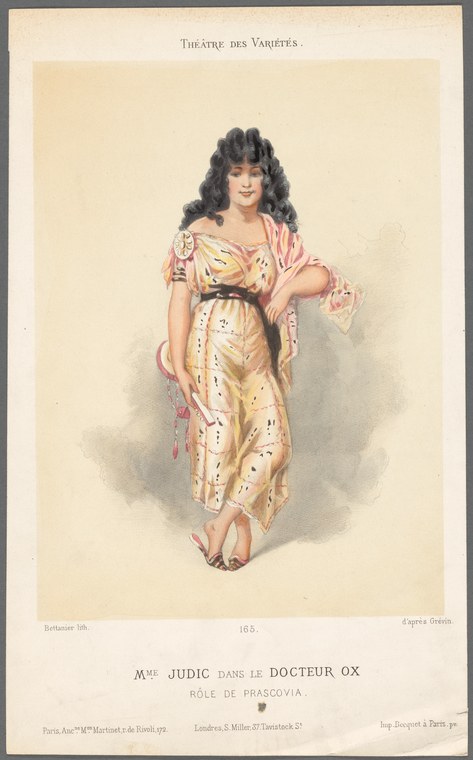
165. Mme. Judic dans Le docteur Ox, rôle de Prascovia, Théâtre des Variétés
Unknown artist
- Collection:
- Prints depicting dance
- Source:
- New York Public Library
- Rights:
- Public domain — free to use, share and adapt.
- Recorded as:
- Public Domain
This print preserves the appearance and costume of a specific performer and role in a now-forgotten operetta, offering historians a detailed visual record of late 19th-century theatrical dress, beauty standards, and the marketing of stage personalities. For researchers interested in the visual culture of theater and the intersection of fashion and performance, it demonstrates how costume design and portraiture worked together to create a performer's public identity.
What you are looking at
A single female figure stands in three-quarter pose against a neutral background, dressed in an early 1890s outfit comprising a pink short-sleeved blouse and a striking yellow skirt with a decorative pattern of small floral or ornamental motifs. A dark belt cinches the waist. Her dark, voluminous hair is styled in the fashionable waves of the period. Her left arm hangs at her side while her right arm is raised with a graceful gesture, the hand near shoulder height. Her posture is relaxed and elegant, with weight distributed evenly on both feet, suggesting a moment of posed portraiture rather than active movement. The figure occupies the upper two-thirds of the composition, rendered in soft watercolor or gouache with subtle shading that gives dimension to the fabrics and the figure's form.
The dancing
A single standing woman in an upright, dignified pose with no visible dance partner or ensemble. The raised right arm and angled torso suggest a gesture of presentation or display rather than active choreography—the kind of pose that would allow an audience to admire both the performer and the costume. The stance is frontal and stationary, with no evidence of weight transfer, elevation, or the kind of articulation that would distinguish active dance movement from theatrical presentation.
The dance depicted
The image represents a theatrical performer in costume from a stage production—in this case, the title records the role as Prascovia in *Le Docteur Ox* (The Doctor's Ox), a vaudeville operetta. The costume and pose correspond to the conventions of late 19th-century comic opera or opérette, where players presented characters in elaborate dress for the amusement of the audience. Whether Prascovia involved significant dance choreography cannot be determined from this image alone; the pose is a portrait of a character in costume rather than a capture of choreography in motion. The work belongs to the tradition of theatrical portraiture that served as both promotion and documentation of popular stage entertainments.
How it was made
This is a color lithographic print, as indicated by the soft tonal gradations, the characteristic way the background fades, and the flat areas of color typical of the medium. The delicate hand-coloring—the pink of the blouse, the yellow of the skirt—is consistent with chromolithography or hand-colored lithography of the 1880s–1890s. The artist's name is not recorded in the catalogue, but the credit line "Imp. Bourgerie à Paris" indicates the Paris printer. Such prints were produced inexpensively in quantities suitable for distribution to theaters, collectors of theatrical ephemera, and the theater-going public, functioning as both souvenirs and advertisements.
About this work
This is a theatrical costume portrait printed in the 1880s or 1890s documenting a performer in the role of Prascovia from *Le Docteur Ox*, a popular comic operetta staged at the Théâtre des Variétés in Paris. The print records the character's costume in meticulous detail—the fashionable dress, the styling, the pose—rather than capturing choreography in action. It belongs to a large body of theatrical ephemera produced to commemorate stage personalities and entertainments, and it offers evidence of how female performers in comic opera were dressed, promoted, and remembered by audiences of the period. While the work does not depict dance as movement, it documents the visual world of a theatrical tradition in which music, comedy, and spectacle were closely intertwined.
How to look at it
Look at the costume detail—the print captures the precise cut, color, and patterning of early 1890s dress in a way that a written description could not convey, and these details were central to the appeal and comedy of the character. Notice the pose: it is not an action but a presentation, the way a performer might turn toward an audience to display a costume or strike a character attitude. The soft modeling and delicate hand-coloring are characteristic of the best chromolithography of the period, and the care taken with the work suggests it was meant for a well-to-do collector rather than a street vendor.
The period
In the 1880s and 1890s, the Théâtre des Variétés was one of Paris's leading venues for comic opera and operetta—a form descended from Offenbach that emphasized colorful costumes, musical comedy, and romantic plot lines. The production and distribution of lithographed portraits of theatrical performers was a thriving industry in Paris, creating collectible images for fans and serving as advertisements for plays and players. These prints often featured elaborate hand-coloring and were priced to be affordable to a broad public, making them among the most widely circulated images of the performing arts from the period.
Where it lives
This print comes from the New York Public Library's collection of theatrical prints and ephemera, a substantial archive documenting the visual history of 19th-century theater. It is one of many such costume portraits produced by Paris printers and lithographers to document the stage productions of the period.
Questions about this work
What is *Le Docteur Ox*?
*Le Docteur Ox* was a comic operetta (opérette) first performed at the Théâtre des Variétés in Paris in the 1870s. It was based on a satirical short story by Jules Verne and featured comedic music, lavish costumes, and romantic entanglements. The character of Prascovia was likely one of the female roles in this popular entertainment.
Is this a dance image?
Not in the sense of capturing choreography or movement. It is a portrait of a theatrical performer in costume from a venue where music, comedy, and dance may all have featured, but the image itself presents a posed figure rather than action. It documents the visual and sartorial context of theater rather than the dance within it.
How were these prints made and distributed?
This is a lithograph printed in Paris (as the imprint indicates) and likely hand-colored after printing. Such prints were sold to theater patrons as souvenirs, collected by enthusiasts of particular performers, and used as advertisements in theater lobbies and print-shop windows. They were inexpensive enough to be accessible to ordinary theater-goers but fine enough to be treasured by collectors.
Why does the catalogue call this a dance image?
The collection *Prints depicting dance* is broad and includes theatrical imagery from venues where dance was performed, including operetta, pantomime, and musical comedy. While this particular image documents costume and character rather than active choreography, it belongs within the visual culture of theatrical entertainment where dance and other performance forms coexisted.
More dance artwork





