49 works in this view — arrow keys or swipe to move between them.
Dance in Art
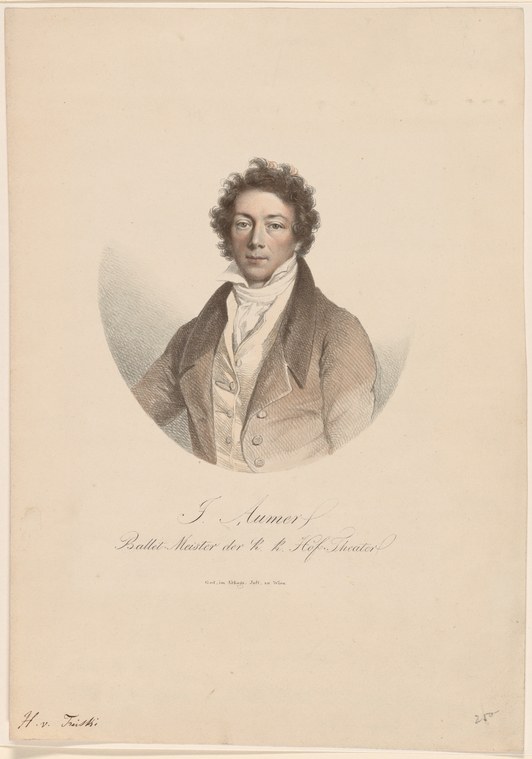
J. Aumer Ballet-Meister der R. R. Hof-Theater.: Ged. in. Lithogr. Juit
Unknown artist
- Collection:
- Prints depicting dance
- Source:
- New York Public Library
- Rights:
- Public domain — free to use, share and adapt.
- Recorded as:
- Public Domain
Jean-Louis Aumer was a major choreographer and ballet master whose work shaped Romantic ballet in Central Europe, yet he is less well-known in English-language dance history than his contemporaries. This portrait is evidence of his prominence and professional standing in Vienna during a crucial period. For historians studying the geography of 19th-century ballet and the role of court theatres in developing Romantic aesthetics, the image documents both the person and the cultural infrastructure that supported professional dance.
What you are looking at
A bust-length portrait of a man in formal early-19th-century dress, shown against a plain cream background. He wears a brown coat with a white cravat, his dark curled hair swept back from a broad forehead. The man's expression is calm and direct, his gaze meeting the viewer. The image is rendered as a lithograph in sepia tones with subtle modeling to suggest volume and the texture of fabric. The composition is tightly cropped, focusing entirely on the figure's head, shoulders, and upper torso. This is a formal commemorative portrait, not a dance scene.
The dancing
The subject is a single male figure, depicted from the chest up. His posture is upright and formal, consistent with the conventions of portraiture. There is no depiction of movement or dance position.
The dance depicted
This is not a dance image. It is a commemorative portrait of J. Aumer, identified in the inscription as Ballet-Master at the Royal Court Theatres (Kaiserliche Hoftheater). While Aumer himself was a significant figure in early-19th-century ballet—a dancer, choreographer, and ballet master—this particular artwork documents him as a person rather than depicting dance or choreography. The image belongs in a dance-related collection because of who the subject was, not because of what the picture shows.
How it was made
This is a lithograph, a print technique that allowed relatively rapid reproduction and distribution. The delicate sepia tones and careful gradations of light and shade across the face indicate skilled hand-drawing on the lithographic stone. Lithography was the dominant medium for portrait prints in the early 19th century, enabling both artistic quality and accessibility to a broader audience than oil portraiture. The technique and execution suggest this was a professional commemorative work, likely circulated among cultivated audiences in the German-speaking world.
About this work
This is a formal portrait lithograph of Jean-Louis Aumer (or J. Aumer), the prominent ballet master of the Austro-Hungarian Imperial court theatres in the early 19th century. Aumer was a dancer and choreographer of international reputation, known for his work in Vienna and his contributions to Romantic ballet. The portrait captures him as a dignified professional during the height of his career. While the image itself depicts no dance, it documents a key figure in European ballet history during a formative period for the art form. Works like this served to commemorate and publicize significant artists and helped establish the public profile of theatrical personalities.
How to look at it
This is a character study rather than a narrative image. Look at the careful rendering of texture—the weight of the coat fabric, the fine linen of the cravat, the softness of hair. Observe the artist's attention to Aumer's features: the broad brow, the composed expression, the direct gaze. The restraint and dignity of the presentation are themselves significant; this is how a major cultural figure wished to be remembered and publicly known. The formal dress and neutral background establish him as a professional of standing, not a romantic hero or a figure of spectacle.
The artist
The artist is not recorded. The lithograph is executed with considerable skill in the portrait conventions of early-19th-century German-speaking Europe. The technique and finish suggest a professional printmaker, possibly working in Vienna or another major Central European city, but without a signature or attribution details, further identification is not possible from the image alone.
The period
This portrait was created during the height of the Romantic era in ballet, a period (roughly 1830–1850) when ballet was shifting toward supernatural and exotic narratives, pointe work, and a new aesthetic of weightlessness and otherworldliness. Aumer, born in 1774, bridged the Classical and Romantic periods; he was trained in the earlier French ballet tradition but became a key figure in introducing Romantic choreography to Vienna. Early-19th-century lithographic portraiture served to publicize theatrical celebrities and cement their reputations among educated audiences. This work is contemporary with the emergence of ballet as a prestigious art form with internationally mobile stars and a cultivated public.
Where it lives
The work is held in the New York Public Library's collection of prints depicting dance. It is a commercial lithograph, designed for distribution and collection; the notation at the base indicates it was drawn and lithographed ("Ged. in. Lithogr.") in Vienna ("Juit"). The exact date is unknown, but the style and inscription conventions point to the 1820s–1830s.
Questions about this work
Who was J. Aumer?
Jean-Louis Aumer (1774–1833) was a French-born dancer, choreographer, and ballet master who had a decisive influence on ballet in Vienna. He trained under major figures of the Classical tradition and became ballet master at the Imperial court theatres, where he choreographed and staged works that introduced Romantic ballet aesthetics to Austrian audiences. He is remembered as a bridge figure between the Classical and Romantic periods.
Why is a portrait in a dance collection?
This portrait documents a historically important figure in ballet rather than depicting the art form itself. Aumer's contributions to choreography and his role in European ballet institutions make him significant to dance history. Prints like this one were used to publicize theatrical celebrities and helped establish the cultural authority of dance professionals during the 19th century.
What does the inscription mean?
The inscription reads 'J. Aumer / Ballet-Meister der R. R. Hof-Theater' — that is, ballet master of the Royal/Imperial Court Theatres. The phrase 'Ged. in. Lithogr. Juit' indicates the work was drawn and lithographed, likely in Vienna. This was a standard format for commemorative theatrical prints of the period.
When was this made?
The record does not give a date. Based on the lithographic technique, the style of dress, and the formal conventions of early-19th-century theatrical portraiture, it was likely created in the 1820s or 1830s, during Aumer's tenure as ballet master in Vienna. Aumer died in 1833, so the portrait probably commemorates him during the height of his career.
More dance artwork





