49 works in this view — arrow keys or swipe to move between them.
Dance in Art
Theatrical hornpipe?
Unknown artist
- Collection:
- Prints depicting dance
- Source:
- New York Public Library
- Rights:
- Public domain — free to use, share and adapt.
- Recorded as:
- Public Domain
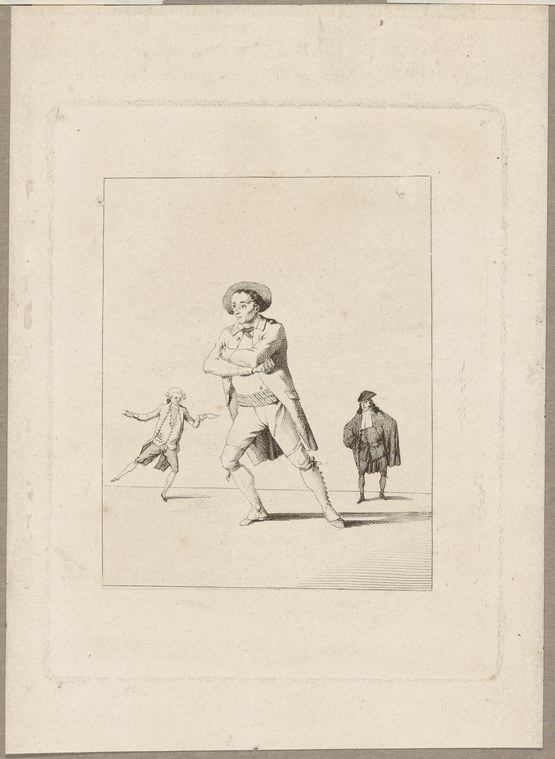
Hornpipe is one of the few social dances of the 18th century to survive into modern performance, yet most knowledge of how it was actually danced comes from rare prints like this one. The engraving shows what a trained dancer's body looked like in the moment, the carriage and frame that defined the style—information no written description can convey. For historians and performers of historical dance, such visual documents are primary sources, the closest thing we have to film.
What you are looking at
A theatrical scene rendered in fine line engraving shows three figures arranged across a shallow stage. At center stands a male dancer in profile, weight on his back leg, torso erect and arms positioned in an active frame—left arm extended forward, right arm bent across his body. He wears a buttoned coat, breeches, stockings, and a wide-brimmed hat. To his left, a smaller figure in lighter dress appears to leap or spring away from him, captured mid-movement with limbs extended. To the right stands a shorter figure in darker, more heavily shaded clothing, possibly female, watching the action. The ground is indicated by a thin baseline; the background is blank, throwing all attention onto the bodies and their disposition. The engraver has paid close attention to the articulation of joints and the tension in limbs, suggesting this depicts a real dance or a choreographed theatrical moment rather than a generic group scene.
The dancing
The central male figure exhibits the upright carriage and extended arm positions associated with trained social or stage dance of the 18th century. His stance is formal and controlled, with clear opposition between upper and lower body. The figure to the left is caught in a moment of springing motion, with both feet apparently off the ground and arms flung outward in abandon—a sharper, more dynamic quality than the centered figure. The relationship between the figures suggests an interaction: the leaping figure seems to be responding to or fleeing from the standing dancer, while the watching figure on the right may represent an audience or participant to the action.
The dance depicted
The catalogue record proposes this is a theatrical hornpipe. Hornpipe was a popular solo male dance of the 18th and early 19th centuries, typically performed in sailor's dress or civilian formal wear, characterized by precise footwork, upright posture, and sharp, controlled movement—exactly what the central figure displays. The lighter, more elastic figure to the left may represent a moment within the hornpipe sequence, or a companion dancer. The presence of three figures and the theatrical framing support a stage context. However, the specific choreographic content cannot be recovered from the print alone; we see the dress, the posture, and the implied energy, but not the actual steps. The image would have served dancers, audiences, or prints collectors as a record of how the dance looked in performance.
How it was made
This is a copperplate engraving, a medium that yields fine, even lines and allows reproduction of subtle modulation in the human form. The artist has used parallel hatching and varying line density to suggest volume and shadow, particularly in the clothing and the darker figure on the right. Engravings of this type were expensive to produce but could be printed in large editions, making them accessible to a broad audience beyond theatre-goers—dancers, choreographers, and amateurs could acquire prints as instruction or reference. The precision of the line and the formal composition suggest this was a professional production, likely part of a series or a published work about theatrical dance or entertainments.
About this work
This engraving documents a moment from theatrical dance in the 18th or early 19th century—most likely a hornpipe, a celebrated male solo that combined virtuosity with a formal, almost military bearing. The artist captures not movement itself, which engraving cannot truly render, but the arrested pose that best conveys the dance's character: the upright frame, the active arm, the springy energy of the body. Hornpipes appeared on stage and in social settings, often performed by professional dancers and sailors; this print preserves a record of how one such dancer held himself and how audiences expected to see the dance executed. The inclusion of onlooking figures suggests the theatrical context, and the fine technique implies this was a work of some commercial value, aimed at an educated audience with interest in dance and performance.
How to look at it
Attend to the stillness and geometry of the central figure's pose—the engraver has frozen the moment at the peak of tension or just after a step, when the body's architecture is most clearly visible. The contrast between this composed, upright frame and the energy of the leaping figure beside him captures the essential character of hornpipe: controlled power rather than fluidity or abandon. The formal hat, the coat, the stockings all signal a dance of social pretension and precision, not a folk or popular form. Look at the feet: though not rendered in perfect anatomical detail, they are positioned to suggest a sprung stance, ready for the next step. The artist understood not just the costume but the bearing of a trained dancer.
The period
The 18th and early 19th centuries saw a flourishing market for prints of theatrical entertainments and social dances. London and European capitals produced thousands of engravings documenting actors, dancers, and acrobats, often sold singly or in series to audiences who had seen the performance and wanted to own a memento, or who simply collected images of fashionable amusements. Hornpipe in particular enjoyed a surge in popularity during the late 18th century, performed by male dancers in both theatrical and social contexts. Prints of hornpipe dancers were common, and they document the evolution of the form from sailor's dance to polished stage entertainment. The precision and formality of this figure reflect the standards of theatrical training and the expectations of an audience accustomed to seeing dance executed with control and exactitude.
Where it lives
Held in the New York Public Library's Prints collection, this work is part of a broader archive of theatrical and dance imagery from the 18th and 19th centuries. Such prints were typically sold to the public as single impressions or in series, and their survival in institutional collections reflects their original commercial circulation and subsequent curatorial value as historical documents.
Dance in this work
Questions about this work
What is a hornpipe?
Hornpipe was a popular solo dance performed in the 18th and 19th centuries, originally associated with sailors but later adopted as a stage entertainment. It was characterized by upright posture, precise footwork, and sharp, controlled movement—the opposite of the flowing, lyrical forms emerging in ballet at the same period. Male dancers were the primary performers, and the dance was considered a vehicle for technical display and wit.
How do we know this depicts a hornpipe?
The catalogue record proposes this identification, and the image supports it: the upright carriage, the formal civilian dress with coat and hat, the male soloist in a theatrical setting, and the sharp-edged posture all match contemporary descriptions and other prints of hornpipe dancers. However, without an inscription or source document, the identification remains probable rather than certain.
Can we learn steps from this print?
No. The print captures the carriage and frame of the dancer at one moment, and suggests his energy and skill, but it cannot convey the sequence of steps or the rhythm of the movement. For detailed choreographic information, we would need a written dance notation (such as Beaumont or Feuillet notation) or a much longer sequence of images. This print tells us what the dancer looked like; it cannot teach us how to dance.
Why did people collect prints of dances?
Prints served multiple audiences: patrons who had seen the performance wanted a keepsake or status symbol; people who had not seen it wanted to visualize an entertainment they'd heard about; and dancers and choreographers used prints as reference material. Prints were also affordable compared to paintings, and could be reproduced in quantity, making them a mass medium of the period.
More dance artwork





