49 works in this view — arrow keys or swipe to move between them.
Dance in Art
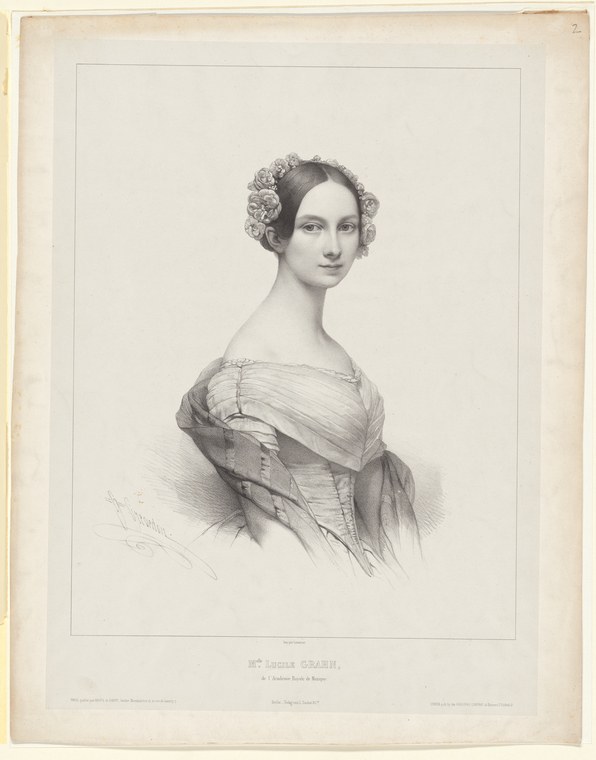
Melle. Lucile Grahn, de l'Académie royale de musique
Unknown artist
- Collection:
- Prints depicting dance
- Source:
- New York Public Library
- Rights:
- Public domain — free to use, share and adapt.
- Recorded as:
- Public Domain
Lucile Grahn was one of the principal dancers of European Romanticism and a contemporary of Marie Taglioni; this portrait is evidence of her public fame and the visual economy of celebrity that sustained the Romantic ballet. The work shows how 19th-century dance history was preserved and circulated—not through images of dancing, but through carefully crafted portraits that offered fans access to the performer's likeness and presence.
What you are looking at
A three-quarter-length portrait of a young woman in fashionable 1840s dress, shown in profile or near-profile facing left. She wears an off-shoulder gown with a fitted bodice and voluminous skirt gathered at the shoulders in the characteristic Romantic silhouette of the era. Her dark hair is arranged in elaborate curls piled at the crown and sides of her head, with ringlets framing her face in the fashion of the period. The woman's posture is upright and graceful, her shoulders drawn back in the refined deportment of a stage performer or aristocratic woman. The execution is a finely detailed engraved or lithographed portrait; the background is plain, allowing the figure and dress to dominate. The delicate stippling and line work suggest an accomplished printmaker's hand.
The dancing
A single standing female figure shown from approximately the waist up, posed in a stationary, presentational manner rather than in active movement. Her body is held with the elongated, lifted posture characteristic of trained dancers of the period—shoulders back, head poised, chin slightly raised. Her arms are not in an active dance position but rest naturally at her sides or just below waist level, consistent with formal portraiture. There is no depiction of turnout or a specific dance stance, though the overall carriage and proportions of the figure reflect the physical training expected of a professional dancer.
The dance depicted
The inscription names this as Mademoiselle Lucile Grahn of the Académie royale de musique (Paris Opera). Grahn was a renowned Danish-French Romantic-era ballerina, born 1819, who performed principal roles in the 1830s and 1840s. This is a formal portrait of the dancer in street or reception dress, not a depiction of her performing. The image belongs to the widespread 19th-century custom of circulating engraved or lithographed portraits of celebrated performers as prints for public consumption and fan collections. While it records nothing of Grahn's actual dancing, it attests to her celebrity and the visual culture surrounding the Romantic ballet star.
How it was made
This is an engraving or fine lithograph, printed from a drawn original; the technique is established from the linear hatching, stippling, and graduated tones visible throughout. The medium allowed for mass production and distribution of affordable copies to the theatre-going public and admirers. The quality of execution and the formal presentation indicate this was a commercial portrait print of professional calibre, likely sold at the theatre, through print sellers, or by subscription. The technique was ideally suited to capturing the subtle facial features and fabric textures that would enhance the celebrity and appeal of the performer.
About this work
This is a formal engraved portrait of Lucile Grahn, a celebrated Romantic-era ballerina who performed at the Paris Opera in the 1830s–1840s. It is not a dance image in the strict sense—Grahn is shown in formal street dress, posed for a conventional portrait rather than depicted in performance. However, it is a significant document of 19th-century dance culture: it records the identity and celebrity status of a major performer of the Romantic ballet period, and it exemplifies the mass-produced portraiture that surrounded the cult of the ballerina during this era. These prints were central to how audiences engaged with and remembered the stars of the stage.
How to look at it
This is a portrait, not an action image, so the viewer should attend to what the choice of pose and presentation tells us about how the subject wished to be seen and remembered. The off-shoulder gown and elaborate hairstyle would have been fashionable street dress for a woman of her standing, but the upright posture, the slight tilt of the head, and the elongated silhouette all reflect the balletic training visible in the performer's body. The artist has not attempted to show Grahn dancing, but rather to convey the refined grace and physical cultivation that her training imparted. The formal, dignified presentation was standard for celebrity portraiture of the era and would have enhanced her status.
The period
Lucile Grahn was active during the height of Romantic ballet (c. 1830–1850), when the ballerina became the central figure of European theatrical culture. The Paris Opera was the most prestigious venue in Europe, and a position there guaranteed international fame. Grahn was known for technical brilliance and expressive power in roles such as *La Sylphide* and *Giselle*. The circulation of engraved and lithographed portraits of dancers exploded during this period; they were sold as souvenirs, collected in albums, and exchanged among admirers—a form of fan culture that predates photography. The formal, idealized presentation of Grahn's portrait reflects the era's conventions of representing aristocratic and celebrated women: refined, elevated, and removed from the everyday.
Where it lives
This work is held in the New York Public Library's collection of prints depicting dance. It is a commercial portrait print, likely produced in France in the 1840s, and part of the vast corpus of theatrical celebrity portraiture that was distributed to paying audiences and collectors of the period.
Questions about this work
Who was Lucile Grahn?
Lucile Grahn (1819–1907) was a Danish-French ballerina renowned for her technical skill and expressive power. She was a principal dancer at the Paris Opera during the Romantic era and performed leading roles in works such as *La Sylphide* and *Giselle*. She was a contemporary and rival of the celebrated Marie Taglioni and remained active on stage for decades.
Why is this a portrait and not a dancing image?
Engraved and lithographed portraits of performers were made as prints for public sale and collection, not as records of their performances. These formal dress portraits were far more practical to produce and distribute than action scenes, and they served as a form of celebrity merchandise. Audiences collected them as souvenirs and as a way to feel connected to the stars they admired.
What does the off-shoulder dress tell us?
The gown shown here is fashionable 1840s day or reception wear for an upper-class woman, not stage costume. It reflects Grahn's status as a celebrated performer and woman of refinement. The Romantic-era fashion for off-shoulder styles and gathered skirts was inspired in part by the silhouettes and lightness valued in ballet costume of the same period.
How do we know this is really Lucile Grahn?
The inscription at the bottom of the print names her as 'Melle. Lucile Grahn, de l'Académie royale de musique' (Miss Lucile Grahn of the Paris Opera). Print publishers and theatres took care to identify their subjects accurately, as the subject's name was essential to the commercial value of the work.
More dance artwork





