49 works in this view — arrow keys or swipe to move between them.
Dance in Art
Der Schäffler-Tanz in München
Unknown artist
- Collection:
- Prints depicting dance
- Source:
- New York Public Library
- Rights:
- Public domain — free to use, share and adapt.
- Recorded as:
- Public Domain
This print is primary evidence for folk and guild traditions in Central European cities at a time when most dance documentation focuses on courtly or theatrical forms. It shows how organized groups used costumed, coordinated movement to claim public space and mark collective identity within urban community life—a function of dance that formal histories often overlook.
What you are looking at
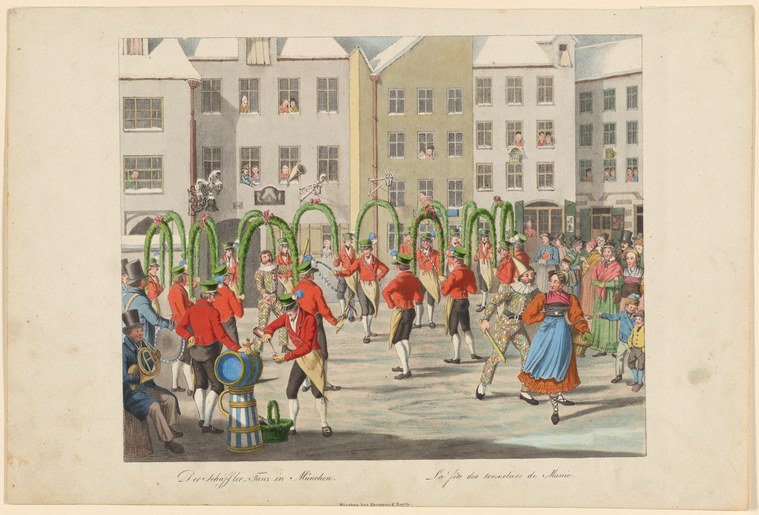
A lively street festival fills a broad urban plaza bounded by four-story residential buildings in what appears to be Munich. Dozens of figures in bright red jackets dominate the composition, arranged in loose circles and lines across the cobblestones. The red-jacketed dancers—recognizable as coopers or barrel-makers (Schäffler) by their traditional guild costume—move among onlookers in ordinary dress who line the square and cluster at windows and doorways above. A large decorative green arbor or trellis structure rises in the center, strung with garlands, creating a focal point for the revelry. The scene captures the energy of a public celebration: some figures leap or gesture expansively, children dart between the adults, and the crowd creates a sense of spontaneous communal joy. The hand-colored engraving employs pale washes of blue, ochre, and green to define architecture and costume, with the red jackets providing vivid accent against the muted urban backdrop.
The dancing
The coopers wear identical red jackets with light breeches and dark stockings, instantly marking them as an organized guild performing in ceremonial dress. Their poses are varied and energetic rather than synchronized: some stand with arms raised or extended, others appear to be in mid-leap, and still others move in loose groupings rather than formal lines. The movement reads as exuberant and improvisational rather than choreographed in the strict sense—bodies are in irregular positions, suggesting dynamic interaction with music and festive momentum rather than prescribed steps. Children and spectators move freely among and around the dancers, creating layers of participation rather than a clear separation between performers and audience.
The dance depicted
This depicts the Schäfflertanz (coopers' dance), a Munich Carnival tradition performed by members of the cooper's guild. The dance was a social and ceremonial event tied to the guild calendar, typically performed to mark important occasions or during Carnival season. The presence of the distinctive red guild jackets, the outdoor public setting, and the mixed composition of dancers and onlookers all confirm this as a folk-regional tradition specific to Munich's urban guild culture. The informality of the poses and the integration of spectators suggest this was participatory community celebration rather than formal theatrical performance, though the coordinated presence of the guild members in identical dress gave it ceremonial weight.
How it was made
This is a hand-colored engraving, identifiable by the fine parallel line-work visible at close examination and the application of watercolor or gouache washes for color. The engraving technique allowed for wide distribution and reproduction; this print format suggests it was made for popular consumption and circulation, likely sold to travelers, residents, or collectors documenting Munich customs. The scale of the plate and composition indicates a commercial print house production. Hand-coloring was a common practice for topographical and genre prints of this period, adding visual appeal while keeping production costs manageable compared to other color media.
About this work
The Schäfflertanz in Munich is a documentary print of an urban folk tradition performed by a craft guild. It records not a theatrical or courtly dance but rather a public, participatory celebration rooted in Munich's civic and commercial life. The print preserves evidence of how folk dance functioned in early modern European cities: as organized guild activity, as public spectacle drawing crowds to streets and windows, and as a form of collective identity and seasonal festivity. The image belongs in a dance archive because it documents the coexistence of multiple dance cultures—guild performance, popular participation, and street celebration—within a single urban moment.
How to look at it
The viewer should trace the arrangement of figures: note how the red-jacketed performers create nodes of activity rather than a unified formation, and observe how the spectators—both street-level onlookers and those watching from windows—are integral to the composition rather than peripheral. The artist has chosen a moment of maximum liveliness and dispersal rather than a single focal choreographic moment, capturing the festive energy and social mixing characteristic of guild celebrations. Pay attention to the green arbor structure: it anchors the composition and provides a marker of civic festivity, suggesting this is not random revelry but organized public celebration.
The period
The Schäfflertanz was performed in Munich from at least the 15th century onward, with strong revival and documentation in the 17th and 18th centuries. Guild-based folk performance traditions were characteristic of German-speaking cities during this period, where craft organizations maintained ceremonial and social functions alongside economic ones. The tradition of documenting local customs in printed form—topographical prints, genre scenes, and costume studies—grew significantly in the 17th and 18th centuries as both artistic practice and commercial enterprise, driven by curiosity about regional difference and by tourism. This print sits within a broader European culture of collecting and circulating images of 'local color' and folk custom.
Where it lives
This print is part of the New York Public Library's collection of prints depicting dance. The source record provides minimal information; the print is catalogued by subject and title rather than by artist or precise date.
Dance in this work
Questions about this work
What is the Schäffler and why did they dance?
Schäffler were coopers—barrel-makers and woodworkers—who formed a professional guild in Munich. The Schäfflertanz was a ceremonial performance the guild enacted during Carnival season and at other significant moments. It served multiple functions: it displayed the guild's collective identity and status, it claimed public space for organized performance, and it gave the broader community a role in festivity and celebration. Guild dances were a common feature of urban social life in medieval and early modern Europe.
Is this a choreographed dance or just celebration?
The image suggests something between formal choreography and spontaneous festivity. The coopers' identical red dress and coordinated presence indicate organization and group identity, but the varied body positions and loose arrangement of figures suggest the movement was energetic and improvisational rather than rigidly prescribed. This was likely a tradition with recognizable character and style, performed by a specific group, but without the kind of step-by-step choreography associated with theatrical or courtly dance.
When and where was this tradition performed?
The Schäfflertanz is documented in Munich from at least the 15th century. It was performed during Carnival and at other civic celebrations, typically in public squares. The tradition survived into the 20th century, with the modern Schäfflertanz still performed in Munich on Rosenmontag (Rose Monday) every seven years, continuing a dance practice that is now over 500 years old.
Why was this print made and who saw it?
This is a topographical and genre print documenting local Munich customs, produced for commercial distribution. Such prints were purchased by travelers, residents interested in local tradition, and collectors of European regional customs. The hand-coloring and the lively composition made it an attractive popular print—a souvenir of a specific place and its distinctive practices.
More dance artwork





