49 works in this view — arrow keys or swipe to move between them.
Dance in Art
Le carnaval de Venise
Unknown artist
- Collection:
- Prints depicting dance
- Source:
- New York Public Library
- Rights:
- Public domain — free to use, share and adapt.
- Recorded as:
- Public Domain
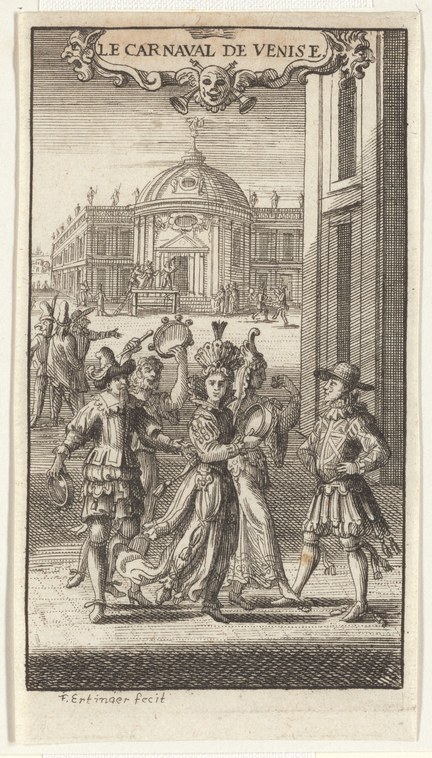
The image preserves a crucial distinction between the theatre of carnival display and choreographed dance, showing how carnival culture involved formal presentation and courtship rituals as much as movement. For historians of social dance and festive culture, it documents the aesthetic values and social hierarchies embedded in carnival society—particularly the prominence and adoration of the central female figure—that shaped the dances and entertainments of the period.
What you are looking at
An engraved scene of Venetian carnival revelry, with an architectural setting dominated by a domed building—likely representing St. Mark's Basilica or a similar Venetian landmark—visible in the middle distance. In the foreground, five figures in elaborate period costume occupy the space: at center, a woman in a richly decorated gown with voluminous skirts stands surrounded by four male attendants in contrasting dress—some in classical or military costume, others in fashion of the period. The woman appears to be the focal point of the composition, positioned as if being courted or admired. The figures are arranged in a loose, conversational grouping rather than a formal line, suggesting an informal social gathering. The engraving employs fine parallel hatching to create depth and shadow, particularly in the architectural elements and the right margin where a large pilaster frames the scene. The ground plane is minimal, with only a narrow band suggesting pavement.
The dancing
The central woman holds herself upright with an elegant bearing, her posture suggesting dignity and social prominence. Her arms are positioned at her sides or slightly gesturing, consistent with courtly decorum. The four male figures adopt varied poses around her: one gestures toward her, another stands at ease, and the composition suggests mutual social acknowledgment rather than formal coupling or group movement. None of the figures adopts a clear dance position or closed hold. The weight distribution and stances are those of standing conversation, not active dance movement.
The dance depicted
While titled as a carnival scene, this engraving does not depict active dancing but rather a formal or ceremonial moment of social interaction during Venetian carnival festivities. The carnival of Venice (Carnevale di Venezia) was a season of masked balls, processions, and theatrical performances, but this particular scene captures a static moment of courtship or social display rather than choreographed movement. The figures' poses and grouping suggest a tableau or promenade typical of carnival balls or ceremonial gatherings, where the presentation and acknowledgment of participants was as important as movement itself.
How it was made
This is an engraving, identifiable by the fine parallel hatching lines (visible especially in the background and right margin) characteristic of intaglio printmaking. The technique allowed for precise detail in costume and facial features while creating atmospheric depth through tonal gradation. Engravings of this period were widely circulated as prints, reaching a broad audience across Europe. The composition and style suggest a 17th-century production, a period when Venetian carnival imagery became increasingly popular in European print culture as both documentary record and theatrical fantasy.
About this work
This engraving documents a moment from Venetian carnival society, capturing the ceremonial presentation and social interaction central to carnival festivities rather than active dance performance. The work belongs to a significant tradition of carnival imagery in European prints, where Venice's masked balls and theatrical culture were sources of fascination and subject matter for artists across the continent. As a print, it circulated as both a record of Venetian custom and a fantasy of exotic Mediterranean revelry for viewers far from Venice.
How to look at it
Attend first to the architectural framing and its role in establishing social status and geographic specificity—the domed building signals Venice and monumentality, elevating the social scene depicted. Then observe the figure arrangement and the woman's central position: carnival's theatrical power operated through the formal presentation and visual admiration of the masked or costumed body, not through synchronized movement. The engraving technique itself—precise, detailed, circulating widely—made Venice's carnival rituals visible to audiences who could never attend them in person.
The artist
The artist is not recorded. The signature or initials at lower left appear partially legible but cannot be definitively attributed without closer technical examination. The work's style and technique are consistent with 17th-century Flemish or Northern European print production, a period when Venetian subjects were in high demand among printmakers serving a wealthy European market.
The period
This engraving dates to an era when Venetian carnival (suppressed in 1162, revived and flourishing by the 17th century) was at the height of its cultural prominence and mystique across Europe. The elaborate costumes, architectural setting, and social dynamics depicted reflect the carnival season's transformation of normal social hierarchies through masking and performance. Simultaneously, European interest in exotic or foreign spectacle—the 'Venetian carnival' as theme—drove demand for such prints, which often presented stylized or fantastical versions of carnival experience rather than documentary accuracy.
Where it lives
The work is held in the New York Public Library's Prints collection, which documents dance and carnival through historical visual materials. This is a print likely made for a general European audience, part of a broader trade in exotic and theatrical imagery.
Questions about this work
Is this actually a dance scene?
The work depicts carnival society and festive interaction, not active choreographed dance. It captures the formal social moment—the presentation, courtship, and mutual acknowledgment—that accompanied carnival balls and festivities. For carnival culture, such moments of display were as significant as movement itself.
What can we learn about actual carnival dances from this image?
The engraving shows the social context, costume, and gender dynamics of carnival rather than dance technique. It suggests that carnival was hierarchical (note the woman's prominence), mixed-gender (both male and female figures), and situated in formal urban settings. The actual dances performed at carnival balls would have been courtly forms like galliards, branles, or minuets, not carnival-specific styles.
Why was Venetian carnival such a popular subject for Northern European prints?
Venice's carnival was exotic and glamorous to Northern audiences: a season of mask-wearing, theatrical performance, and social transgression in a wealthy, powerful city-state. Prints allowed viewers across Europe to glimpse this theatrical culture. The subject matter was commercially successful and allowed printmakers to depict elaborate costume, urban architecture, and social pageantry.
More dance artwork





