49 works in this view — arrow keys or swipe to move between them.
Dance in Art
Folk and ethnic dancing in wood engravings
Unknown artist
- Collection:
- Prints depicting dance
- Source:
- New York Public Library
- Rights:
- Public domain — free to use, share and adapt.
- Recorded as:
- Public Domain
The work shows how European artists of the late 18th or 19th century imagined classical movement and pleasure, translating literary sources into visual form. For dance historians, it documents the neoclassical vocabulary of body and space—how the period understood ancient social dance and celebratory movement. The engraving's circulation as a print made these classical ideals accessible to a broad educated public, shaping how dancers and choreographers understood their relationship to antiquity.
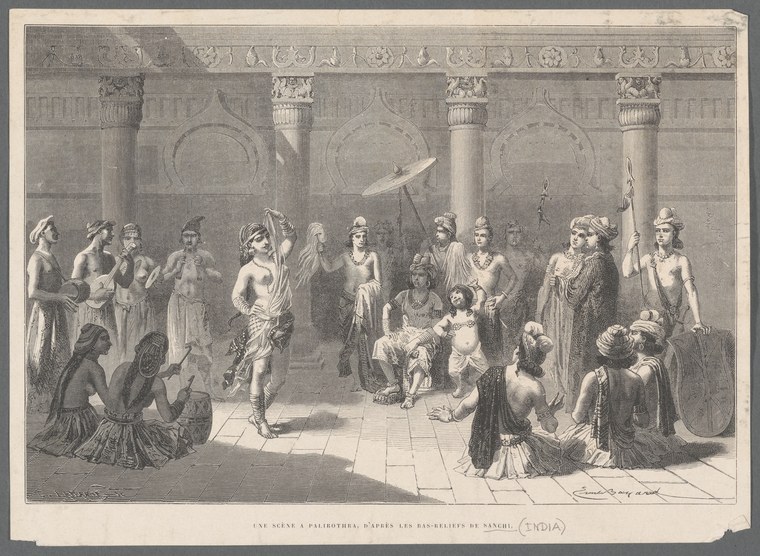
What you are looking at
A grand interior with columned architecture and ornamental frieze opens onto a scene of classical revelry. The space is crowded with figures in Greco-Roman dress arranged in loose clusters across a tiled floor. At center, a nearly nude male figure in a Phrygian cap stands with one arm raised, holding what appears to be a spear or staff, while seated and standing figures around him gesture toward him in varied attitudes of attention or abandon. The composition is densely populated: women in draped chitons and men in short tunics occupy the foreground and middle ground, some seated on the ground, others standing in conversation or apparent dance. The lighting creates a uniform gray tone across the engraving, with depth suggested through figure placement and the architectural recession of the colonnade. The scene has the character of a Dionysian revel or symposium rather than formal dance—a moment of collective pleasure frozen in a classical setting.
The dancing
The bodies are rendered with anatomical attention to musculature and drapery, characteristic of neoclassical engraving. The central male figure stands in a contrapposto stance with raised arm, dominating the composition; surrounding figures are scattered without geometric precision, some reclining, some seated cross-legged on the floor, others standing in loose groupings. The poses suggest informal, social movement rather than coordinated dance steps—raised arms, turned torsos, and casual weight shifts predominate. The drapery of the women's garments is carefully articulated, falling in classical folds that reveal the figure beneath. No couples appear to be in closed or formal hold; the overall impression is of individuals moving independently within a collective space.
The dance depicted
This appears to depict a scene from classical antiquity, most likely a Bacchanal, Dionysian revel, or symposium rather than a specific named dance form. The Phrygian cap and spear of the central figure suggest association with Dionysus or a satyr-figure. The scene captures social, celebratory movement in a mythological context rather than a codified dance style. The informality of the poses and the mix of seated and standing figures suggests this represents reveling or processional movement—what classical sources might call a komos (revel)—rather than a structured choreography. Without clear evidence of specific steps, holds, or formations, the work documents the classical vocabulary of joyous movement rather than identifying a particular dance tradition.
How it was made
This is a wood engraving, a relief-printing technique that allows fine detail through the use of end-grain hardwood blocks and burins. The technique is evident in the fine cross-hatching used for shading and the crisp lines delineating drapery and architecture. Wood engraving became the dominant medium for book and periodical illustration in the 18th and 19th centuries, allowing rapid mass production and wide circulation. The refined neoclassical style and high finish suggest this was created for a cultivated audience—likely illustrating a classical text or serving as independent print for educated collectors with interest in antiquarian subjects.
About this work
This wood engraving depicts a classical reveling scene—a Bacchanal or Dionysian komos—set within an idealized architectural interior. The composition gathers multiple figures in loosely coordinated movement, celebrating through informal gesture and dance-like spatial play rather than executing a formal choreography. The work exemplifies neoclassical aesthetic interest in recovering and imaginatively reconstructing classical leisure, pleasure, and the social rituals of the ancient world. It belongs in a dance archive not because it documents a specific dance form, but because it captures how movement, celebration, and collective joy were visualized and valued in European artistic culture—a record of what counted as dance-worthy celebration in the classical imagination.
How to look at it
Attend to the scattered, non-aligned positioning of the figures—this is not a formal ball or theatrical arrangement but a representation of spontaneous social movement. Notice the variety of poses and the emphasis on individual gesture within a collective space: the raised arms, the reclining bodies, the turned torsos. The engraver has chosen a moment of gathering rather than a moment of synchronized step, suggesting that classical pleasure was imagined as joyous informality rather than geometric precision. The architectural frame—the columns, the frieze, the tiled floor—provides a rational, ordered container for irrational, joyous movement, a tension central to neoclassical aesthetics.
The period
This work belongs to the neoclassical period's sustained fascination with Greco-Roman antiquity, intensified by archaeological discoveries at Pompeii and Herculaneum from the mid-18th century onward. European artists systematically mined classical texts and visual sources to reconstruct scenes of ancient life and pleasure. The engraving reflects the period's investment in classical dance revival—the belief that understanding ancient movement could reform or elevate contemporary practice. Simultaneously, this era saw the rise of Romantic ballet, which paradoxically used neoclassical vocabulary (tutus suggesting Greek dress, pointe work suggesting ethereal lightness) to depict otherworldly rather than historical subjects. The classical scene thus occupies a liminal space between antiquarian documentation and imaginative projection.
Where it lives
The work is held as part of the New York Public Library's collection of prints depicting dance, catalogued under folk and ethnic dancing, though the actual subject is classical antiquity. The catalogue record does not specify date, artist, or technical medium; the medium and period have been inferred from the visual evidence of wood-engraved technique and neoclassical style.
Dance in this work
Questions about this work
Is this depicting a real ancient dance?
Not a specific one. The scene is imaginative reconstruction based on classical texts and visual sources, showing what an educated European artist thought ancient reveling and celebration might have looked like. It is more useful as evidence of 18th–19th-century ideas about classical pleasure than as documentation of actual ancient practice.
Why is the figure in the center nude with a Phrygian cap?
The Phrygian cap and nudity signal association with Dionysus, satyrs, or the Bacchic tradition—classical codes for ecstatic, liberating movement and celebration. The figure appears to be the focus or catalyst of the revel, a common compositional strategy for depicting mythological festivity.
What is the dance style?
The work does not depict a named dance style but rather a komos (classical revel)—collective, spontaneous, celebratory movement within a social gathering. This represents the classical vocabulary of pleasure and social dance as imagined by neoclassical artists, rather than a specific choreographed form.
How was this print made and shared?
It is a wood engraving, a relief-printing technique that allowed fine detail and mass production. This meant it could circulate widely as an independent print, serve as book illustration, or reach educated collectors—making it a tool for spreading neoclassical ideals about classical life and movement to a broad audience.
More dance artwork





