49 works in this view — arrow keys or swipe to move between them.
Dance in Art
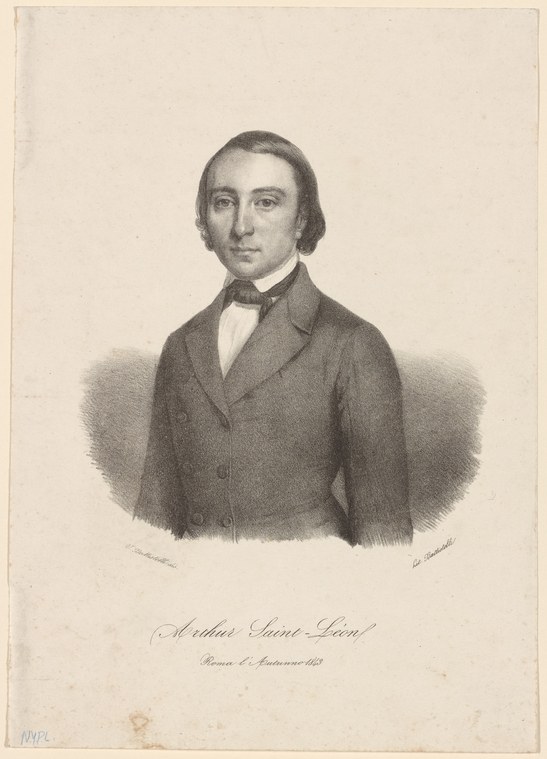
Arthur Saint-Léon. Roma l'Autunno 1843
Unknown artist
- Collection:
- Prints depicting dance
- Source:
- New York Public Library
- Rights:
- Public domain — free to use, share and adapt.
- Recorded as:
- Public Domain
Saint-Léon was a crucial bridge between Romantic ballet and its later evolution, and among the few major male choreographers of his era—his work was known across Europe. This portrait is evidence of how dancers and choreographers were documented and promoted in the 19th century: not in action, but as professional individuals. The lithographic format, the careful dress, the formal pose all speak to a deliberate construction of artistic identity and market presence.
What you are looking at
A bust-length portrait in the formal tradition of 19th-century dance documentation. The subject is a man of middle years wearing a dark velvet or wool coat with a white shirt front and dark bow tie, the standard dress of a mid-century gentleman and dance master. His hair is dark and shoulder-length in the fashion of the 1840s. The background is plain and neutral, rendered in soft gradations of grey wash that suggest a studio setting rather than a specific location. The image employs the conventions of lithographic portraiture—soft modeling, careful attention to the tonal values of fabric, and a three-quarter pose that turns the body slightly toward the viewer while the head faces forward. The inscription below reads "Arthur Saint-Léon" and "Roma l'Autunno 1843," indicating both subject and date.
The dancing
The figure is seated or positioned at rest, with no active dance movement depicted. The posture is upright and dignified, the shoulders relaxed but squared. The left arm is not visible; the right appears to rest naturally. The face is rendered with careful attention to individual features—a long nose, somewhat austere expression, direct gaze. This is a portrait of a person, not a representation of dance itself, though the sitter's profession and the date inscribed suggest documentary rather than artistic purpose.
The dance depicted
This is a portrait of Arthur Saint-Léon, a major figure in 19th-century ballet who danced and choreographed across Europe. He was known for his technical virtuosity, his work as a premier danseur and later as a choreographer, and his contributions to the development of Romantic ballet. The inscription "Roma l'Autunno 1843" (Rome, autumn 1843) suggests this was made during or after an Italian engagement. The image itself contains no depiction of dance movement or technique; it is a formal document of identity and profession rather than a record of performance.
How it was made
This is a lithograph, a process visible in the soft tonal modeling, the way the image sits in a delicate frame of handling, and the characteristic texture of the medium. Lithography allowed rapid reproduction and circulation among the theatrical world—dancers, choreographers, impresarios, and patrons could all own copies. The technique required the artist to work backwards on stone and encouraged bold but economical draftsmanship. The soft grey tones and careful modeling of the coat fabric demonstrate the medium's capacity for tonal subtlety, making it ideal for the kind of middle-market theatrical portraiture that documented the 19th-century stage.
About this work
This is a formal documentary portrait of Arthur Saint-Léon, one of the major male dancers and choreographers of the Romantic ballet era, dated to 1843 and inscribed with a location in Rome. It belongs in a gallery of dance art not because it shows dance but because it is a professional record—a lithographic portrait that circulated among the theatrical world as a form of documentation, celebrity, and market. Saint-Léon's contributions to ballet included both performance and significant choreographic works, and this image is part of the visual economy by which 19th-century dancers made and maintained their reputations. The portrait records a moment in the career of a figure who shaped how ballet developed across the 19th century.
How to look at it
Read this as a professional document first—the equivalent of a modern publicity photograph. Observe how the artist has chosen to represent Saint-Léon: not in a dramatic arabesque or theatrical gesture, but in formal dress and composed dignity. The lighting and modeling emphasize the face and the quality of the coat fabric, suggesting both respectability and distinction. The inscription is integral to the image's purpose—it anchors the likeness to a name and a date, making this a certificate of identity and place rather than a pure portrait study. The neutral background and the three-quarter pose follow conventions that would have been immediately recognizable to theater-goers as marking an important performer.
The artist
The artist is not recorded in the catalogue. However, the style and technique are consistent with professional theatrical lithography of the 1840s, produced in Rome or circulated through European theatrical networks. Such portraits were commonly made by artists attached to theaters or to the print trade rather than by major or named painters, and many remain anonymous. The quality of the work suggests a trained hand familiar with stage portraiture.
The period
In 1843, Romantic ballet was at or past its zenith in Paris but remained vital across Europe, with active seasons in London, Milan, Rome, Vienna, and other centers. Male dancers occupied an ambivalent position in the ballet hierarchy—despite their technical necessity and often their commanding presence on stage, female dancers attracted the primary attention of audiences and critics. Lithographic portraiture was the primary medium for the circulation of dancers' images; colored or plain versions would be sold outside theaters and through the print trade. Saint-Léon worked in this ecosystem of constant movement and documentation, and this portrait dates to one of his known engagements abroad.
Where it lives
The work is held in the Prints depicting dance collection at the New York Public Library, classified as a print. It entered the collection as part of a broader archival accumulation of 19th-century theatrical imagery. The inscription and catalogue data suggest it was acquired as documentary evidence of theater history rather than as a fine art print.
Questions about this work
Why is this a portrait and not a scene of dancing?
This is a professional portrait of a major dancer and choreographer, not a depiction of performance. In the 19th century, portraits in lithographic form were the primary way dancers maintained their public presence and professional identity between engagements. They functioned as publicity, as tokens of fame, and as documentary records. The formal pose and dressed appearance were conventional for such work.
Who was Arthur Saint-Léon?
Arthur Saint-Léon (1815–1870) was a French dancer, choreographer, and violinist who was one of the most prominent male ballet figures of the 19th century. He danced across Europe, partnered with famous ballerinas of the Romantic era, and choreographed important works including Giselle (revival) and La Source. He also served as ballet master at major European theaters, making him one of the few men to hold significant choreographic authority in ballet during a period when women dominated the art form.
What does "Roma l'Autunno 1843" mean?
It means "Rome, autumn 1843"—indicating where this portrait was made or inscribed. Saint-Léon traveled extensively, and this date and place mark a documented moment of his career. Rome had an active theater scene and ballet was regularly performed there; the inscription suggests this portrait was made during or immediately after a professional engagement.
Is this a famous artwork?
No—this is a working document of theatrical history rather than a major artwork. It is valuable as evidence of how 19th-century dancers were promoted and remembered, and as a record of Saint-Léon's career, but it was made as part of the print trade rather than as a fine art object. Thousands of similar theatrical lithographs were produced and circulated during this period.
More dance artwork





