49 works in this view — arrow keys or swipe to move between them.
Dance in Art
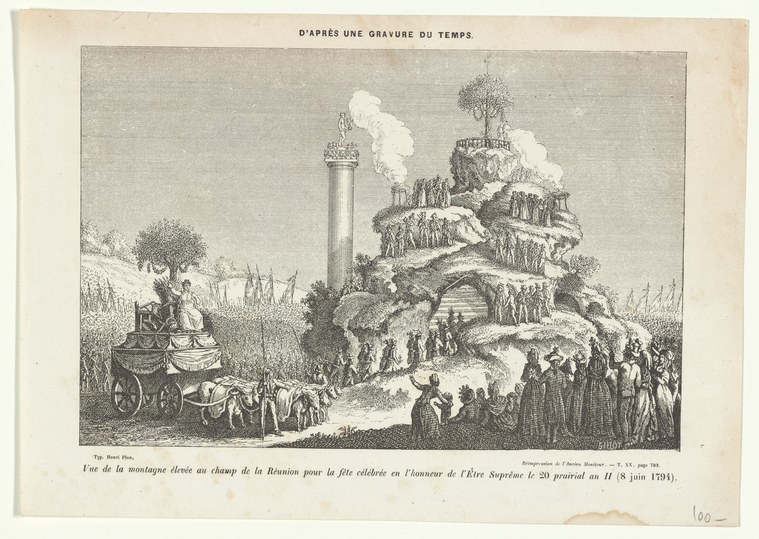
Vue de la montagne élevée au champ de la Réunion pour la fête célébrée en l'honneur de l'Être Suprême le 20 prairial an II (8 juin 1794): d'après une gravure du temps
Unknown artist
- Collection:
- Prints depicting dance
- Source:
- New York Public Library
- Rights:
- Public domain — free to use, share and adapt.
- Recorded as:
- Public Domain
Dancers and historians studying how political power has used the body, assembly, and movement will find this essential. It shows the scale and seriousness with which the revolutionary state invested in collective bodily experience as a tool of political transformation—a practice that would echo through twentieth-century mass spectacles.
What you are looking at
This engraving depicts a vast public celebration on a mountainous terrain, with crowds of figures arranged on multiple ascending levels of a constructed landscape. At the center stands a tall column or obelisk with smoke or flames rising from its summit, suggesting a ceremonial fire or beacon. The mountain itself appears to be an artificial construction—a tiered monument built for the occasion—with grouped figures stationed at various heights. In the foreground, a procession or gathering of people moves toward or around the base, while spectators line the slopes. The composition is rendered in fine engraving lines with careful attention to atmospheric perspective; the sky is stormy or dramatic, and the entire scene conveys the scale and solemnity of a state ceremony. The title indicates this records a specific event: the celebration of the Supreme Being on 20 Prairial, Year II of the Revolutionary calendar (8 June 1794).
The dancing
The human figures are rendered at a small scale appropriate to the vast architectural and landscape composition, making individual gesture difficult to discern, but they are grouped in organized formations suggesting processional or ceremonial movement rather than social dance. Figures appear to be standing, walking, or arranged in loose congregations rather than in closed holds or formal dance positions. The scale and formality of their arrangement—massed groups on terraces—suggests civic assembly rather than couple-based or partner dancing. No visible footwork, turns, or dance-specific body positions can be distinguished at this resolution and scale.
The dance depicted
This engraving does not depict theatrical or social dance. It records a civic spectacle—a revolutionary festival celebrating the Cult of the Supreme Being, an episode in the Terror under Robespierre. The event involved processional movement, massed assembly, and ceremonial rather than choreographed dance performance. While revolutionary festivals occasionally incorporated sung or processed movement, this image emphasizes architecture, crowds, and the symbolic flame rather than dance as an art form. The work is a document of political ritual, not dance documentation.
How it was made
This is a copper engraving, identified as 'd'après une gravure du temps' (after a contemporary engraving)—meaning it is itself a print after an original contemporary print, likely from 1794 or shortly after. The technique uses fine parallel and cross-hatched lines to create tone and shadow, allowing for subtle gradation in the sky and landscape and fine rendering of small figures across a complex composition. This method of reproduction—engraving after engraving—was standard for disseminating images of significant public events, making copies available to a educated readership across France and Europe. The reproduction as an engraving (rather than preservation of a painting or drawing) indicates this was meant for print circulation and documentary purposes.
About this work
This engraving records a specific historical spectacle: the Festival of the Supreme Being celebrated on the Champ de la Réunion in Paris on 8 June 1794, during the French Revolution's Reign of Terror. The image shows the constructed mountain, ceremonial flame, and assembled crowds that constituted this revolutionary civic ritual. While not a depiction of dance proper, the work documents the role of bodily assembly, processional movement, and public gathering in revolutionary political theater—a context in which the boundaries between dance, procession, and ceremony become permeable.
The work belongs in a gallery of dance in art because it captures a moment when the state choreographed human bodies en masse for political meaning. Revolutionary festivals drew on courtly and theatrical traditions of spectacle while rejecting aristocratic culture, and they employed music, song, movement, and visual symbols to constitute a new kind of civic body. This engraving records the architectural and crowd-based dimensions of that project.
How to look at it
Attend to the composition's emphasis on scale and arrangement over individual bodies: the artist chose a distant viewpoint that makes the human figure legible only as part of a massed group, reinforcing the revolutionary ideology of collective will. The dramatic sky and the tall central flame draw the eye upward, making the monument and its symbolic fire the true subject rather than the people. Notice how the engraver's technique—fine cross-hatching—renders atmosphere and grandeur rather than physiognomy or individual gesture, appropriate to a document of state spectacle rather than social behavior.
The artist
The artist is not recorded in the catalogue. The engraving is identified as 'after a contemporary engraving,' suggesting it is a secondary print made to circulate an image of the event beyond the original documentation. Such reproductive engravings were common practice for major public events and were often created by professional print shops rather than a single identified artist.
The period
The Festival of the Supreme Being in June 1794 was one of the last great civic spectacles of the Reign of Terror, orchestrated by Robespierre and the Committee of Public Safety as part of the revolutionary project to replace Catholic ritual with civic religion. The festival drew on French traditions of court ballet and royal spectacle while inverting their purposes—substituting the people and reason for the king and God. Revolutionary festivals were designed as total sensory experiences: music, song, processional movement, visual monumentality, and crowd participation merged to create what historians now recognize as choreographed civic ritual. This engraving, made in the immediate aftermath, was part of the effort to memorialize and circulate the image of the revolution's achievement.
Where it lives
The work is held in the New York Public Library's Prints collection as part of their holdings of prints depicting dance. The catalogue identifies it as a contemporary or near-contemporary engraving after an original print recording the event; the exact publication date and printmaker are not recorded.
Questions about this work
Did the French Revolution involve dance?
Yes, but differently from courtly tradition. Revolutionary festivals involved processional movement, mass gathering, and what we might now call choreographed assembly, but they rejected the aristocratic forms of ballet and social dance. The revolution created new civic rituals that used the body collectively rather than as an art of individual virtuosity.
What is the Cult of the Supreme Being?
It was Robespierre's attempt to replace Catholic religion with a civic religion based on reason and virtue. The Festival of 8 June 1794 was its public inauguration, held on the Champ de la Réunion (Field of Reunion) in Paris. Within weeks, Robespierre was executed; the cult did not survive him.
Why is this in a dance collection if it is not dance?
Because it documents how states and societies have used organized human movement for meaning-making. The distinction between dance, procession, ceremony, and crowd control is historically and culturally specific. This image shows a moment when political power choreographed large numbers of bodies to constitute a new kind of social order.
More dance artwork





