49 works in this view — arrow keys or swipe to move between them.
Dance in Art
Maypole dance
Unknown artist
- Collection:
- Prints depicting dance
- Source:
- New York Public Library
- Rights:
- Public domain — free to use, share and adapt.
- Recorded as:
- Public Domain
Maypole dances represent one of the few folk dance traditions recorded in sufficient detail to show us the actual body mechanics of historical popular dance. This engraving is valuable because it freezes the exact moment of the spiral pattern—the hold, the direction of travel, the posture, the spatial relationship to the pole—in a way that verbal descriptions alone cannot convey. For historians of social dance and festival culture, it documents a practice that has left almost no other visual record.
What you are looking at
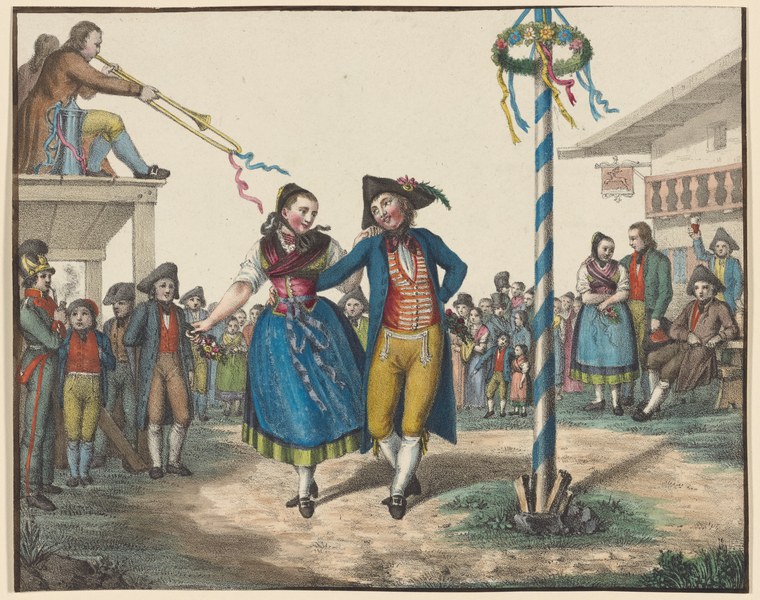
A festive outdoor scene centered on a tall maypole decorated at its crown with flowers and ribbons in blue, green, and red that stream downward. A young couple in fashionable 18th-century dress dances in the foreground: the woman wears a blue skirt with a red bodice and white fichu, while the man wears a yellow waistcoat, dark coat, and breeches. They are linked by a ribbon attached to the pole, performing the characteristic figure-eight or spiral pattern of maypole dancing. Around them stands a crowd of onlookers—men, women, and children in period dress—watching from a loose circle. The setting appears to be a village or town square, with classical architecture including a columned portico and balustrade visible on the right. A trumpet player sits elevated on a stone pedestal or plinth at the left, providing music. The scene is rendered in hand-colored engraving with careful attention to fabric textures, period dress details, and the play of light across the figures.
The dancing
The two central dancers are shown in the middle of their spiral path around the pole, their bodies angled outward from the center as they turn. The woman's skirt is caught mid-swirl, showing the full arc of her movement. Both dancers hold the ribbons lightly, their arms extended at shoulder height, and their posture is upright and graceful—the man's weight appears to shift forward into the turn. The crowd is rendered as individual figures rather than a mass, with clear faces and varied postures of attention and pleasure, suggesting this was a participatory social occasion rather than a staged performance.
The dance depicted
This is a maypole dance, a folk celebration recorded here in what appears to be an 18th-century European setting. Maypole dancing was primarily a spring fertility festival and community occasion, performed by villagers of all classes around a central decorated pole. The couple shown here is performing the spiral weaving pattern characteristic of the tradition, in which dancers holding ribbons walk around the pole in alternating directions, creating interlocking geometric patterns. The image captures not the final interwoven result but the active moment of the dance itself, with the ribbons still untwined and the dancers mid-turn. The presence of the trumpeter and the formal crowd suggest this was a public, semi-ceremonial occasion even in its recreational context.
How it was made
This is a hand-colored engraving, a commercial print medium of the 17th–18th centuries. The fine parallel lines visible in the background and shading indicate engraved copperplate work; the hand coloring—applied in translucent washes—suggests this was a moderately priced popular print, more expensive than a plain engraving but far cheaper than an oil painting. The technique allowed for rapid reproduction and wide circulation, making this the kind of print that documented contemporary customs and festivals for a broad urban audience. The quality of the engraving and coloring suggests a professional print shop rather than folk art, indicating the maypole had sufficient cultural cachet to merit commercial reproduction.
About this work
This hand-colored engraving documents a maypole dance in what appears to be an 18th-century European town or village setting. The image captures the moment of active performance: two dancers spiral around a flower-crowned pole while townspeople watch and a trumpeter provides music from an elevated platform. Maypole dancing was a seasonal folk celebration tied to spring fertility rites, performed communally across social ranks. The print serves as a record of popular custom and public festivity in the early modern period, showing how a pre-Christian ritual was incorporated into the European social calendar and commemorated in commercial visual culture.
How to look at it
Watch the spiral created by the ribbon paths: the artist has caught the moment when the dancers are mid-turn, their bodies angled outward from the pole, creating the optical illusion of the interlocking pattern that would result from sustained repetition. Notice how the woman's skirt motion is rendered as a volume of fabric rather than a sharp outline, conveying the actual weight and momentum of the turn. The elevation of the trumpeter and the arrangement of the crowd create a kind of theater-in-the-round, positioning the viewer as a participant in the festivity rather than a distant observer.
The period
Maypole dancing is a pre-Christian spring fertility rite that persisted through the medieval and early modern periods across northern Europe, particularly in England and Germanic territories. By the 18th century, when this print was made, it had become primarily a recreational community event, though some of its ceremonial character remained. The period saw a surge of interest in documenting national customs and folk practices, particularly among urban commercial print publishers who catered to a growing middle-class audience curious about rural traditions and manners. This engraving is part of that broader documentary impulse—a visual record of 'the people's' pastimes for an urban, literate audience.
Where it lives
This work is held in the New York Public Library's collection of historical dance-related prints. It is catalogued under the general rubric of 'Prints depicting dance' with minimal metadata, suggesting it entered the collection as part of a broader acquisition of 18th-century social documentation rather than as a specifically identified artifact.
Dance in this work
Questions about this work
How did maypole dancing actually work?
Dancers held ribbons attached to a central pole and danced around it in opposite directions, creating interlocking patterns. The woman and man shown here are performing the fundamental figure-eight spiral motion that, repeated many times by multiple dancers, would weave the ribbons into a dense geometric lattice around the pole. After the dance, the ribbons would be unwound in reverse, returning the pole to its original state.
When and where was this print made?
The costume, engraving technique, and hand coloring are consistent with 18th-century European commercial prints, likely from the 1750s–1800s. The classical architecture and urban setting suggest a Northern European context, possibly German or English, though the artist is unknown. The print's presence in the NYPL collection indicates it was imported to or circulated in North America by the early 20th century.
Was maypole dancing a serious ritual or just entertainment?
Both. By the 18th century, maypole dancing had become primarily a festive community occasion and social entertainment, particularly for young people. However, its roots in spring fertility rites and pre-Christian seasonal ceremony remained culturally present. The presence of the town's civic architecture and the formal trumpet music in this print suggest that even as 'folk entertainment,' it retained a degree of ceremonial significance in community life.
More dance artwork





