49 works in this view — arrow keys or swipe to move between them.
Dance in Art
La danza de cani
Unknown artist
- Collection:
- Prints depicting dance
- Source:
- New York Public Library
- Rights:
- Public domain — free to use, share and adapt.
- Recorded as:
- Public Domain
The print captures a moment in which dance was understood not merely as an art form or social practice, but as a vehicle for satire and social commentary. It reveals how 18th-century European print culture used the body and movement—especially the bodies of dancing figures—to create humor and critique. For historians of print culture and popular entertainment, the work documents the visual language through which ordinary people engaged with and mocked the fashions and rituals of their own time.
What you are looking at
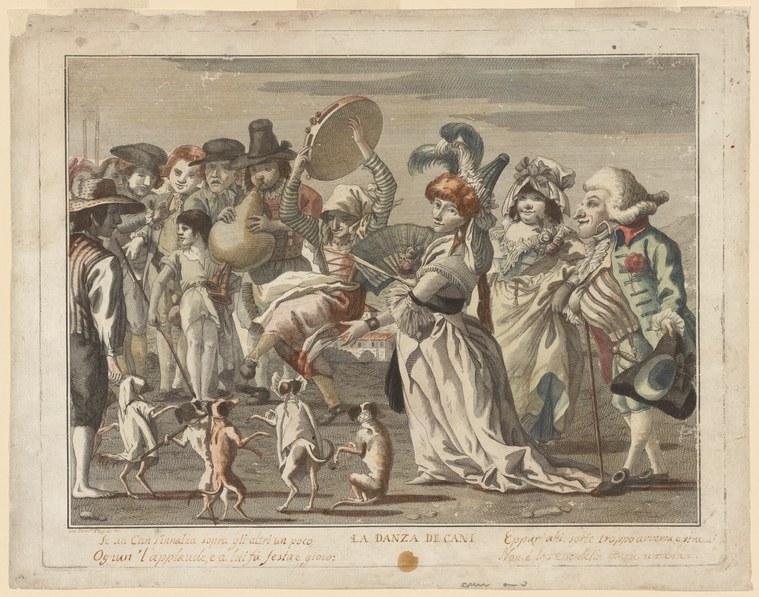
A lively street or garden scene populated by approximately fifteen figures of mixed social station, gathered in loose formation around two central dancers. The composition is crowded and animated, with musicians and onlookers arranged informally across the foreground and middle ground. The two principal dancers—a woman in a long pale dress with a large hat and a man in breeches and coat—occupy the center, accompanied by smaller figures (possibly children or dogs) at their feet. The woman holds her skirt dramatically, the man gestures with raised arm. The setting appears to be outdoors in daylight, suggested by the pale sky. The print's surface is dense with cross-hatching and fine linear detail, typical of 18th-century engraving technique. The overall impression is of a satirical or ethnographic genre scene: the title 'La danza de cani' (The Dance of Dogs) suggests this is a burlesque or mockery, and the small animal figures at the dancers' feet reinforce this reading.
The dancing
The male dancer leans into the movement with one arm raised expressively, the other held at his side; his posture suggests a gallant, courtly bearing despite the ludicrous subject. The female dancer faces him with her considerable skirt lifted or gathered, a pose common in 18th-century country and comic dances. Their relative positioning suggests a partnered dance, though not in a closed ballroom hold—rather a loose, playful spatial relationship. The surrounding figures watch with varied attitudes of amusement or indifference; none are engaged in the primary action. The small quadrupedal forms at the dancers' feet (whether dogs or other animals) are essential to the composition's meaning and are integral to the scene's comic thrust.
The dance depicted
This is almost certainly a satirical print depicting a popular country or carnival dance of the 18th century, rendered absurd by the substitution of dogs (or the implication of canine participation) for human dancers or companions. The print's title and composition suggest it is a mockery of a real dance form, probably one of the livelier European folk or social dances of the period—possibly a variant of the Cotillon, Contredanse, or similar divertissement. The dress and setting place it in 18th-century Europe, likely France given the French title. The dance itself cannot be precisely identified from movement alone, but the loose partnering, outdoor setting, and comic treatment are consistent with country dances or street entertainments of the era.
How it was made
This is a hand-colored engraving, recognizable from the fine parallel line work (hatching and cross-hatching) that defines form and shadow, the delicate outlines, and the evidence of hand coloring in the figures' garments and flesh tones. Engravings of this period were printed from a copper plate incised with a burin, allowing for fine detail and wide circulation; the hand coloring was applied after printing, making each impression unique in its palette. This technique was the dominant means of reproducing satirical and genre imagery in 18th-century Europe, enabling both artistic quality and mass distribution. The print's condition—visible wear, foxing, and the browning of the paper—is consistent with age and long handling.
About this work
This is an 18th-century hand-colored engraving depicting a burlesque or satirical dance scene centered on two costumed dancers in an outdoor setting surrounded by onlookers and animals. The title 'La danza de cani' (The Dance of Dogs) indicates a popular print, likely French, intended to mock or amuse through the juxtaposition of courtly or social-dance conventions with low-comedy subject matter. The work belongs to a tradition of genre and satirical prints that used dance as a vehicle for social commentary and entertainment. It documents not a specific historical dance style, but rather the 18th-century appetite for prints depicting human folly, courtship rituals, and the collision between genteel pretension and comic reality.
How to look at it
Attend first to the two central figures and their stance relative to one another: the artist has frozen a moment of dynamic movement, with the woman's skirt caught in mid-lift and the man's body angled forward. Notice how the surrounding figures—musicians, onlookers, and the small animals—are distributed to frame and contextualize the dancers without overwhelming them. Observe the fine linear detail in the engraving and the way hand coloring has been applied to distinguish social rank and character (the dancers are brightly colored, the onlookers more muted). The composition's apparent casualness—the loose grouping, the outdoor setting, the mixed company—is itself a satirical device, contrasting with the formality of courtly dance imagery.
The period
This engraving dates to the 18th century, when hand-colored engravings were the primary medium for the mass distribution of satirical, genre, and topical imagery across Europe. The period saw an explosion of prints depicting dance, courtship, carnival, and street life, often with a moralistic or mocking intent. Such prints were affordable, collectable, and widely circulated, making them vehicles for both artistic expression and popular commentary. The fashion for 'genre' prints—scenes of rustic life, street entertainments, and social folly—was at its height, particularly in France and the Low Countries. Dance scenes, whether courtly or comic, were popular subjects because they combined visual interest with opportunities for satire and moral instruction.
Where it lives
The print is held in the New York Public Library's collection of prints depicting dance. The sparse catalogue record suggests it is part of a broad genre collection rather than a well-documented individual work, consistent with 18th-century satirical prints, which were often made in series or sets and circulated widely without systematic attribution or cataloging.
Dance in this work
Questions about this work
What does 'La danza de cani' mean?
'The Dance of Dogs'—a title that signals satire. The print mocks human dancers and courtly pretensions by associating them with dogs, a common device in 18th-century comic prints. Whether the dogs are literally present or metaphorically implied (the dancers are behaving like dogs) is ambiguous, which is part of the humor.
Is this a real dance or a made-up joke?
The underlying dance is likely real—probably a country dance, contredanse, or carnival entertainment of the 18th century. The print does not invent the dance; it ridicules it by recontextualizing it in a comic or degrading scenario. This was a standard satirical strategy.
Who made this print and when?
The artist is unknown, and the date is unrecorded in the catalogue. From the style, technique, and fashion depicted, it was almost certainly made in the 18th century, likely in France or the Low Countries, where such satirical genre prints flourished. The hand-coloring and engraving technique place it before lithography's rise in the early 19th century.
Why should I care about a silly old print?
Because it shows how ordinary people in the past used imagery—cheaply made, widely distributed prints—to comment on their own world and on dance itself. It documents the link between dance, humor, and satire, and reveals that the mockery of dance and dancers is not modern; it is centuries old.
More dance artwork





