49 works in this view — arrow keys or swipe to move between them.
Dance in Art
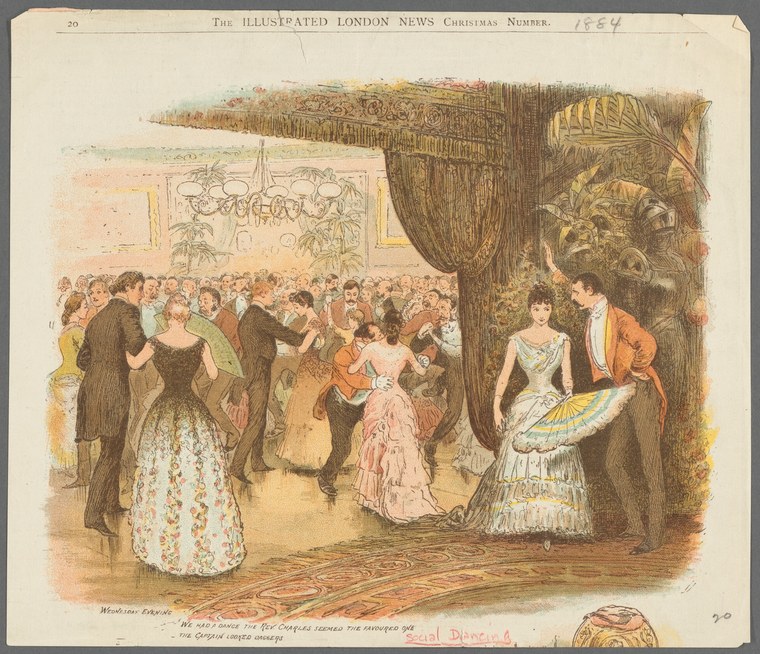
Wednesday evening, We had a dance, the Rev. Charles seemed the favoured one, the captain looked daggers
Unknown artist
- Collection:
- Prints depicting dance
- Source:
- New York Public Library
- Rights:
- Public domain — free to use, share and adapt.
- Recorded as:
- Public Domain
This work documents the waltz not as a choreographic innovation but as a site of social performance and gender negotiation in Victorian Britain. For dancers and historians, it is evidence of how the ballroom functioned simultaneously as pleasure, courtship ritual, and staged observation—a context in which the dance itself was inseparable from its social meaning.
What you are looking at
A crowded ballroom scene rendered in hand-colored engraving or lithograph shows a formal dance in progress, likely from the mid-Victorian era. The composition is dense with figures: in the foreground, a woman in a floral-patterned white gown dances with a man in dark coat and orange waistcoat, while behind them a crowd of elegantly dressed guests mills about the room. Some couples are actively dancing in the middle ground; others stand in conversation or observation. The setting appears to be a grand interior with draped curtains visible at upper right and what may be decorative garlands or wreaths on the walls. The lighting is warm and diffuse, created by hand-coloring in ochres, pinks, and pale greens that give the scene a festive, intimate quality despite the crowd. The artist has captured a moment of social animation—several figures gesture in conversation, one man appears to lean in with particular interest toward a woman in pink, and the overall mood is one of flirtation and social complexity rather than pure dance spectacle.
The dancing
The principal couple in the foreground occupies a closed ballroom hold: the woman's right hand rests on the man's shoulder, his left hand at her waist, their bodies aligned in the standard position for Regency and Victorian-era social dance. The woman's weight is balanced, her skirts allowing the full turn of a waltz or polka. Around them, other couples adopt similar frames, their bodies tilted slightly toward each other in the characteristic stance of couple-dances of the 1840s–1860s. The crowd behind creates a sense of multiple simultaneous interactions rather than coordinated group choreography—some figures stand upright in observation, others lean together in conversation, creating a social rather than formal geometric arrangement.
The dance depicted
This is almost certainly a depiction of a Victorian-era ballroom waltz or possibly a polka, the dominant couple-dances of the mid-to-late nineteenth century among the British upper and middle classes. The closed hold, the woman's gown, the formal dress code, and the stated context of a Wednesday evening social gathering all point to domestic ballroom dancing of the 1850s–1870s. The image captures the waltz not as choreographic spectacle but as social ritual—a framework for courtship, conversation, and the negotiation of rank and affection. The caption's reference to "the Rev. Charles" and "the captain" suggests the dance functioned as a stage for the kind of social drama the image depicts: the tension between competing suitors, the woman's choice of partner, and the observation of that choice by others in the room.
How it was made
This is a hand-colored engraving or chromolithograph, a reproductive medium that allowed wide circulation among the educated classes. The technique required separate printing plates or stones for each color layer, then hand-finishing—visible in the loose, watercolor-like application of the ochres, greens, and pinks that warm the scene. This combination of mechanical precision in the line work and the spontaneity of hand-coloring was typical of commercial reproductive prints of the 1850s–1870s, designed for middle-class collectors and periodical readers. The Illustrated London News, from which this print derives, used such techniques to bring topical and domestic scenes into homes across Britain with speed and affordable cost.
About this work
This is a mid-Victorian social scene depicting a ballroom dance, likely a waltz or polka, rendered as hand-colored engraving from the pages of The Illustrated London News. The work captures a specific narrative moment—a woman's choice of dance partner observed by others in the room—rather than an abstract celebration of dance itself. It is a document of how the waltz functioned in British middle-class society: not as performance or instruction, but as a legible code through which courtship, rank, and social judgment were simultaneously enacted and witnessed.
The image belongs in a gallery of dance because it shows dance as social practice rather than formal art, and because it preserves the visual language of the ballroom in a period when that language was being codified, disputed, and vigorously circulated through print culture. It reveals what dancers and observers of the period understood: that the choice of partner, the quality of the hold, and the presence or absence of animation in the dance were all meaningful statements in a crowded room.
How to look at it
Look first at the principal couple in the foreground and the precision of their hold—the woman's right hand on the man's shoulder, the alignment of their bodies—which tells you this is a formally governed dance, not folk or improvised movement. Notice how the artist has frozen not the spectacle of the dance itself but the social moment around it: the crowd's attention, the geometry of looking, the way bodies orient toward or away from the dancing pair. The background figures, some dancing and some observing, create a kind of parallel narrative—this image is about the dance as social theater, where what matters is not technical excellence but the drama of choice and observation.
The period
The waltz arrived in Britain from Continental Europe in the early 19th century amid considerable moral controversy about its close hold and the physical proximity it required between partners. By the mid-Victorian period depicted here, it had become firmly established as the dominant couple-dance in ballroom society, though it remained a site of social attention and comment. The Illustrated London News, founded in 1842, made such domestic scenes—balls, garden parties, and social gatherings—a staple of its weekly illustrations, creating a vast archive of middle-class visual culture and establishing the ballroom scene as a recognized subject in popular prints. The period saw the waltz's gradual professionalization through dance instruction manuals and the codification of strict rules about position and movement, even as social ballroom dancing remained largely improvisational within the basic frame.
Where it lives
This image is part of the New York Public Library's collection of prints depicting dance, sourced from The Illustrated London News, a weekly periodical that circulated widely among British and American middle-class readers during the mid-to-late nineteenth century. It is a documentary artifact of ballroom culture as well as an artwork—part of a vast archive of engraved social scenes that defined visual representation of dance in the period.
Dance in this work
Questions about this work
What dance are they doing?
Most likely a waltz, the dominant couple-dance of the mid-Victorian ballroom. The closed hold—with the woman's right hand on the man's left shoulder and his right hand at her waist—and the formal dress suggest the waltz as it was danced in British society rooms of the 1850s–1870s. The image does not show the footwork or turning in detail, but the positioning and the context of a formal evening gathering make the waltz the most probable identification.
What does the caption tell us?
The caption—"Wednesday evening. We had a dance. The Rev. Charles seemed the favoured one. The captain looked daggers"—reframes the dance as a social drama of romantic competition. The woman dancing in the foreground has chosen "the Rev. Charles" as her partner, and another man (presumably "the captain") watches with jealous disapproval. The dance, in other words, is readable as a coded statement about preference and social standing.
Why was this image printed in The Illustrated London News?
The Illustrated London News published weekly engravings of topical and domestic scenes to a broad readership. Social gatherings and balls were regular subjects because they interested middle-class readers, offered opportunities for depicting fashionable dress and interior decoration, and provided narrative drama. This image participates in a long tradition of ballroom scenes in popular printmaking, serving both as entertainment and as a kind of visual conduct manual for ballroom behavior.
How was this image made?
The work is a hand-colored engraving or early chromolithograph, a technique in which line work was created through engraving or lithographic stone, then colored by hand or through additional printed layers. This made it reproducible and affordable enough for periodical circulation, while the hand-coloring gave each impression slight variations and a warmer, more intimate quality than black-and-white reproduction would have allowed.
More dance artwork





