49 works in this view — arrow keys or swipe to move between them.
Dance in Art
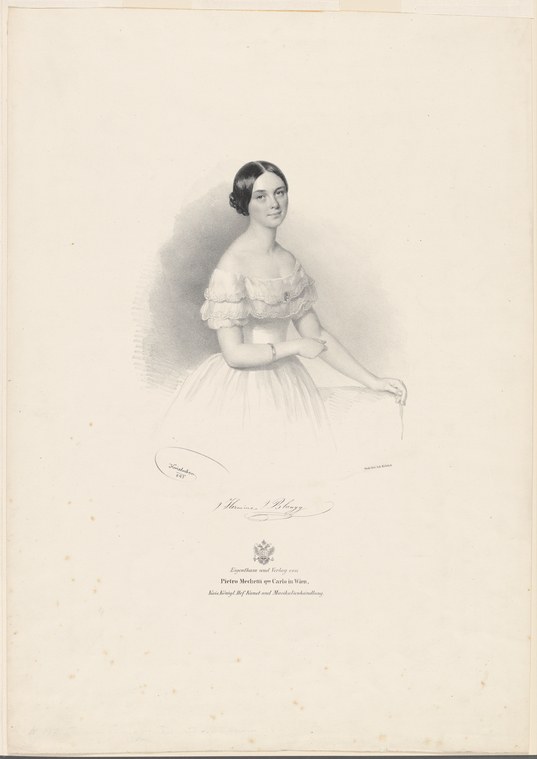
Hermine Blangy [facsimile signature]
Unknown artist
- Collection:
- Prints depicting dance
- Source:
- New York Public Library
- Rights:
- Public domain — free to use, share and adapt.
- Recorded as:
- Public Domain
Hermine Blangy was a significant dancer of the 1840s–50s; this print is primary evidence of her fame and of how dancers' likenesses were monetized and distributed during the Romantic period. The image reveals the conventions of how female performers were posed, dressed, and presented to the public eye—often in refined, desexualized portraiture rather than in action—and what that framing meant for how dancers were perceived as artists versus celebrities.
What you are looking at
A three-quarter-length portrait of a woman in mid-nineteenth-century dress, shown seated in a graceful pose against a plain background. She wears a white ball gown with a low, off-shoulder neckline and puffed sleeves typical of the 1840s–50s, with a full skirt that extends to the floor. Her dark hair is parted in the center and pulled back smoothly. Her right arm rests lightly on her lap while her left arm extends downward in an elegant, relaxed gesture. The figure is rendered in fine stippled tones that create soft modeling and depth; the fabric of her dress is indicated with delicate line work. A facsimile signature reading "Hermine Blangy" appears below the composition in script. The work is a steel engraving or lithograph, characteristic of the mid-Victorian portrait print trade.
The dancing
The figure is seated in a composed, symmetrical pose with an upright but unstudied posture. Her shoulders are level and relaxed; her arms hang naturally, one bent and resting, the other extended with the hand visible. The overall carriage is one of elegant repose rather than active movement. The pose suggests either a formal portraiture session or a moment of stillness, rather than mid-performance or mid-step. Her face is turned slightly toward the viewer with a calm, forward-focused gaze.
The dance depicted
While the sitter is identified by the signature as Hermine Blangy, a known dancer of the Romantic ballet era, this is a formal portrait rather than a depiction of dance itself. The dress, pose, and setting are those of mid-Victorian portraiture convention. There is no indication of choreography, partnering, or active movement. If Blangy was a professional dancer, this image documents her as a social figure, not as a performer in motion or costume.
How it was made
This is a steel engraving or lithograph from the mid-nineteenth century, executed in fine linear work and stippling to create tonal gradation. The technique allows for subtle modeling of the face and drapery and indicates a work produced for commercial distribution—likely a popular print sold individually or bound in albums of theatrical celebrity portraits. The facsimile signature suggests a promotional or authenticated reproduction. The delicate handling and finish indicate work by a skilled reproductive printmaker rather than direct drawing.
About this work
This is a mid-Victorian portrait print of Hermine Blangy, a dancer known to the London and European stage. It belongs in a dance archive not because it depicts dance itself, but because it documents a historical performer and the conventions of how dancers were marketed and consumed as public figures during the Romantic ballet era. The image sits at the intersection of theatrical celebrity, printmaking commerce, and the cult of the prima donna that drove mid-nineteenth-century popular culture. Portrait prints like this circulated widely among opera and ballet enthusiasts and served as both souvenirs and advertisements.
How to look at it
Attend to the pose and its deliberate restraint. Unlike later photographs of dancers, which often attempted to capture movement or the performer in character, this portrait holds the figure in perfect stillness and social composure. The off-shoulder gown and elegant simplicity of the composition are designed to present the dancer as a refined woman of society rather than as an exotic performer. The artist has chosen repose, not action—a choice that tells you something about how dancers were expected to present themselves outside the theater, and how they were imagined by their public.
The artist
The engraver or lithographer is not recorded. The work was likely produced by a London or Continental print publisher in the mid-nineteenth century, at a time when theatrical portrait prints were a major commercial enterprise. Publishers employed teams of skilled reproductive printmakers to capture likenesses of celebrated performers for sale to the theatergoing public. Attribution to the specific artist is often lost in this commercial context, though the quality of execution suggests a competent hand trained in the reproductive print tradition.
The period
The mid-nineteenth century saw an explosion in lithographic and engraved theatrical portraiture. The Romantic ballet, at its height in the 1840s with dancers like Marie Taglioni and Fanny Elssler commanding international fame, generated an enormous appetite for prints of celebrated performers. These images were collected, framed, and traded, functioning much as photographic star cards would later. The technical refinement and sentimental pose of this portrait—the young woman in ethereal dress—draws directly on Romantic aesthetics and the cult of the dancing body as ideal feminine beauty. Such prints also served a practical commercial function: they advertised upcoming performances and helped establish the 'brand' of the dancer.
Where it lives
The work is part of the New York Public Library's prints collection, which holds a substantial archive of theatrical portraiture from the nineteenth century. The facsimile signature and commercial finish indicate it was a published print distributed through normal commercial channels, not a unique artwork.
Questions about this work
Who was Hermine Blangy?
Hermine Blangy was a European ballet dancer active in the mid-nineteenth century, during the height of Romantic ballet. She performed in London and on the Continental stage in the 1840s–50s. Beyond her presence in dance histories and theatrical archives, specific details of her training and repertory remain sparse; this portrait print is one of the primary visual records of her public image.
Why is this a portrait and not a dance image?
This is a formal sitting portrait, not a performance or rehearsal scene. It follows the conventions of mid-Victorian portraiture: the sitter is posed in a ballroom or reception gown, seated indoors, in a pose of social composure. Even though the subject was a performer, the image presents her as a woman of fashion and society, not as a dancer in action or in costume.
How were dancers promoted in the nineteenth century?
Theatrical portrait prints like this one were a primary medium of promotion and fan consumption. Publishers produced thousands of individual and bound sets of lithographed or engraved likenesses of celebrated performers—singers, dancers, and actors. Theatergoers collected them, pasted them into albums, and displayed them at home. The prints were inexpensive, attractive, and served both as souvenirs and as advertisements for upcoming performances.
What was Hermine Blangy's dance style?
Based on her period of activity and her European prominence, she almost certainly performed in the Romantic ballet repertory—pointe work, ethereal movement, classical technique. However, this portrait gives no indication of her technique, roles, or stylistic approach, as it depicts her in social dress rather than performance attire or action.
More dance artwork





