49 works in this view — arrow keys or swipe to move between them.
Dance in Art
Paris exposition
Unknown artist
- Collection:
- Prints depicting dance
- Source:
- New York Public Library
- Rights:
- Public domain — free to use, share and adapt.
- Recorded as:
- Public Domain
The work is a rare example of Belle Époque commercial illustration that captures the costume, posture, and self-presentation of a professional female performer—evidence of the kinds of women who danced, acted, and sang in Paris's popular theaters and how they were marketed and imagined. It shows how theatrical performance was packaged and consumed as a visual commodity in the late 19th century, with fashion and theatrical character inseparable.
What you are looking at
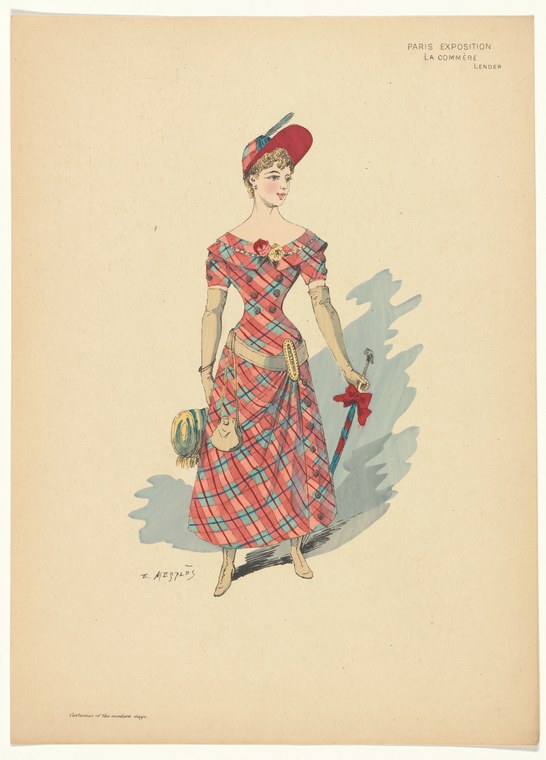
A elegantly dressed woman stands in three-quarter view against a cream background, her figure rendered in a delicate hand-colored fashion illustration style. She wears a striking red and black plaid dress with short puffed sleeves, the skirt gathered and draped asymmetrically to one side in the fashionable silhouette of the 1890s. A red hat with feathers adorns her head, and she holds a small straw hat in one hand and a red parasol or fan in the other. Her posture is graceful and composed, with her body angled as though pausing mid-promenade. The illustration is signed in the lower left corner and labeled at top as part of the Paris Exposition, with the subtitle "La Comedie" (The Comedy), suggesting this figure represents a theatrical or ballroom character type.
The dancing
The single figure stands with weight distributed evenly, her body turned slightly in contrapposto, suggesting a moment of pause or presentation rather than active dance movement. Her arms are held naturally at her sides, one extended to display the parasol or fan as an accessory. The posture is upright and formal, with the elaborate dress doing much of the visual work—the asymmetrical draping and gathered skirt suggest mobility and the possibility of movement, but no actual dance position or footwork is evident. This is a portrait of a dancer or theatrical figure in street dress rather than a captured moment of dancing.
The dance depicted
The figure cannot be identified with confidence as depicting a specific dance style. The illustration presents a theatrical or music-hall character type from the Belle Époque period, titled "La Comedie" and associated with the 1889 Paris Exposition. The dress, accessories, and confident pose suggest a performer—possibly a café-concert singer, actor, or dancer—rather than a classical ballet dancer. The lack of pointe work, turnout, or any codified dance vocabulary suggests this is theatrical or commercial performance dress rather than documentation of a particular technique.
How it was made
This is a hand-colored fashion illustration, likely a watercolor or gouache over a pen or pencil drawing. The technique allows for fine detail in the plaid pattern and feathered hat, while the soft watercolor wash of the background and the subtle modeling of the figure's form convey both precision and elegance. The hand-coloring and presence of a signature suggest this is a work of commercial fashion illustration intended for publication or exhibition—a category that flourished in Paris in the 1880s–90s alongside department store catalogs and theater programs. The presence of the Paris Exposition label indicates it was likely part of a portfolio or collection shown at or documented for the 1889 or 1900 Exposition.
About this work
This is a hand-colored fashion illustration of a theatrical or music-hall performer from the Belle Époque period, likely created for or in connection with the Paris Exposition. The work sits at the intersection of fashion and theatrical documentation: it records not a specific dance, but the costume and presentation style of a performer type—a woman of the stage or popular entertainment venues. It belongs in a dance gallery not because it depicts dance technique, but because it documents the visual culture of theatrical performance and the performer's identity in the 1890s, when the music hall, café-concert, and boulevard theaters were vital contexts for professional dance.
How to look at it
Attend to the asymmetrical draping of the skirt and the way the fabric suggests movement even in a standing pose—this is how a fashion illustrator conveyed that a dress was designed for an active, performing body. The accessories (the parasol, the second hat) and the confident posture tell us that this figure is on display, aware of being seen, and embodying a modern theatrical type. The soft hand-coloring and the artist's attention to the plaid pattern and feather detail show that this is a luxury object, made for viewers who would appreciate fine craftsmanship and who were invested in the visual codes of theatrical fashion.
The artist
The artist's signature appears in the lower left but is not clearly legible in standard references. The work bears the stylistic hallmarks of 1890s Parisian fashion and theatrical illustration, a field in which many artists worked for publishers, exposition organizers, and theaters. The hand-colored illustration technique and the inclusion in an exposition portfolio suggest a professional illustrator working within the commercial and promotional infrastructure of Parisian theater and fashion.
The period
This illustration was created during or shortly after the 1889 Paris Exposition Universelle, a moment of unprecedented celebration of modern industry, entertainment, and visual spectacle in Paris. The 1880s–90s saw the explosion of the music hall and café-concert as venues for female performers, where singers, dancers, and actors achieved celebrity and shaped fashion trends. At the same time, fashion illustration itself became an art form and a profitable industry, with illustrated catalogs, journals, and exposition portfolios creating an insatiable demand for images of fashionable women. The Belle Époque was fascinated by theatrical femininity—the visual presentation of the modern female performer—and illustrations like this were both documentation and advertisement.
Where it lives
The work is part of the NYPL's prints collection focusing on dance imagery and comes from or is associated with exposition documentation materials. The notation "Paris Exposition" and "La Comedie" in the image itself suggests it was part of a published or exhibition set cataloging performers or theatrical character types.
Questions about this work
Is this person actually dancing?
No. This is a portrait of a theatrical performer in street or promenade dress, not a depiction of dance in action. The figure is posed and presented as a type—a character from comedy or popular theater—rather than shown mid-movement. The illustration records how performers dressed and presented themselves, not how they danced.
What does 'La Comedie' mean?
'La Comedie' means 'The Comedy' in French, suggesting this figure represents a comic or theatrical character type associated with the Paris Exposition. It may refer to a character from a play, operetta, or music-hall sketch, or simply to the theatrical genre of comedy itself as embodied in a fashionable female performer.
Why is the skirt draped so unusually?
The asymmetrical draping is both fashionable (characteristic of 1890s evening and theatrical dress) and practical—it suggests the dress was designed for an active body that would move, sit, and perform. The way the fabric is gathered and pulled to one side creates visual interest and hints at the mobility the wearer would need.
Where would someone dressed like this have performed?
In the 1890s, a woman dressed in this theatrical finery would likely have performed in a music hall, café-concert, operetta house, or boulevard theater. The confident, on-display posture and the fashionable costume suggest a performer of some celebrity, not a classical ballet dancer—those worlds had different dress codes and contexts.
More dance artwork





