49 works in this view — arrow keys or swipe to move between them.
Dance in Art
Teresa Heberle
Unknown artist
- Collection:
- Prints depicting dance
- Source:
- New York Public Library
- Rights:
- Public domain — free to use, share and adapt.
- Recorded as:
- Public Domain
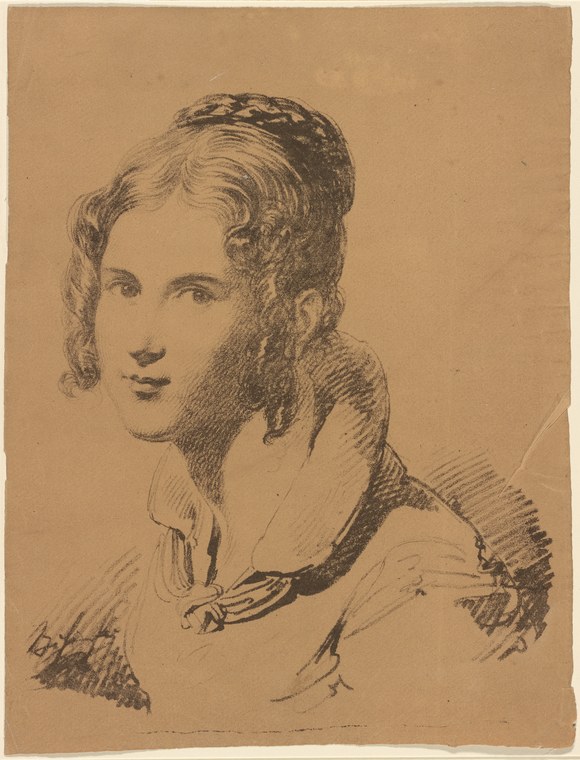
The identification of the sitter as Teresa Heberle links this technical portrait study to the history of theater and performance, even in the absence of dance imagery. For historians, it offers a rare labeled portrait from the nineteenth-century performance world, a period when most dancers went unrecorded by name. The technique itself is historically significant as an example of mid-century portraiture practice.
What you are looking at
A three-quarter length portrait of a woman, shown in profile facing left, rendered in ink on tan paper. She wears her hair in long ringlets pinned up and covered with what appears to be a decorative net or snood. Her shoulders and upper body are visible, clothed in a garment with puffed sleeves trimmed in lace or ruffled edging. A braided or twisted cord necklace drapes across her chest. The artist has used fine cross-hatching and linear shading to model the face and fabric, building form through parallel lines rather than wash. The background is plain, allowing the figure to occupy the full compositional attention. The sketch has the immediacy of a study or rehearsal piece—economical in line, focused on capturing likeness and the character of dress rather than elaborate narrative or setting.
The dancing
The sitter is rendered in a relaxed, three-quarter pose with her head turned toward the viewer and her body angled away. Her expression is calm and direct. There is no indication of active movement or dance posture; the figure is stationary and presented for portraiture. The positioning of the shoulders and the way the fabric falls suggest a moment of repose rather than motion.
The dance depicted
This does not depict dance. It is a portrait study of a named individual, Teresa Heberle, rendered in a technique consistent with mid-nineteenth-century theater or society portraiture. While Heberle may have been a dancer—the name suggests possible connection to theatrical circles of the German-speaking world—the image itself shows her as a subject of portraiture, not in the act of dancing. No movement, costume for performance, or dance setting is evident.
How it was made
This is a pen and ink drawing on tan or buff paper, likely created as a portrait study or sketch. The technique employs fine parallel hatching and cross-hatching to build form and shadow, a method characteristic of nineteenth-century printmaking studies and academy training. The economical line work and lack of finish suggest this may be a preparatory drawing for an engraving or lithograph, or a finished sketch intended for circulation among theater or society circles. The paper and ink have aged to a warm tone, consistent with archival preservation.
About this work
This is a portrait sketch of Teresa Heberle, a woman whose name and theatrical-era dress suggest possible connection to performance, though the image itself offers no evidence of her profession or skill. It is a technical study in portraiture using nineteenth-century ink methods, preserved in the New York Public Library's collection of dance-related prints. The work belongs in an archive of dance imagery not because it depicts dance, but because it documents a named individual from a period rich in European theatrical history, and because the name has been catalogued as dance-related. It is a reminder that archives of dance include not only action and spectacle but also the faces and identities of performers captured in quieter moments.
How to look at it
Attend to the quality of the line and the patience of the cross-hatching, which gives the portrait its authority and subtlety. Notice how the artist has used the texture of the paper itself to contribute to the effect—the tan ground is not covered but allowed to show through, creating a sense of luminosity. The profile angle and the slight turn of the head create an informality despite the formal technique; this is a studied likeness, not a stiff frontal pose. The careful rendering of the hair pins and the braided necklace suggests these details were important to the sitter's identity or status.
The artist
The artist is not recorded. The hand is competent and practiced, suggesting professional training in figure drawing and portraiture technique. The style is consistent with mid-nineteenth-century German or European academic practice, but without signature or attribution, the maker cannot be identified with confidence.
The period
This sketch dates to an era—likely 1830s–1860s—when theatrical portraiture was a standard practice for documenting performers. Unlike painted theatrical scenes, which often romanticized or stylized performers, sketches like this one served as quick, accurate records of appearance and costume. The technique reflects academic drawing pedagogy of the period, in which parallel hatching and controlled line were taught as foundational skills. The theater itself was undergoing rapid transformation: ballet was establishing itself as a virtuosic art form, and performers' identities were beginning to be recorded more systematically, though archival gaps remain.
Where it lives
This drawing is held in the New York Public Library's collection of prints depicting dance. It was catalogued as dance-related, presumably on the basis of the sitter's name, though the collection contains both images of dance in action and related archival material including portraits of performers.
Questions about this work
Is this a portrait of a famous dancer?
The sitter is identified in the catalogue as Teresa Heberle, but no biographical information is recorded. While the name suggests a connection to theater—possibly the German-speaking theatrical world—the image itself gives no indication of her profession or prominence. She may have been a dancer, a teacher, an actress, or a member of a theater family; the portrait alone does not tell us.
Why is a portrait in a collection of dance imagery?
Archives of performance history often include portraits of performers alongside action images. This sketch may have been preserved because Heberle was known to be connected to dance or theater, or because it was acquired as part of a larger collection. Portraits serve historians as documentary evidence of dress, appearance, and the way performers were represented to the public.
What technique was used?
This is a pen and ink drawing executed with fine parallel lines (hatching) and cross-hatching to build shadow and form. This technique was standard in academic training and was also used in the preparation of engravings and lithographs for theatrical prints. The economy of line and lack of wash or color suggest it is either a finished sketch or a preparatory study.
More dance artwork





