49 works in this view — arrow keys or swipe to move between them.
Dance in Art
Le cancan
Unknown artist
- Collection:
- Prints depicting dance
- Source:
- New York Public Library
- Rights:
- Public domain — free to use, share and adapt.
- Recorded as:
- Public Domain
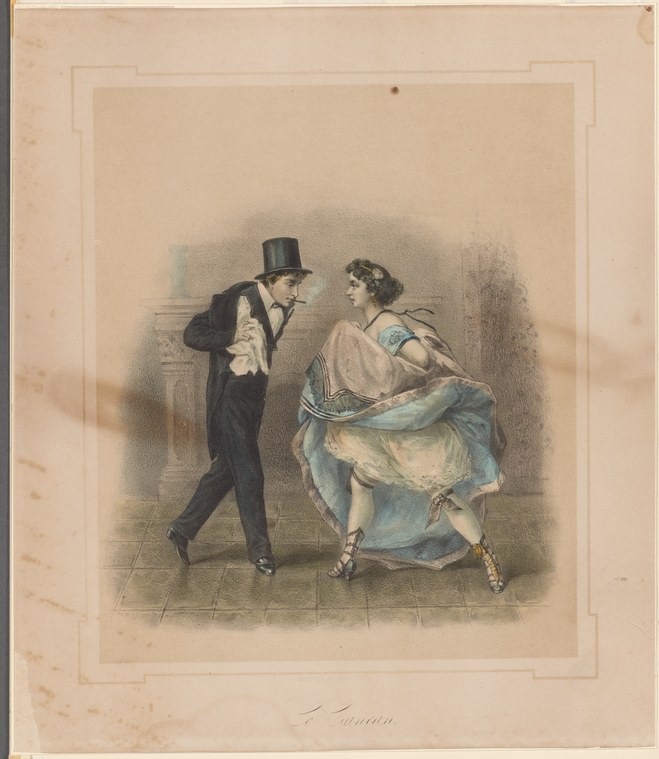
The cancan was one of the first dances to be explicitly condemned by moral authorities and celebrated by urban audiences precisely because of its association with female bodily freedom and sexual display. This print preserves not a stage performance but a social imagining of how the dance worked in the space between partners, showing us how the dance was understood through the fantasy of the male gaze—and how the female figure commandingly dominates that gaze.
What you are looking at
A man in formal evening dress—black tail coat, white shirt, top hat—bends forward in an exaggerated posture of surprise or alarm, his body at an acute angle. Opposite him stands a woman in a pale blue dress with a sheer overlay or shawl, caught mid-movement with her skirt swirling around her legs. The woman's pose is dynamic and flirtatious, her body angled away while her gaze meets the man's. The floor beneath them is rendered in perspective with a tile pattern, and a shadowed architectural element (possibly a doorway or pilaster) rises behind them. The background is rendered in soft tones with hatching that suggests interior space, while the figures are modeled with careful attention to light and shadow. The scene captures a moment of social comedy—a dance of courtship and playful provocation.
The dancing
The man's spine curves sharply backward in a posture of mock horror or exaggerated reaction; his weight appears to shift onto one leg while his torso recoils. The woman is in a turning or pivoting motion, her legs in an active stride beneath her billowing skirt, her upper body rotated to face the man. Both figures are upright and mobile rather than locked in a closed hold; the distance between them suggests a social dance in which partners separate and re-engage. The woman's raised arm and the sweep of her fabric suggest vigorous footwork and a playful, theatrical energy.
The dance depicted
This depicts the cancan, the notorious high-kicking dance of Parisian music halls that emerged in the 1830s–1840s. The woman's swirling skirt, dynamic leg work, and flirtatious pose toward a formally dressed male partner are characteristic of cancan as a courtship dance in a social or theatrical setting. The man's exaggerated reaction—whether surprise, delight, or mock shock—captures the provocative nature of the dance and its effect on male observers. The print celebrates the cancan's status as a spectacle of female bodily freedom and masculine vulnerability in the face of it.
How it was made
This is a hand-colored lithograph, identifiable by the soft tonal modeling, the characteristic graininess of the stone, and the careful integration of color washes with black line work. Lithography allowed for rapid reproduction and broad circulation as a popular print; the quality of drawing and the skillful use of mid-tone shading suggest this was a commercially significant image, likely sold as a single sheet or as part of a series. The technique was well suited to capturing the gestural energy and theatrical moment of social dance.
About this work
This hand-colored lithograph captures a moment from the cancan, the Parisian dance that scandalized and delighted nineteenth-century society. The print shows the dance not in the formal setting of a stage or music hall, but as a social exchange between two figures—a woman in full command of her movement and sexuality, and a man rendered almost helpless by surprise or desire. The image is both a record of how the dance was performed and a commentary on its transgressive power. It belongs in a dance archive as evidence of how cancan was understood, marketed, and consumed in its own era: not as a fixed choreography, but as a provocation, a moment of social reversal, and a display of female agency.
How to look at it
Notice the precise moment the artist chose: not a high kick or a dramatic split, but the instant of turning, of response, of flirtation. The man's backward curve is almost balletic in its exaggeration—this is not naturalistic movement but a stylized rendering of masculine surprise. Attend to the woman's footwork and the trajectory of her skirt: the fabric tells us she is in mid-stride, rotating, and the angle of her body shows her gaze locked on her partner even as her lower body propels her away. The composition forces the viewer to read the dance as a dialogue, not a display.
The period
The cancan emerged in Parisian dance halls in the 1830s–1840s, coinciding with the rise of lithography as a medium for popular culture. By the mid-nineteenth century, the dance had become iconic: celebrated in cabarets like the Moulin Rouge (opened 1889) and reproduced in prints, paintings, and photographs that circulated across Europe and America. These images served multiple functions—as souvenirs of entertainment, as commentary on modern social mores, and as vehicles for fantasies about Paris, modernity, female sexuality, and urban pleasure. The formal dress of the male figure and the interior setting suggest this is not a theatrical performance but a salon or ballroom scene, indicating the cancan's presence in middle-class social life as well as music-hall spectacle.
Where it lives
This work is held in the New York Public Library's collection of prints depicting dance. It is a popular print from the nineteenth century, likely produced for broad circulation and consumption.
Dance in this work
Questions about this work
What is the cancan and why was it controversial?
The cancan emerged in Parisian dance halls in the 1830s–1840s, characterized by high kicks, rapid leg movements, and the dramatic lift of skirts that exposed the legs and undergarments of female dancers. It was condemned by moral authorities as obscene and indecent, and yet it became wildly popular as a symbol of Parisian modernity, female sexual freedom, and urban transgression. For nineteenth-century society, the cancan represented everything modern and dangerous about city life.
Was the cancan always performed in music halls, or was it a social dance?
The cancan originated in music halls and cabarets but quickly migrated into social contexts—ballrooms, salons, and private entertainments. This print suggests the latter: the formal dress and interior setting point to a social dance rather than a stage performance. The cancan existed in both contexts simultaneously, as both a theatrical spectacle and a social practice.
What does the man's pose tell us about how the cancan was perceived?
The man's exaggerated backward arch and expression of shock or delight reveal that the cancan was understood, at least in popular imagery, as a display directed at male viewers—something that provoked, challenged, and threatened conventional masculine composure. Whether the man's pose is meant as mockery or admiration, it positions the female dancer as the active agent and the male as the one who reacts.
What was the social class of cancan dancers?
Cancan dancers in music halls were typically working-class women, often recruited from modest backgrounds. The formality of the male partner's dress in this print—top hat and tails—suggests the fantasy of cross-class encounter that the cancan represented: a moment of transgression in which a bourgeois or aristocratic man encountered female sexuality and agency outside the constraints of respectable society.
More dance artwork





