49 works in this view — arrow keys or swipe to move between them.
Dance in Art
Petit bal costumé, six petits morceaux pour violon avec accompaniment de piano par Guido Papini
Unknown artist
- Collection:
- Prints depicting dance
- Source:
- New York Public Library
- Rights:
- Public domain — free to use, share and adapt.
- Recorded as:
- Public Domain
This object represents the material and commercial infrastructure of early twentieth-century musical life, including the minor but ubiquitous role that dance and dance-associated imagery played in concert and domestic music. Papini's compositions and their framing by a Rococo putti vignette exemplify how dance, music, and visual ornament were marketed together as elements of genteel entertainment and amateur cultivation.
What you are looking at
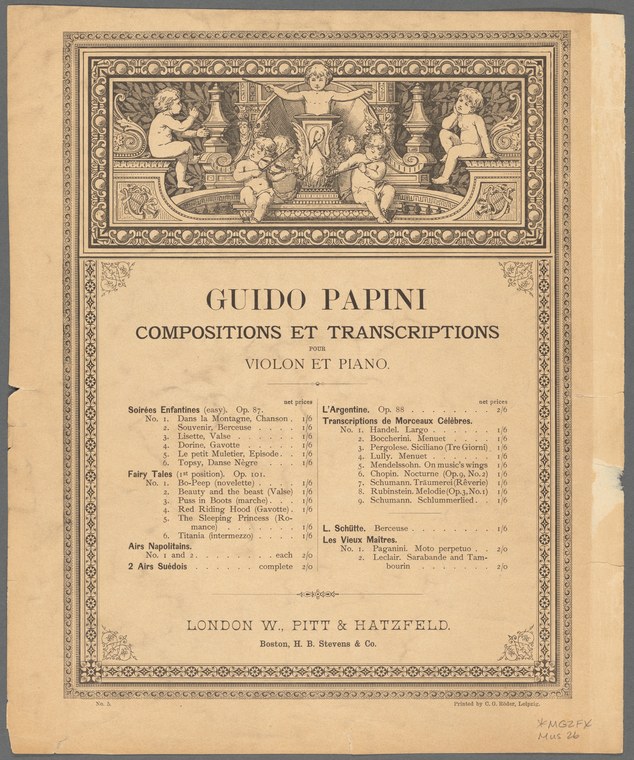
This is a title page and contents listing for a published collection of compositions and transcriptions for violin and piano by Guido Papini. The upper half features an ornamental engraved vignette in the Baroque style depicting putti (cherubs) at play in an architectural setting with classical urns and drapery. The figures are arranged in a frieze composition across a columned interior; some putti recline, others stand or gesture, and their poses suggest movement and playfulness. The lower half presents the title in large capitals, followed by a detailed table of contents listing individual pieces organized by category: Soirées Enfantines, Fairy Tales, Airs Négligés, and L'Argentière, with opus numbers and page references. The typography and layout are characteristic of early twentieth-century music publication, with decorative corner ornaments and the publisher's imprint at the foot (London: W. Pitt & Hatzfeld; Boston: H. B. Stevens & Co.).
The dancing
The putti in the vignette are rendered in a light, playful manner typical of Rococo decoration. Their bodies are plump and cherubic, with minimal musculature; poses range from reclining to upright, some with arms raised or extended in gestures of greeting or play. There is no formal choreographic hold or frame; the composition emphasizes spontaneous, infantile movement rather than structured dance. The figures appear weightless and occupy space freely without the spatial logic of a dance floor.
The dance depicted
This is not a work depicting dance per se, but rather a musical publication. The putti vignette is ornamental and referential to a long tradition of Rococo imagery associated with pleasure, music, and entertainment—contexts in which dance frequently appeared. The image does not document any actual dance practice, form, or technique. Putti were conventional decorative motifs on music publications and concert programs of the era, signaling elegance, refinement, and the leisurely arts.
How it was made
This is a printed title page, reproduced through engraving and letterpress. The vignette is an engraved illustration; the text is set in metal type. The fineness of the line work in the putti scene and the decorative borders suggests skilled engraving, likely produced by a London or Boston music publisher's in-house shop or a specialist subcontractor. This was a standard production method for music publication in the early 20th century, permitting distributed production and circulation to performing musicians and music teachers.
About this work
This title page documents a published collection of short compositions for violin and piano intended for domestic or teaching use. The decorative engraved vignette of putti, though not depicting actual dance, signals the cultural context in which such music was consumed: drawing rooms, recital halls, and music lessons where amateurs and professionals performed together. The collection itself—organized thematically into 'evening entertainments,' 'fairy tales,' 'negligible airs,' and 'Argentine' works—suggests a repertoire designed for social occasions, amateur performance, and perhaps theatrical or ballet accompaniment. The presence of an engraved illustration on the title page marks this as a product of commercial music publishing aimed at a middle-class market valuing both musical competence and aesthetic refinement.
How to look at it
The vignette is conventional ornament, not a documentary record of choreography or performance. A viewer should recognize it as belonging to a visual language of genteel entertainment rather than interpreting the putti poses as dance instruction or evidence of actual movement practice. The title page's format, typography, and publisher information situate it within the infrastructure of commercial music distribution—a structure that included dance and music as linked social practices, even when the visual content on any single page was purely decorative.
The artist
Guido Papini was an early twentieth-century composer and arranger whose works for violin and piano were published internationally. Little is documented about his training or career trajectory, but the scope and distribution of his publications—handled by major London and Boston music houses—suggest he was a working professional supplying the pedagogy and amateur performance markets. His catalogued works are primarily short character pieces and light transcriptions, genres that dominated music publishing for domestic use in this period.
The period
The early twentieth century saw a boom in published music for amateur performance and music education, especially for violin and piano—instruments central to bourgeois household musicianship. Illustrative vignettes on title pages, particularly Rococo-inspired putti and pastoral scenes, remained fashionable ornaments even as design movements shifted; they evoked leisure, pleasure, and an implied continuity with the 18th-century salon culture in which both dance and music thrived. Papini's publication exemplifies the commercial standardization of concert life and the professionalization of music pedagogy during this era.
Where it lives
The object is catalogued as a print from the New York Public Library's collection of prints depicting dance. It is a published title page from a music publication distributed internationally by W. Pitt & Hatzfeld (London) and H. B. Stevens & Co. (Boston).
Questions about this work
Is this actually a dance work?
No. This is the title page of a published collection of musical compositions for violin and piano. The engraved vignette of putti is a conventional ornamental illustration typical of music title pages in this period, not a depiction of dance practice or a choreographic diagram. However, the work belongs in a dance archive because it documents the cultural and commercial contexts in which dance and music were jointly marketed and consumed.
What is Guido Papini known for?
Papini was an early twentieth-century composer and arranger working primarily in light character pieces and transcriptions for amateur musicians. His published works were distributed by major music houses in London and Boston, indicating a successful career in the pedagogy and salon music markets. Beyond the published titles catalogued here, little biographical information is readily available.
What are the putti doing in the vignette?
The putti are depicted in playful, leisure activity—reclining, gesturing, and interacting informally around classical architectural elements. Their poses are generic representations of pleasure and entertainment rather than choreographed movement. This imagery was conventional decoration on music publications and concert programs, evoking an association between music, dance, and genteel social life.
More dance artwork





