49 works in this view — arrow keys or swipe to move between them.
Dance in Art
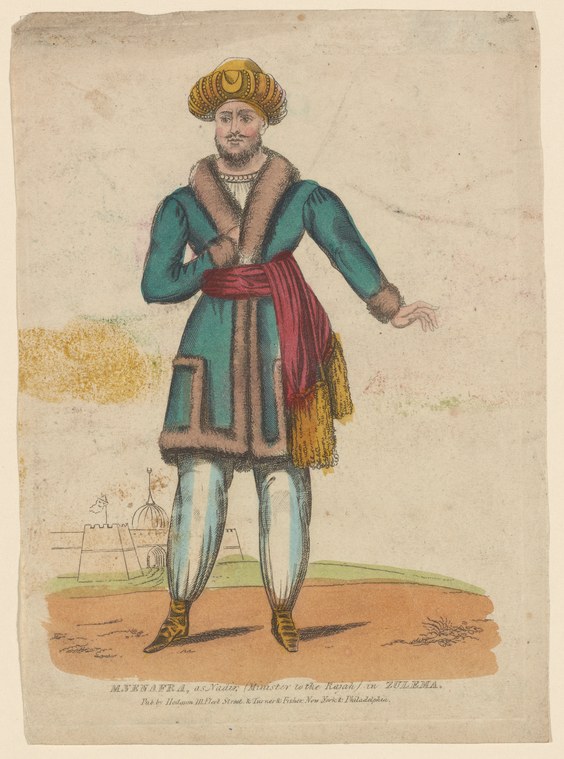
M. Venafra, as Nadir (minister to the rajah) in Zulema
Unknown artist
- Collection:
- Prints depicting dance
- Source:
- New York Public Library
- Rights:
- Public domain — free to use, share and adapt.
- Recorded as:
- Public Domain
This print documents how European theatre of the 18th century deployed costume, posture, and racial exoticism to create 'oriental' authority and prestige—a practice central to understanding both the aesthetics and the colonial imagination of the period. For dance historians, it reveals the boundaries between dance and theatrical gesture in this era: the performer's stance is dignified and composed but not balletic, suggesting that 'oriental' court roles depended more on tableaux vivant and dramatic address than on the codified movement of ballet or social dance.
What you are looking at
A single male figure stands in a relaxed contrapposto against a sparse landscape background, with a domed structure (possibly a pavilion or palace) sketched in pale wash at the left. He wears an opulent costume of the 18th-century Ottoman or Mughal court: a tall golden turban, a jeweled neck collar, a teal-green long-sleeved coat with brown fur trim, a deep crimson silk sash draped asymmetrically across the hips, and yellow-gold drapery falling from the sash. His stance is poised but not tense; his weight rests on one leg, the other knee slightly bent, one arm raised in a gesture of address or presentation. The figure occupies the center of the composition against a peachy-brown ground that suggests bare earth or stage floor. The hand-coloring is delicate and restrained, applied in transparent washes that allow the underlying engraved line to read clearly. The inscription below identifies him as a named performer in a specific role.
The dancing
The single figure stands in an open, approachable stance rather than in a codified dance position. His raised arm and forward-facing orientation suggest presentation or courtly address rather than balletic elevation or turn. The posture is upright and dignified but not formally restrained; there is a conversational ease in the bearing that suggests dramatic or theatrical address. The body shows no sign of being engaged in virtuosic footwork or the turning momentum that would mark a trained dancer mid-movement.
The dance depicted
This appears to be a theatrical or operatic costume study rather than documentation of dance proper. The figure is identified as Nadir, a minister character, in an opera or theatrical work titled Zulema. This is likely a printed souvenir or advertisement circulating knowledge of a specific production—either a named dancer performing a particular role in a London or Philadelphia venue. The costume and setting suggest the 18th-century European fascination with 'oriental' spectacle on stage, a mode in which exotic dress and courtly gesture stood in for both narrative authority and entertainment.
How it was made
This is a hand-colored engraving, printed from a copper plate and then finished with watercolor or gouache washes applied by hand. The engraved line is fine and precise, preserving sharp detail in the jewelry and fabric texture; the coloring follows rather than obscures this underdrawing. The technique was standard for theatrical prints of the 18th century—portable, reproducible, and cheap enough to circulate to playgoers. The survival of multiple copies, each slightly variant in coloring, was typical of this commercial printing practice.
About this work
This is a theatrical print documenting a performer in a named role in a specific stage production, likely British or colonial American in origin. It belongs to the genre of 18th-century operatic and theatrical prints that recorded fashionable stage costume and celebrated named performers for a literate and cosmopolitan audience. The work sits at the intersection of dance history, theatre history, and visual culture: it records not how dance was performed, but how exotic character and courtly spectacle were visualized on stage, and how that spectacle was commodified and circulated in print.
How to look at it
Note the stillness of this figure. He is not caught mid-gesture or mid-step, but rather composed in a moment of address or presentation—a theatrical tableaux rather than a dance arabesque. Observe the weight distribution: balanced, open, conversational. The raised arm is expressive rather than structural—it does not frame or prepare the body for a turn or jump. This is what 18th-century stage 'exoticism' looked like: opulent costume, courtly bearing, and the visual authority of luxurious fabric and ornament, but not virtuosic dancing. The inscription below anchors the image to a specific performer and role, reminding us that this print was made to be recognized and purchased by people who had seen this exact person on stage.
The period
The 18th century saw a sustained European appetite for operatic and theatrical spectacles featuring 'oriental' courts, harems, and potentates. Works with titles like *Zulema*, *Roxelane*, *The Sultan*, and *The Seraglio* populated London and Philadelphia stages and were reproduced in widely circulating prints aimed at theatregoers. These productions were typically sung (opera seria or ballad operas) and featured elaborate costumes, processions, and posed groupings rather than danced action. The genre borrowed from both the court ballet tradition and from contemporary travel narratives and painting that rendered the Ottoman or Mughal East as a site of luxury and moral ambiguity. By the late 18th century, such 'orientalist' spectacle had become a staple of commercial theatre in Britain and America, consumed by audiences who prized both the exotic costume and the celebrity of named performers.
Where it lives
The print is held in the New York Public Library's collection of prints depicting dance, acquired from the Holdings at 42nd Street. It is catalogued as a theatrical print from an unknown date, likely 18th or early 19th century based on style and hand-coloring technique. The inscription cites a London publisher and a Philadelphia address, suggesting it was either printed in London and imported, or reprinted in Philadelphia for a local audience.
Questions about this work
Is this person actually dancing?
Not in the balletic or formal sense. The figure is posed in a theatrical stance of presentation or address—the kind of dignified immobility that an 18th-century audience would have associated with a courtly or authoritative character. Stage dance of this era existed in tandem with, but distinct from, dramatic gesture and costume display. This image documents the costume and persona more than the movement.
What is Zulema?
Zulema was likely an opera or stage play in the 18th-century European tradition of 'oriental' spectacle, now quite obscure. The work does not appear in standard theatrical histories, suggesting it was either ephemeral, regional, or simply not preserved in English-language records. The print is more likely to survive than the text of the play itself.
Who was M. Venafra?
The print identifies the performer by name and role, but no other biographical information is recorded. Venafra was evidently a known theatrical performer in an 18th-century London or Philadelphia production, celebrated enough to be memorialized in a printed portrait for public sale, but now obscure to scholars. The print itself is the primary historical evidence of his existence and work.
Why is the costume so elaborate?
The opulent turban, fur-trimmed coat, jeweled collar, and layered silk drapery signaled 'oriental' splendor and authority to 18th-century European audiences. These costumes were expensive to make and were a major draw for theatregoers—people attended partly to see exotic costume on stage. The exoticism was understood as spectacle, not as ethnographic documentation.
More dance artwork





