49 works in this view — arrow keys or swipe to move between them.
Dance in Art
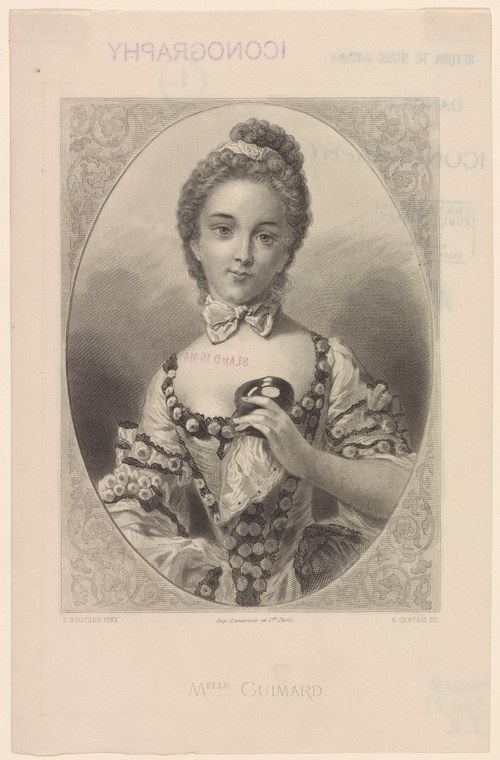
Melle Guimard
Unknown artist
- Collection:
- Prints depicting dance
- Source:
- New York Public Library
- Rights:
- Public domain — free to use, share and adapt.
- Recorded as:
- Public Domain
This image documents the celebrity culture and visual representation of 18th-century theatrical dance, showing how prominent dancers were commemorated and circulated as images to a broad public. The engraving format and the care of its execution reveal that Guimard commanded significant renown—such works were expensive and selective, made only for performers of established fame. Understanding how dancers of this period were portrayed—formal, elegant, static—reveals the values and aesthetics that governed how performers presented themselves beyond the stage.
What you are looking at
A three-quarter-length portrait of a young woman in an oval frame, rendered in fine engraving technique. She wears an elaborate 18th-century dress of white muslin or silk with ornate embroidered or patterned sleeves, and carries a long beaded necklace—possibly pearls—that drapes across her torso. Her hair is elaborately dressed in the style of the period, swept up and adorned. Her pose is graceful and composed; she faces slightly toward the viewer with a slight turn of the shoulders, her gaze serene. The background is plain, allowing the figure and her richly detailed costume to dominate. The oval frame itself is decorated with rococo ornamental motifs, establishing the work's formal, commemorative character. The engraving is delicate and precise, with careful cross-hatching to model the face and fabric.
The dancing
The figure's posture is upright but relaxed, with the weight evenly distributed in a standing position. The arms hang naturally, one hand resting near the beaded necklace. There is no active dancing posture—no turned-out legs, no lifted port de bras, no dynamic weight shift. The body is presented in a formal, static pose typical of 18th-century portraiture of aristocratic or theatrical women. The softness of the face and the graceful tilt of the head suggest refinement and training, but the gesture is presentational rather than kinetic.
The dance depicted
This is a portrait of a dancer rather than a depiction of dance itself. The work commemorates an individual—identified as Melle (Mademoiselle) Guimard—rather than capturing movement or a performance moment. Without context beyond the image, it is not possible to identify the specific dance forms she performed, though the 18th-century date and her apparent prominence (warranting an engraved portrait) suggest she was likely a theatrical dancer of the Paris or European stage, possibly known for court ballet or ballet d'action. The lack of any costume elements or poses specific to a particular dance style leaves the precise nature of her repertoire unknown.
How it was made
This is an engraving, identifiable by the fine parallel lines (hatching and cross-hatching) used to build tone and form, and the crisp edges characteristic of the intaglio process. The delicate rendering of the face and the precise detail of the costume suggest skillful execution by a professional engraver, likely a reproductive print made to circulate an image of a notable performer. Engravings of this type were among the most prestigious and widely distributed forms of portraiture in the 18th century, indicating that Guimard was sufficiently famous to warrant this medium of circulation. The oval frame with decorative surround was a standard format for such commemorative theatrical portraits.
About this work
This is an engraved portrait of Melle Guimard, an 18th-century dancer of evident prominence and refinement. Rather than capturing a moment of dance, it presents her as a figure of aristocratic bearing and elegance in formal dress—a visual record of her status and beauty as a performer. The work belongs to a widespread 18th-century genre of engraved theatrical portraiture, documenting the most celebrated dancers of the European stage and their public image. For dance historians, such portraits provide evidence of how performers were styled, how they presented themselves socially, and who was considered worthy of circulation and fame during the ancien régime of European dance.
How to look at it
Note how the engraver chose a moment of stillness and composure rather than action. The elaborate costume and jewelry indicate her status as a star performer, while the formal pose and serene expression present her as a woman of grace and breeding. Observe how the rococo surround and the precision of the engraving technique lend prestige to the image; this was a costly and honorific form of circulation. The portrait invites admiration of the sitter's beauty and refinement, not her physical skill—a reminder that 18th-century theatrical fame was constructed as much through visual and social presentation as through dancing ability.
The period
The 18th century saw a dramatic rise in the celebrity of individual dancers and the circulation of their images through engravings and prints. This coincided with the development of ballet d'action—narrative ballet with expressive movement—and the emergence of the professional dancer as a star of the opera house and court. Actresses and dancers became celebrities of a sort, and engraved portraits were a primary medium through which their images reached the wider public. The style and elegance of such portraits reinforced the social status of performers as cultivated and refined figures, even as dancers remained ambiguous in social standing. The format of this work—the oval frame, the rococo ornamental surround, the formal dress—was conventional and prestigious, conferring honor on the subject.
Where it lives
The work is held in the New York Public Library's collection of prints depicting dance. It is a reproductive engraving, likely produced and distributed in the 18th century or possibly later as a historical record.
Questions about this work
Was Melle Guimard a famous dancer?
The fact that she warranted an engraved portrait strongly suggests she was a celebrated performer of the 18th-century European stage. Engraved theatrical portraits were reserved for stars of the opera house and court. However, without additional documentation, her specific achievements and roles cannot be established from the image alone.
What dance did she perform?
The portrait does not show her dancing, so it does not reveal her specific repertoire. Eighteenth-century theatrical dancers typically performed ballet, court dances, and pantomime. Without further research into Guimard's career, her particular specialties remain unknown.
Why is she wearing such elaborate clothes in a portrait?
The ornate costume and jewelry were likely her stage or formal wear, chosen to present her as an elegant and refined figure of high status. This was standard practice in theatrical portraiture: the sitter was shown in the costume and jewels that defined her public image and social standing.
More dance artwork





