49 works in this view — arrow keys or swipe to move between them.
Dance in Art
Maria Taglioni
Unknown artist
- Collection:
- Prints depicting dance
- Source:
- New York Public Library
- Rights:
- Public domain — free to use, share and adapt.
- Recorded as:
- Public Domain
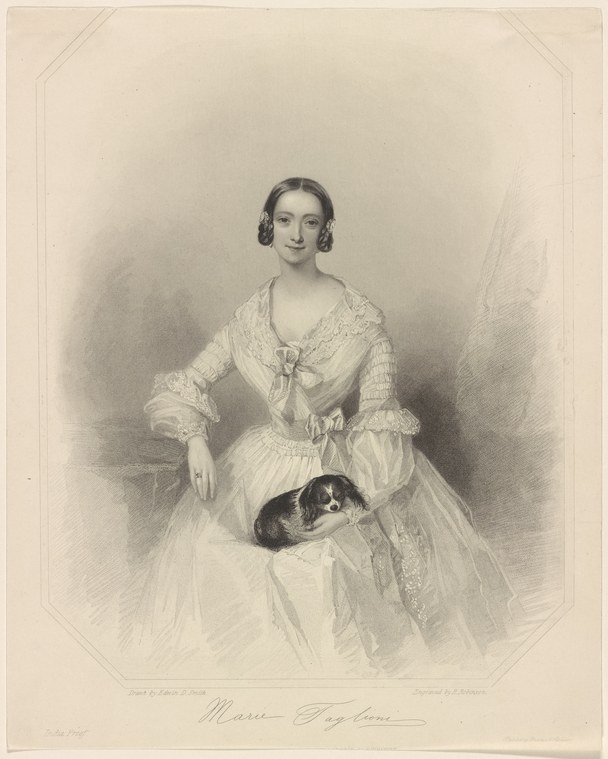
Maria Taglioni was the defining ballerina of Romantic ballet and a global celebrity; this portrait engraving testifies to the appetite for images of her among the paying public. It shows how dancers' likenesses were commodified and distributed in the pre-photographic era, and why understanding celebrity dance culture requires looking beyond performance images to portraiture and print.
What you are looking at
A young woman in an elaborate white dress sits in a relaxed, informal pose, her body angled toward the viewer with her left arm resting on the back of a chair. She wears a gossamer gown with puffed sleeves and decorative lace or embroidery at the bodice, the skirt full and gathered. Her dark hair is pulled back in a fashion typical of the 1830s-1840s. A small spaniel or similar breed of dog rests across her lap, its dark coat contrasting with the pale fabric of her dress. The background is rendered in soft gray tones with subtle shading that creates depth without detail—a studio setting rather than an identifiable location. The overall mood is intimate and genteel, capturing a moment of repose rather than activity. This is a printed portrait—an engraving or lithograph—not a painting.
The dancing
The subject is seated, not dancing. Her posture is relaxed and tilted, one arm across the chair back, the other hand resting on the dog. There is no evidence of dance technique, stance, or movement in her body position. The dog's presence and her attention to it anchor the image as a portrait of leisure rather than performance.
The dance depicted
This print does not depict dance. It is a portrait of Maria Taglioni, the celebrated Romantic-era ballet dancer, but it shows her in street dress and a social setting, not performing. The image is valuable as a document of her identity and status in the period, but it contains no visual information about her dancing technique, repertoire, or the ballets for which she was famous.
How it was made
This is an engraving or lithograph—a printed work made for circulation to a wide audience. The technique is evident in the fine hatching and tonal gradation used to model form, particularly in the fabric folds and facial features. The soft gray background and restrained line work are characteristic of mid-19th-century portrait printing. Such prints were affordable and popular, making celebrity dancers like Taglioni accessible to the public beyond those who could attend performances.
About this work
This is a portrait engraving or lithograph of Maria Taglioni, the most celebrated ballet dancer of the Romantic era, shown in her street dress with a pet dog. It documents her fame and cultural status rather than her dancing practice. The work belongs in a dance archive as evidence of how Romantic-era dancers were marketed and consumed as celebrities, and as a record of Taglioni's iconic image during her period of greatest renown in the 1830s and 1840s.
How to look at it
This is not a performance image; attend instead to its function as celebrity portraiture. The informal pose and the inclusion of the pet dog humanize Taglioni and present her as an accomplished lady of leisure rather than a mere performer. The quality of the printing—the fine detail, the soft modeling—signals the prestige of the subject. Compare this to other portrait engravings of actresses and singers from the same period to understand how dance celebrities were positioned within the broader culture of theatrical fame.
The artist
The artist is not recorded. The print is held by the New York Public Library as part of a collection of prints depicting dance. The inscription at the base reads "Maria Taglioni" but gives no maker attribution. Many such prints were made by commercial engravers and lithographers working after paintings or drawings by portrait artists of the period, and the original painter or draftsman may have been forgotten or uncredited.
The period
This print dates from the height of Romantic ballet in Europe, when dancers like Taglioni revolutionized the art form through pointe work, ethereal costuming, and narratives of supernatural beings and tragic heroines. The 1830s and 1840s saw an explosion of printed celebrity imagery as commercial printing and the leisure reading public expanded. Taglioni's image circulated widely across Europe and America, making her one of the most recognizable performers of her era. This portrait captures her in the genteel, refined manner that appealed to the bourgeois audiences who supported ballet as a respectable art form.
Where it lives
This print is held in the New York Public Library's collection of prints depicting dance. It is a commercial print, likely 19th-century, made for sale to the public and now part of a research collection documenting the visual culture of dance.
Questions about this work
Does this image show Taglioni dancing?
No. This is a portrait of Taglioni at leisure, not a performance or rehearsal image. It shows her dressed in fashionable street clothes with a pet dog, in a pose designed to convey elegance and refinement. Dance historians value it as evidence of her celebrity status and how dancers were marketed as social figures, not for information about her dancing technique.
How do we know this is Maria Taglioni?
The inscription at the base of the print reads "Maria Taglioni." Without signature or other provenance information in the catalogue record, we rely on this inscription and the holding institution's attribution.
Why is a non-dance portrait in a dance collection?
Celebrity portraiture is part of dance history. These prints show how dancers were seen and sold to the public, what status they held, and how the dance world intersected with broader celebrity and consumer culture. They document the dancers who defined an era, even when they depict them off-stage.
What was Taglioni famous for?
Maria Taglioni (1804–1884) was the leading dancer of the Romantic ballet era. She pioneered extended pointe work, danced in the most celebrated ballets of the 1830s and 1840s including *La Sylphide*, and was the first international ballet superstar. Her refined technique and ethereal style defined Romantic ballet and made her a household name across Europe and America.
More dance artwork





