49 works in this view — arrow keys or swipe to move between them.
Dance in Art
Fanny Elssler
Unknown artist
- Collection:
- Prints depicting dance
- Source:
- New York Public Library
- Rights:
- Public domain — free to use, share and adapt.
- Recorded as:
- Public Domain
Fanny Elssler was a pivotal figure in the transition of ballet from aristocratic court art to commercial theatrical spectacle. This engraving is one of many portraits made to capitalize on and sustain her celebrity, demonstrating how 19th-century print culture shaped the global reputation of dancers and created the first generation of international dance celebrities.
What you are looking at
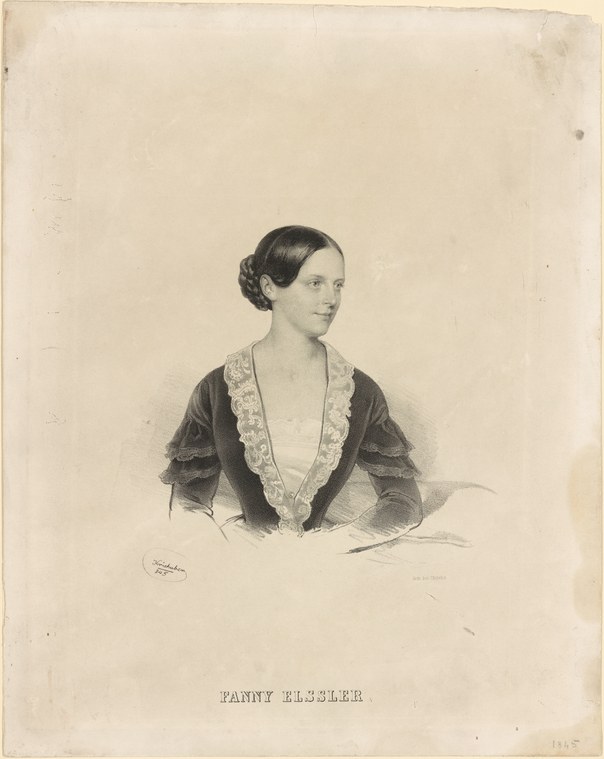
This is a bust-length portrait engraving of a woman in three-quarter view, her head turned slightly toward the viewer's left. She wears a dark, richly draped dress with voluminous sleeves of sheer or lightweight fabric that fall from the shoulder, and an ornate lace or embroidered collar that frames her décolletage in a deep V. Her dark hair is gathered at the back of the head in a smooth, fashionable arrangement typical of the mid-19th century. The background is plain and neutral, allowing the figure to dominate. The work is executed in a fine linear style characteristic of steel engraving, with careful hatching to model form and suggest the texture of fabric. The artist has signed the work in the lower left; the name is legible but difficult to confirm with certainty from the image alone.
The dancing
The sitter is shown at rest, not in motion or a dance pose. Her posture is upright and composed, the shoulders back, the neck elongated. The arms are not visible below the shoulders. The rendering emphasizes stillness and dignity rather than any kinetic quality. This is a formal portrait convention, not a representation of movement.
The dance depicted
Fanny Elssler was a celebrated Austrian ballerina of the Romantic era, most famous for her role in La Sylphide and her virtuosic execution of character dances, particularly the Cachucha. However, this engraving does not depict her dancing. It is a portrait made for circulation, showing her as a public figure and celebrity. The image records her appearance and fashionability in her era, not her work as a dancer. The dress and styling suggest the 1840s, when Elssler was at the height of her fame.
How it was made
This is a steel engraving, a reproductive print medium that allowed mass production of portraits. Steel could sustain many more impressions than copper, making it the ideal medium for distributing images of famous performers to the public. The fine parallel lines and careful modeling visible in the face and fabric indicate hand-engraving by a skilled craftsperson, likely working from a painted or drawn original. The signature in the lower left is the engraver's mark, not that of a portrait painter.
About this work
This is a mid-19th-century celebrity portrait engraving of one of the most important dancers of the Romantic ballet era. Fanny Elssler's fame transcended the stage; her image was disseminated widely through prints such as this, making her one of the first international dance stars in the modern sense. The work documents both her historical significance and the mechanisms by which theatrical fame was manufactured and circulated in the 1840s. Though Elssler is not shown dancing here, the portrait is part of the visual culture of Romantic ballet and belongs in a dance archive as evidence of how dancers were represented, consumed, and remembered by their public.
How to look at it
This is a formal portrait, not a dance image, so attend instead to what it reveals about how a celebrated dancer was presented to the public. Note the elegance of the dress, the formality of the pose, and the skill of the engraver in rendering the textures of silk and lace. The neutrality of the setting—the absence of any theatrical or narrative context—emphasizes the sitter's status as a person of fashion and refinement, not merely an entertainer. This was how a Romantic-era ballet star wanted to be remembered.
The artist
The engraver is unknown or illegible from the signature visible in this impression. Steel engravings of famous performers were often the work of specialist reproductive engravers working for print publishers rather than artist-painters. Multiple engravers may have produced versions of the same portrait design.
The period
Fanny Elssler danced from the 1820s into the 1840s, a period when Romantic ballet was at its aesthetic and commercial peak. The 1840s saw the rise of mass-produced celebrity imagery, with lithographs and engravings of famous singers, actors, and dancers available for purchase by the middle class. Elssler's 1840–42 tour of North America made her an international celebrity and created demand for her portrait in multiple media. The dress and styling of this engraving place it in that era of her greatest fame.
Where it lives
The work is held in the New York Public Library's prints collection, specifically in a series of prints depicting dance. It is a reproductive engraving made for public sale and circulation, not a unique work or original drawing.
Questions about this work
Who was Fanny Elssler?
Fanny Elssler (1810–1884) was an Austrian ballerina and one of the most famous dancers of the Romantic ballet era. She was known for her brilliant technique and her mastery of character dances like the Cachucha and the Tarantelle. She danced across Europe and made a celebrated tour of the United States in 1840–42, becoming one of the first international dance superstars.
Why is this a portrait rather than a dance image?
Celebrity portraits were one of the primary ways famous performers were represented and remembered in the 19th century. Engravings like this were sold to the public as fashion prints and souvenirs, capitalizing on the sitter's fame. They showed the dancer as a person of elegance and social standing, not merely as a stage performer. This was part of the machinery of theatrical celebrity in the Romantic era.
What is a steel engraving?
A steel engraving is a type of relief print made by hand-cutting lines into a steel plate, which is then inked and printed. Steel plates could withstand many more impressions than copper, making them cost-effective for producing large runs of prints. This made them the dominant medium for distributing popular imagery—including portraits of famous performers—to a mass audience in the 19th century.
What does her dress tell us?
The dark silk dress with sheer puffed sleeves and deep lace collar was fashionable among wealthy women in the 1840s. It signals Elssler's status as a celebrated artist and woman of means, not merely a stage worker. The elegance and expense of the dress were part of how she was marketed to the public as a figure of refinement and sophistication.
More dance artwork





