49 works in this view — arrow keys or swipe to move between them.
Dance in Art
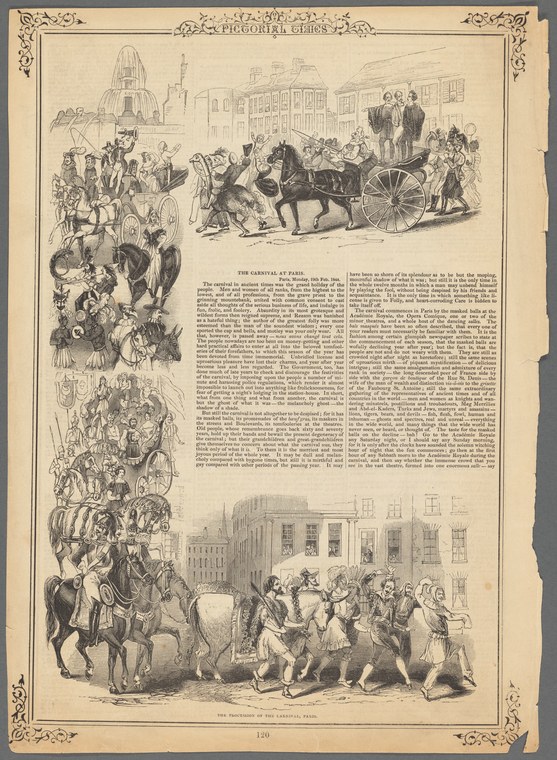
The carnival at Paris; The procession of the carnival, Paris; The galop; [two untitled images, half-length figures of dancing couples]; Bal masque at the grand Opera, Paris
Unknown artist
- Collection:
- Prints depicting dance
- Source:
- New York Public Library
- Rights:
- Public domain — free to use, share and adapt.
- Recorded as:
- Public Domain
This work captures the historical reality of social dance in the 19th century: not the idealized, posed studio dances depicted in academic painting, but the actual crowded, chaotic, socially transgressive experience of carnival. It shows dance as participation and masquerade rather than performance for an audience, revealing how ordinary Parisians danced together in public space during seasonal celebration.
What you are looking at
This is a multi-panel engraving depicting Parisian carnival scenes, likely from the 19th century. The composition is divided into several vignettes showing different moments of celebration and dance. The top panel shows a street scene with a horse-drawn carriage, crowds of costumed revelers, and onlookers—some standing on the carriage itself—against a backdrop of Parisian buildings and monuments. The left margin contains a tall vertical stack of crowded scenes showing dancers and revelers packed together, their bodies twisted and overlapping in energetic interaction. The bottom panel depicts another carnival moment outside what appears to be the Grand Opera building, with costumed figures, dancers, and spectators mingling. Throughout, the artist uses dense cross-hatching and fine linear detail to create texture and depth, capturing the frenetic energy of urban carnival—the pushing, posturing, and performative chaos of the season.
The dancing
The dancers and revelers appear in a variety of dress and poses: some in formal evening wear, others in costumes and masks characteristic of carnival masquerade. Many figures are shown mid-gesture—arms raised, bodies twisted, heads turned toward companions. The groupings are intimate and chaotic rather than ordered; couples and small clusters interpenetrate, and the vertical panel on the left emphasizes density and compression, with bodies stacked and overlapping to suggest the press of crowds. Where couples can be discerned, they stand close, sometimes with an arm around a partner, but the overall effect is of spontaneous social mingling rather than formal partnered dance steps.
The dance depicted
This appears to document the Parisian carnival (Mardi Gras season) as street festival and social dance, rather than a specific ballroom dance form. The carnival at Paris was a seasonal public celebration where masked revelers, costumed performers, and dancers filled the streets and gathered at major public buildings and ballrooms. The imagery suggests both street carnival (the carriage, the crowds, the architectural backdrop) and salon or theatrical spaces (the Opera building reference, the density of well-dressed figures). This is social and carnivalesque dance rather than a codified partner dance—the emphasis is on masquerade, costume, proximity, and the temporary transgression of social order characteristic of carnival culture.
How it was made
This is a wood engraving or steel engraving, recognizable from the fine parallel hatching, crisp linear marks, and tonal gradation achieved through line density. The technique allowed for high-resolution reproduction and wide circulation in newspapers, periodicals, and illustrated books—suggesting this was journalism or popular cultural documentation rather than fine art for a single patron. The precision of the line work and the multiplication of small, densely observed figures indicate a skilled reproductive engraver, likely working from a sketch or painting. The format and style are consistent with mid-19th-century illustrated journalism, the period when French publications like L'Illustration and Le Monde Illustré published such scenes.
About this work
This engraving documents the Parisian carnival as a public social phenomenon, capturing the street festivals, masked balls, and collective dancing that characterized the Mardi Gras season in 19th-century Paris. Rather than depicting a single ballroom waltz or quadrille, it presents carnival as a carnivalesque mixing of social classes, costumes, and strangers—the temporary suspension of order implicit in masquerade. The work is journalism as much as art: it circulated to a wide audience through illustrated periodicals and served to document and celebrate a seasonal urban ritual. The engraver's technique—precise, detailed, and capable of rendering both distant architecture and intimate bodily gesture—was perfectly suited to this documentary project.
How to look at it
Look at the composition's strategy for handling crowd and chaos: rather than a single perspectival moment, the engraver has stacked multiple scenes vertically and horizontally, creating an inventory of carnival moments and types. Notice how the vertical panel on the left uses compression and overlapping bodies to suggest density and press, while the horizontal panels above and below open onto street space and architectural backdrop. The artist's choice to show carnival as crowded, energetic, and composite—rather than as a single ballroom dance in proper perspective—reflects the actual experience of the season as dispersed, multiple, and transgressive.
The period
The 19th century saw a flourishing of illustrated journalism in Europe, particularly in France. Publications like L'Illustration (founded 1843) made use of wood and steel engraving to reproduce contemporary scenes—fashion, society, current events—for a growing middle-class readership. Simultaneously, the carnival tradition itself was changing: by the mid-19th century, Paris's Mardi Gras had become increasingly commercialized and theatrical, with organized balls, costume parades, and public festivities rather than the older street traditions. Dance in this period was undergoing codification in ballrooms (the polka, the galop, the quadrille were all popular), but the carnival remained a space of improvisation, masquerade, and social mixing.
Where it lives
This engraving is held in the NYPL's Prints collection depicting dance. It is likely a reproduction from an illustrated newspaper or periodical of the mid-19th century, part of the broader documentary project of illustrated journalism.
Dance in this work
Questions about this work
What was the Parisian carnival, and why did artists depict it?
The carnival (Mardi Gras season) was an annual period of masked celebration, public dancing, and temporary social transgression in Paris. Artists and journalists documented it because it was newsworthy, visually spectacular, and symbolically important—a moment when ordinary social hierarchies were temporarily suspended and crowds mingled in public space. Illustrated newspapers in particular made carnival scenes a regular feature.
Is this showing a specific ballroom dance, or something else?
This depicts carnival as social practice rather than a specific codified dance form. While quadrilles, galops, and waltzes were certainly danced at carnival balls, this engraving emphasizes the street festival, the costumes, the masks, and the mingling of strangers—the carnivalesque atmosphere rather than the formal steps. It is a document of social dance in the broadest sense.
Why is the composition so crowded and chaotic?
The engraver is capturing the actual experience of carnival: crowded, energetic, with multiple simultaneous moments happening across public and semi-public space. Rather than a single polite ballroom scene, the composition reflects carnival as a collective, somewhat lawless, densely packed phenomenon. This is documentary realism adapted to engraving.
More dance artwork





