49 works in this view — arrow keys or swipe to move between them.
Dance in Art
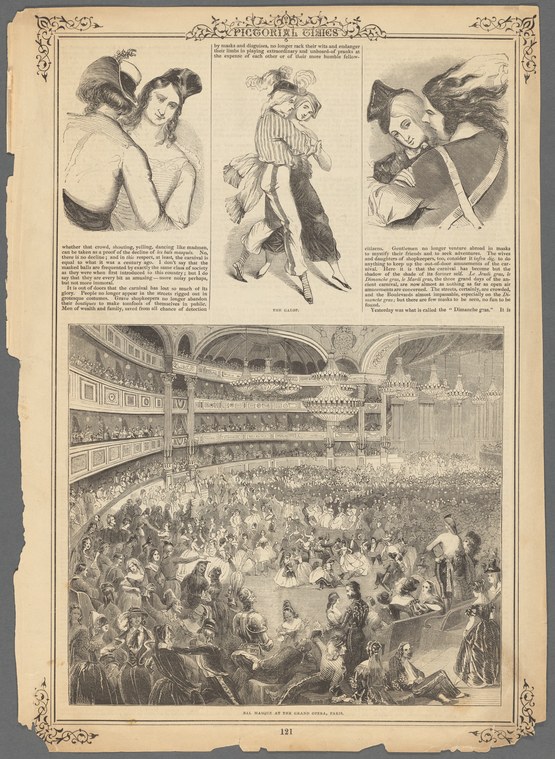
The carnival at Paris; The procession of the carnival, Paris; The galop; [two untitled images, half-length figures of dancing couples]; Bal masque at the grand Opera, Paris
Unknown artist
- Collection:
- Prints depicting dance
- Source:
- New York Public Library
- Rights:
- Public domain — free to use, share and adapt.
- Recorded as:
- Public Domain
This work bridges two documentary registers rare in a single image: close study of ballroom technique alongside evidence of how those dances functioned in actual social space. For dancers and historians, it is a primary source for Victorian ballroom posture, frame, and the vigor of dances like the galop—dances often underestimated in later accounts. The masquerade ball also documents the continued prestige of public ballroom spectacle in Second Empire Paris, a moment before the technology of dance shifted toward theatrical ballet.
What you are looking at
This is a page from a 19th-century illustrated periodical featuring dance imagery and a grand ball scene. The upper half contains three half-length sketches of dancing couples in Victorian dress: at left, a couple in an intimate closed position with the woman's head tilted back; center, a pair in energetic motion with the woman's skirts lifted; at right, another couple with the woman's hair and fabric caught in dynamic movement. All three pairs wear formal evening wear consistent with 1860s–1880s fashion. Below these vignettes sits a large engraved scene of a masquerade ball at the Grand Opéra in Paris, rendered in fine detail. The theater interior is crowded with hundreds of masked and costumed revelers filling the floor, boxes, and galleries. The architecture is palatial—a vast arched ceiling with ornamental detailing, tiered box seating on multiple levels, and architectural elements suggesting the opulence of the Second Empire. The crowd wears elaborate costumes, masks, and period evening dress. The composition emphasizes spectacle and social congregation rather than individual technical movement.
The dancing
The upper sketches show couples in closed ballroom position with high engagement and visible movement through the torso and limbs. The woman at left leans back in a classic Romantic-era supported tilt; the center pair capture mid-turn with the woman's leg extended and skirt displaced by the motion; at right, a woman's hair streams horizontally, suggesting rapid rotation or a vigorous turn. The lower ball scene contains dozens of figures in various attitudes—some in dance position, others promenading, conversing, or observing. The artists render fabric movement and body weight clearly, suggesting familiarity with Victorian ballroom deportment. The scale emphasizes crowd and setting over individual choreographic detail.
The dance depicted
The work depicts Victorian ballroom dancing, most likely the galop, polka, or waltz—the dominant social dances of mid-to-late 19th-century European ballrooms. The energetic tilts, spins, and skirt displacement in the upper sketches are consistent with the galop and polka, vigorous couple dances performed in closed position. The masquerade ball below shows ballroom dancing as a social and architectural spectacle, the kind of grand public event held regularly at the Opéra during the Second Empire. The image conflates intimate technical study (the three vignettes) with the ballroom as theater and social phenomenon. Carnival balls in Paris were famous occasions; this appears to document both the dances themselves and the social world in which they circulated.
How it was made
This is a wood engraving or steel engraving, characteristic of mid-Victorian periodical illustration. The fine parallel line-work, tonal gradation through hatching, and ability to render both intimate portraiture and architectural recession across a large field suggest skilled reproductive engraving. The composition and technique imply this was printed as a page in an illustrated newspaper or journal—a form that reached a mass audience and required both technical virtuosity and the ability to capture contemporary life with immediacy. The style and finish indicate this was published between 1860 and 1890, when such illustrated periodicals dominated visual journalism.
About this work
This is a Victorian-era engraved page from an illustrated periodical, documenting ballroom dancing in Paris. It combines studied sketches of couple technique—likely galop and polka—with a panoramic view of a masquerade ball at the Opéra, suggesting both the physical practice of dance and its place in mid-19th-century social spectacle. The work belongs in a dance gallery because it captures the ballroom as both a technical and social phenomenon: the upper half shows how bodies moved, the lower half shows where and why they gathered to move.
The page is a primary document of Victorian ballroom culture. It records not just steps but the whole ecology of social dance—the dress codes, the architectural settings, the mixing of genders and classes, the role of spectacle and costume. For a historian of 19th-century dance, it is a rare image that shows both the intimate detail of technique and the large social world that contained it.
How to look at it
Observe the three upper sketches as technical studies: notice how the artist captures the tilt of the woman's spine, the position of her head relative to her partner's, and the displacement of fabric as evidence of rapid motion. These are not romantic fantasies but notations of actual ballroom movement. Then descend to the ball scene and notice how the architectural space dwarfs the dancers—the point is not individual movement but the scale of the social event. The masquerade costumes and masks signal a particular moment in the Parisian social calendar. The engraving technique allows simultaneous focus on intimate detail and vast crowd, a feat difficult in other media.
The artist
The artist is not recorded. The work appears in a bound collection of prints from an illustrated periodical, likely a weekly or monthly journal of fashion, society, and current events. Such publications employed accomplished engravers working from sketches and designs by art staff; authorship was typically collective and rarely credited to individual artists. The quality of the engraving and the sophistication of composition suggest a major periodical house, possibly in Paris or London.
The period
This image dates to the height of Victorian ballroom culture, roughly 1860–1890, when the waltz, polka, and galop dominated European social dancing. The masquerade ball tradition in Paris, particularly the famous balls held at the Opéra during Carnival, was a celebrated feature of Second Empire social life. Simultaneously, theatrical ballet was establishing itself as an elite spectacle: the contrast between the democratic, crowded ballroom and the elite stage became a defining feature of 19th-century dance. This image captures the ballroom as still a major form of social spectacle, before the rise of professional dance performance shifted cultural prestige toward the theater.
Where it lives
This page is held in the New York Public Library's prints collection, catalogued as a work depicting dance. The evidence suggests it is a single leaf from a bound periodical rather than a standalone print, part of a broader collection of 19th-century illustrated journalism documenting social and cultural life.
Dance in this work
Questions about this work
What dances are shown in the upper sketches?
The vigorous couple dancing, high tilts, and energetic skirt displacement suggest the galop or polka, the most popular couple dances in Victorian ballrooms. The closed position, engagement of the entire body in the turn, and the artist's emphasis on vertical tilt are consistent with both dances. The masquerade setting and ballroom context support this identification.
Where and when was this ball held?
The title indicates this is a ball at the Grand Opéra in Paris. The architectural detail matches the Palais Garnier's ball facilities. The costume, gas lighting, and social context place it in the Second Empire or early Third Republic era, likely mid-to-late 1870s or 1880s. Masquerade balls were a famous tradition during Carnival season in Paris.
Why combine technical sketches with a crowd scene?
The layout serves two editorial purposes: the upper sketches are fashion and movement studies, what readers wanted to see and imitate; the lower scene documents a major social event and spectacle. Together, they show both how to dance and the social world where that dancing happened. This was a common periodical format for capturing contemporary life.
How does this compare to later ballroom images?
Victorian ballroom images are rarer than their popularity might suggest. Most surviving records of 19th-century dance focus on theatrical ballet. This engraving is valuable because it takes social ballroom dancing seriously as a subject worthy of detailed artistic representation, capturing both technique and spectacle.
More dance artwork





