49 works in this view — arrow keys or swipe to move between them.
Dance in Art
The Hungarian flag dance, gallop des drapeaux
Unknown artist
- Collection:
- Prints depicting dance
- Source:
- New York Public Library
- Rights:
- Public domain — free to use, share and adapt.
- Recorded as:
- Public Domain
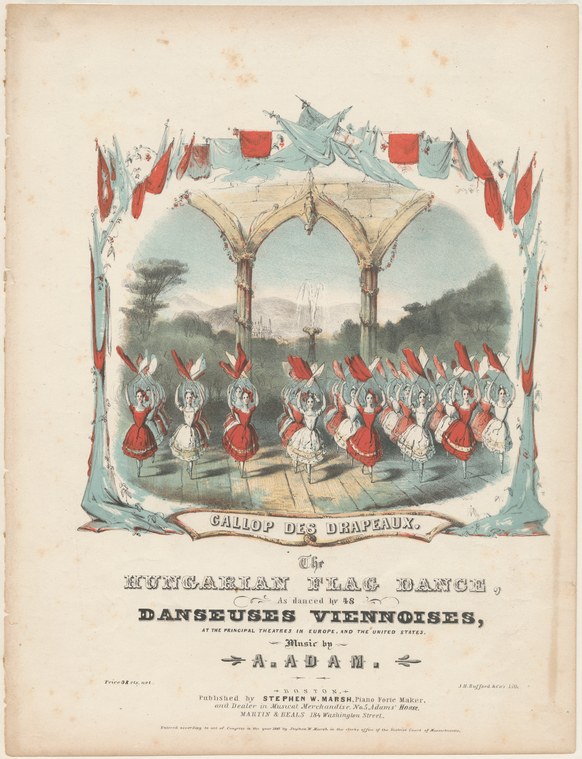
The galop des drapeaux illustrates how ballroom dances were adapted and politicized for public spectacle in the 19th century, transforming an intimate couple's dance into a mass ensemble performance tied to national identity. For historians of both dance and visual culture, this image provides rare documentation of how a specific choreographic concept—the fusion of rapid footwork with patriotic gesture—was realized in performance and then circulated as a souvenir print.
What you are looking at
A festive outdoor gathering under an ornamental pavilion decorated with flags in red and white. Two rows of dancers, roughly a dozen figures in each, face one another in a formal line formation. The dancers wear brightly colored costumes—predominantly red and white—with the women in full skirts and the men in military or formal dress. Each dancer holds a flag or pennant aloft, contributing to a patriotic visual spectacle. The setting opens onto a distant landscape with hills and a town or city visible in soft focus, suggesting a public celebration in a European town square or park. The entire scene is framed by an ornate decorative border featuring heraldic elements, including a coat of arms at the top.
The dancing
The dancers stand in two parallel lines with bodies upright and arms extended overhead to wave their flags. The hold is open formation, with each dancer operating independently while maintaining alignment with neighbors. The flags are held aloft and appear to be in motion or ready for coordinated movement. Both men and women participate, with the women distinguished by full-skirted dresses and the men by tailored jackets. The arrangement suggests synchronized ensemble movement rather than partnered dance.
The dance depicted
This is the *Gallop des drapeaux* (Galop of Flags), a group dance of the 19th-century Gilded Age, known as the Hungarian flag dance when performed in Austro-Hungarian contexts. The galop itself was a rapid, animated couple's dance in duple time; this version transforms it into a patriotic ensemble spectacle in which groups of dancers wave flags in unison. The image shows the dance as a theatrical or festival entertainment, performed in formal costume before an audience or as a public demonstration of national or civic identity. The simultaneous waving of flags by both men and women suggests a coordinated, drill-like choreography rather than the improvisation typical of ballroom galop.
How it was made
This is a hand-colored engraving or lithograph, likely produced in the mid-19th century for commercial distribution as a popular print. The ornamental border, coat of arms, and publication information suggest this was a published theatrical or social dance advertisement or souvenir. The soft coloring and composition indicate lithographic printing, which allowed for broader circulation than engraved works. The title appears below the image in printed text, and the work was published by a London house (visible in the imprint), indicating it was marketed to English-speaking audiences interested in Continental dance fashions.
About this work
This is a hand-colored lithograph depicting the *Gallop des drapeaux*, a patriotic ensemble dance of the 19th century. The work documents a specific stage or festival performance in which the rapid galop—normally a ballroom couple's dance—was transformed into a synchronized group spectacle centered on the display of flags. The image captures the marriage of dance, nationalism, and theatrical entertainment characteristic of the Gilded Age, when European social dances were constantly being adapted into new forms for public performance. The ornamental presentation and commercial printing suggest this was a popular souvenir or advertisement aimed at the growing middle-class audience for dance.
How to look at it
Attend to the rigid, linear geometry of the two facing rows: this is a choreography of order and precision, quite different from the spontaneous-looking couples dancing in ballroom contexts. Notice how the flags dominate the composition—they are the focal point, not the dancers' feet or frame. The artist has chosen a moment of static readiness or mid-action, when the flags are aloft and the formation is intact, rather than a moment of rapid movement. The decorative border frames this as a significant cultural event worthy of memorialization and sale, similar to how military parades or coronations were documented and distributed.
The period
The galop emerged in the 1820s as a fast, energetic dance that became wildly popular throughout Europe and America during the Gilded Age. By the mid-19th century, composers and choreographers were creating variations on the galop for theatrical performance. The Hungarian flag dance likely reflects the rise of national romanticism in the 1830s–1850s, when composers like Liszt and Strauss drew on Hungarian and other national musical traditions, and when dance became increasingly tied to assertions of cultural and national identity. This print was issued during a period of intense dance-mania in urban centers, when dancing societies, balls, and theatrical dance demonstrations were major public entertainments. The use of flags and formal costume reflects both the militarism and the nationalism of the period.
Where it lives
The work is held in the New York Public Library's collection of prints depicting dance. The imprint credits a London publisher, suggesting wide commercial distribution to English and American audiences in the mid-19th century.
Dance in this work
Questions about this work
What is a galop?
A galop was a spirited ballroom dance in quick duple time, extremely popular from the 1820s through the end of the 19th century. It was typically performed by couples and featured rapid, gliding steps. The galop des drapeaux adapted this dance into an ensemble patriotic spectacle.
Why were flags used in this dance?
Flags transformed the galop from a private ballroom entertainment into a public and patriotic display. The flags served as visual symbols of national or civic identity and created a dramatic, coordinated visual effect when waved in unison. This was characteristic of 19th-century performances that merged dance, nationalism, and theatrical spectacle.
Where would this dance have been performed?
The galop des drapeaux was performed at public festivals, theater stages, dance demonstrations, and civic celebrations. The landscape and pavilion visible in this print suggest an outdoor public venue rather than a ballroom. It was the kind of dance that would have been advertised and attended as a special theatrical event.
More dance artwork





