49 works in this view — arrow keys or swipe to move between them.
Dance in Art
Vif et leger: galop brillant pour le piano
Unknown artist
- Collection:
- Prints depicting dance
- Source:
- New York Public Library
- Rights:
- Public domain — free to use, share and adapt.
- Recorded as:
- Public Domain
As a sheet music illustration, this work circulated directly to dancers and piano players, shaping how the dance was imagined and performed. It documents a crucial moment in ballroom history when the galop was the height of fashion, and it shows how dance was marketed and consumed as domestic entertainment in the nineteenth century.
What you are looking at
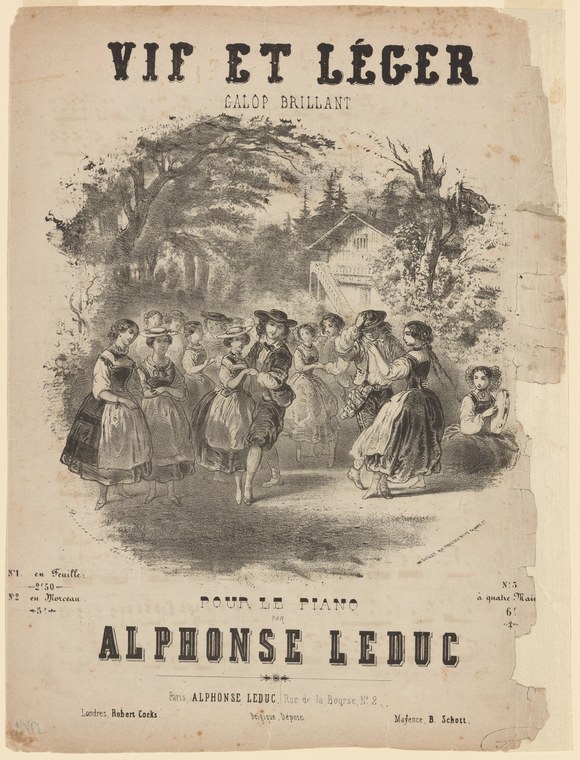
A wood-engraved illustration depicts a lively social gathering in what appears to be a garden or park setting, with a large tree prominent in the background and a modest building visible beyond. A group of fashionably dressed young women and men gather in the center of the composition, their poses suggesting animated conversation and flirtation rather than formal dancing. The women wear full skirts with defined waistlines characteristic of the 1840s, some adorned with bonnets or ribbons, while the men are dressed in tailcoats and top hats. The scene captures a moment of social interaction—several figures gesture expressively, and their body positions suggest movement and liveliness. The composition is loose and sketchy, with atmospheric effects created through varied line work that gives depth to the background landscape and suggests a warm, outdoor social occasion.
The dancing
The figures stand in a scattered, informal arrangement rather than in the closed holds typical of ballroom dancing. Their postures are upright but relaxed, with arms active—some reaching toward companions, others gesturing in speech. Several women appear to be turning or shifting weight, and the overall impression is of bodies in social motion rather than executed dance steps. The closest figures to the viewer show animated expressions and hand gestures that suggest conversation and flirtation. The spacing and grouping indicate a social promenade or gathering rather than couples in dance partnership.
The dance depicted
This is a galop, a fast, spirited dance of the 1840s–50s that was central to ballroom social life. The title *Vif et léger* (lively and light) directly describes the galop's character: a quick, bouncy dance typically danced by couples in a closed or semi-closed position, often performed as a finale to an evening's dancing. The image shows the social context of the galop rather than the moment of execution—the gathering before or between dances, when courtship and flirtation occurred. The outdoor garden setting and fashionable dress confirm the period and social standing of the dancers, while the loose, spirited composition evokes the galop's reputation for gaiety and abandon.
How it was made
This is a wood engraving, identifiable by the fine parallel lines (hatching and cross-hatching) that model form and create tonal gradation, and by the characteristic delicate line work of the medium. Wood engraving on the end grain of boxwood allowed for finer detail than woodcut and was the dominant technique for book and periodical illustration in the 1830s–60s. The print shows the skilled use of white paper as highlight and the layering of line to suggest atmosphere and recession. As a music cover or sheet music illustration, it circulated widely among the dancing public and helped establish visual conventions for representing ballroom social life.
About this work
This is a sheet music cover or title page illustration for a galop—a fast, bouncy ballroom dance that dominated social dancing in the 1840s. The wood engraving depicts the social world of the dance rather than its technical execution: a fashionable outdoor gathering of young people in the elegant dress of the era, their postures and gestures suggesting the flirtation and animated conversation that accompanied such occasions. The image preserves both the dance itself and the social rituals that surrounded it, making it a valuable document of how galops were experienced as social events. The artist has captured not the steps but the spirit—the liveliness and sociability that gave the dance its name and its appeal.
How to look at it
Observe the artist's choice to depict the social moment rather than the dance itself—the gathering, the dress, the interplay between figures—rather than frozen footwork or a formal dance position. This was a common choice in dance illustration of the era: the cover image needed to evoke the pleasure and sociability of the occasion rather than instruct in technique. Notice how the scattered composition and loose poses create a sense of spontaneity and liveliness that matches the title *Vif et léger*. The outdoor garden setting and fashionable dress ground the image in a specific moment of social history.
The artist
The artist is not recorded. The work credits Alphonse Leduc as the publisher and music vendor (London: Robert Cocks). The credit line mentions *Madame B. Sabat*, likely the composer or arranger of the piece. The engraving is competent and professional, suggesting a skilled specialist in dance illustration working within the commercial music publishing industry.
The period
The galop emerged in the 1820s and became the fashionable closing dance of ballroom evenings throughout Europe and America by the 1840s. It represented a democratization of ballroom dancing—faster and more exuberant than the stately waltz or quadrille, it appealed to younger dancers and was often the moment when formal etiquette relaxed slightly. The 1840s were the height of the galop's popularity, and sheet music covers and dance manuals proliferated. In visual culture, dance illustration became a major genre in wood engraving, used to advertise dances, sell music, and help dancers learn steps from printed instructions.
Where it lives
This is from the New York Public Library's collection of prints depicting dance. It is a published sheet music cover or title page, one of hundreds of galop publications that circulated in the 1840s–50s.
Dance in this work
Questions about this work
What is a galop?
A galop is a fast, lively couples dance that became hugely popular in ballrooms from the 1820s onward. It was typically danced in a closed position, with quick hopping or sliding steps, and was known for its spirited, almost wild character. By the 1840s, it was the standard finale to a ballroom evening, a moment when etiquette relaxed and dancers could be more exuberant. It was eventually superseded by the polka in the 1850s.
Why does the picture show a social gathering rather than people dancing?
Sheet music covers needed to appeal to the broadest possible audience—not just skilled dancers but also people who played music, gave dances, or attended them. The artist chose to show the social pleasure and fashionable context of the dance rather than technical steps, which would have been harder to convey in a single static image. This approach also allowed the cover to function as aspirational marketing: it showed the buyer the kind of elegant social world they could enter by learning this dance.
How can you tell this is a galop and not some other dance?
The title *Vif et léger* (lively and light) and the credit to *Alphonse Leduc* for the music are the primary identifiers. The image's style and the fashionable dress of the figures are consistent with the 1840s, when galops were at their peak. The loose, exuberant composition matches the galop's reputation for gaiety. Without the title, the image alone would be hard to identify as a specific dance, which is why sheet music covers often included text.
What does wood engraving tell us about how this dance was circulated?
Wood engraving was the dominant printing technology for illustrated books, periodicals, and sheet music in the nineteenth century. It was faster and cheaper than copper engraving, and it could be printed alongside text and music on the same press. This made galop sheet music affordable and widely available, so the dance could circulate not just through ballrooms and dance instructors but through printed music, illustrations, and advice literature that reached middle-class homes.
More dance artwork





