49 works in this view — arrow keys or swipe to move between them.
Dance in Art
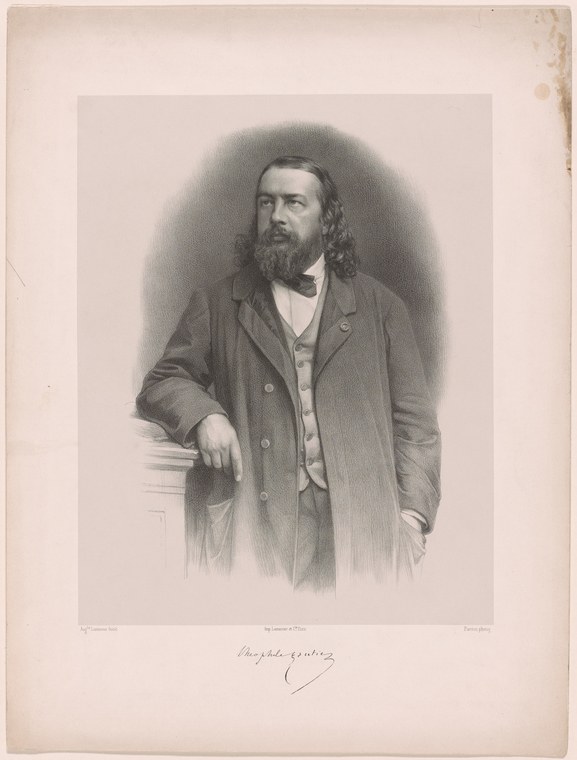
Theophile Gautier (fac. sig.)
Unknown artist
- Collection:
- Prints depicting dance
- Source:
- New York Public Library
- Rights:
- Public domain — free to use, share and adapt.
- Recorded as:
- Public Domain
Théophile Gautier's reviews and essays defined Romantic ballet for his generation and established critical language that endures. Understanding his ideas about grace, illusion, and the ethereal feminine ideal is essential to interpreting the dance imagery of his era. A portrait of Gautier is a portrait of the eye through which much nineteenth-century ballet was seen and judged.
What you are looking at
This is a portrait engraving of a bearded man in mid-nineteenth-century dress, shown from the waist up against a plain background with subtle shading that creates depth around the figure. He wears a dark double-breasted coat with a white shirt and black bow tie, the formal attire of a European intellectual or artist of the 1850s–1870s. His long hair falls past his shoulders in the Romantic style. His left arm rests on what appears to be a table or ledge, and he gazes slightly to the left with a contemplative expression. The engraving is finely executed with careful attention to the texture of fabric and the modeling of the face; the background dissolves into a soft vignette. A signature in script appears at the foot of the image.
The dancing
A single standing or seated figure, viewed from the waist up. The pose is static and frontal in bearing, with the left arm relaxed and supported. There is no indication of movement or dance gesture. The body is arranged for portraiture rather than action.
The dance depicted
This work does not depict dance. It is a portrait of an individual, likely a writer, critic, or artist of the Romantic era. The catalogue identifies the subject as Théophile Gautier, the French writer and dance critic (1811–1872) who was instrumental in championing Romantic ballet and wrote extensively about dancers and choreography, but the image itself shows only a formal portrait.
How it was made
This is an engraving, likely a steel or copper-plate engraving given the fine detail and regular tonal graduation. The technique produces the soft vignetting at the edges and the careful hatching used to model form. Such portraits were produced commercially in the nineteenth century for publication and distribution, suggesting a work of some cultural standing. The signature at the base indicates the engraver's hand, though the identity of the engraver is not recorded in the catalogue.
About this work
This is a formal portrait engraving of Théophile Gautier, a central figure in the history of Romantic ballet and dance criticism in nineteenth-century France. Although the image itself contains no dancing figures, Gautier's influence on how ballet was written about, theorized, and preserved makes him historically significant to dance scholarship. His critical writings shaped the aesthetics and reception of works by dancers including Marie Taglioni and Carlotta Grisi. The work belongs in a dance archive because Gautier himself was a maker of dance history through the power of the pen rather than the body.
How to look at it
Approach this as a portrait of a writer and theorist rather than a depiction of dance. Attend to the period costume and the formal, almost stagey arrangement of the figure—the supported arm, the gaze, the Romantic-era hair and dress. The engraver has chosen to present Gautier as a man of contemplation and authority, fitting for someone whose power lay in words rather than movement. The vignetting and careful modeling suggest the care taken to honor a culturally significant figure.
The artist
The engraver is not identified in the catalogue record. The work is part of the New York Public Library's collection of prints depicting dance, suggesting it was catalogued for its subject rather than its maker. Nineteenth-century portrait engravings of this quality were typically produced by professional reproductive engravers working from drawings or photographs, often as part of larger series of portraits of notable cultural figures.
The period
This portrait dates to the height of Romantic ballet (1830s–1870s), a period when ballet achieved unprecedented cultural prestige in Paris and across Europe. Gautier's career as a critic and librettist (he wrote the scenario for *Giselle*) coincided with the ascendancy of the ballerina as the central figure of ballet. The formal, dignified style of this engraving reflects the nineteenth-century convention of portraying men of letters and the arts in a manner that emphasized intellectual authority rather than physical presence.
Where it lives
The work is held in the New York Public Library's collection of prints depicting dance, catalogued as a portrait. The catalogue record is minimal; the subject identification rests on the signature visible at the foot of the engraving.
Questions about this work
Why is a portrait of a writer in a dance collection?
Théophile Gautier was one of the most influential dance critics of the nineteenth century. His reviews of Romantic ballet defined the aesthetic and cultural values of the era, and his libretto for *Giselle* remains canonical. Understanding how dance was seen and understood in the nineteenth century requires studying how critics like Gautier wrote about it. This portrait documents a key figure in dance history, even though the image itself shows no dancing.
Is this engraving well-known or documented?
The catalogue record is sparse, and the engraver is not identified. Without additional provenance information, it is difficult to say whether this is a widely circulated portrait or a more specialized print. Portrait engravings of notable figures were common in the nineteenth century, often produced in multiple states and widely distributed; this may be one such example, or it may be a less common variant. Further research would be needed to establish its editorial and commercial history.
When was this engraved?
The catalogue record does not provide a date. Based on Gautier's life (1811–1872) and the style of his hair and dress, this portrait was almost certainly made in the 1850s or 1860s, during the latter half of his career. The engraving style and printing technique are consistent with mid-to-late-nineteenth-century practice, but a precise date cannot be established from the image alone.
More dance artwork





